English
 Français
 Türkçe
 Español
 Русский

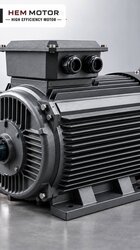

No; a larger motor running at the same speed does not increase the flow of a centrifugal pump. How much water the pump delivers is determined not by the motor's power but by the impeller diameter, the pump speed and the resistance of the system the water flows through. The motor only supplies the power the pump demands; any extra power remains unused at the shaft. If the flow really needs to increase, what has to change is usually the pump, the impeller or the pipework; the motor is selected according to the result of that change.
The division of work between pump and motor
An asynchronous motor runs at a speed determined by the supply frequency and the number of poles. A 4-pole motor runs at about 1,450 rpm and a 2-pole motor at about 2,900 rpm. When the motor's power increases, this speed does not change; under load it slips a few rpm less, and that is all.
The pump, in turn, works at this fixed speed according to its own curve. The impeller diameter and blade design determine what pressure it can produce at what flow at a given speed. The resistance of the system (pipe length, diameter, bends, valves, delivery height) determines where on this curve the pump will sit. The point where the pump curve and the system curve intersect is the operating point.
In this picture the motor's role is limited: to supply the shaft power at the operating point. If an 11 kW motor is fitted to a pump that needs 7.5 kW, the pump still draws 7.5 kW; the motor runs at part load.
What actually changes the flow?
| Change | Effect on flow | Consequence for the motor |
|---|---|---|
| Larger motor at the same speed | No change | The motor runs at part load; starting current and cost increase |
| Fewer poles (higher speed) | Increases roughly in proportion to speed | Power demand rises with the cube of speed; the pump may not be suitable for that speed |
| Larger diameter impeller | Increases (if the pump casing allows) | Power demand increases; the motor is recalculated |
| Lower system resistance | Increases | The point moves right on the pump curve; power demand usually rises |
| Opening a throttled valve | Increases | Power rises in the same way; if the motor is at its limit, the thermal relay may trip |
The table can be summed up as follows: every real change that increases flow puts more load on the motor. So the correct order is not "upsize the motor so the flow increases" but "make the change that increases the flow, then upsize the motor if necessary".
Why is changing the speed risky?
What looks like the quickest way to increase flow is to fit a 2-pole motor instead of a 4-pole one. In that case the speed roughly doubles. According to the approximate relationships, flow doubles, head increases four times and shaft power eight times. For example, a pump drawing 1.5 kW at 1,450 rpm theoretically needs around 12 kW at 2,900 rpm.
The practical consequences are:
- The pump impeller, bearings and mechanical seal may not be designed for this speed; the maximum speed permitted by the pump manufacturer must not be exceeded.
- Suction conditions deteriorate and the risk of cavitation increases.
- Pipes, valves and equipment may not withstand four times the pressure.
- A motor in the same frame cannot deliver this power; a much larger motor and base are needed.
For small adjustments, a frequency inverter is a more controlled route, but the speed limit permitted by the pump still applies. Our three-phase series are suitable for speed control with a frequency inverter; for long periods of full-torque operation at low speed an external fan may be needed, and if the cable between drive and motor is long a dv/dt or sine filter is considered; these conditions are stated with the order. Going above 50 Hz with an inverter requires checking the limits of the motor and the pump separately.
Checks to make before changing the motor
The complaint "the pump doesn't deliver as much as it used to" is often not about the motor. Before ordering a new motor, make these checks:
- Direction of rotation: A centrifugal pump turning in reverse still delivers some water, but flow and pressure drop markedly. If the phase sequence has changed, so has the direction.
- The motor's actual speed: Compare it with the rated speed on the nameplate. A markedly lower speed points to voltage drop or overload.
- Impeller wear: In sandy or abrasive water, the impeller and wear rings wear over time; as the clearance grows, the pump loses flow through internal leakage.
- Suction side: A blocked strainer, a suction pipe drawing in air or a falling water level reduces flow.
- System changes: A newly added line, a filter or a higher delivery point may have shifted the operating point.
- Current drawn by the motor: If the current is well below the nameplate value, the pump is running at low load; the problem is not motor power.
If these checks reveal a problem on the pump side, the solution is there too. The motor is only changed when it is genuinely insufficient, for example if it runs continuously at nameplate current and overheats.