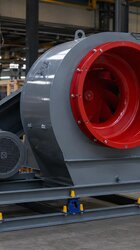
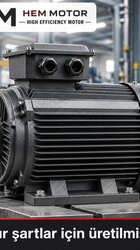
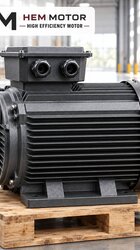
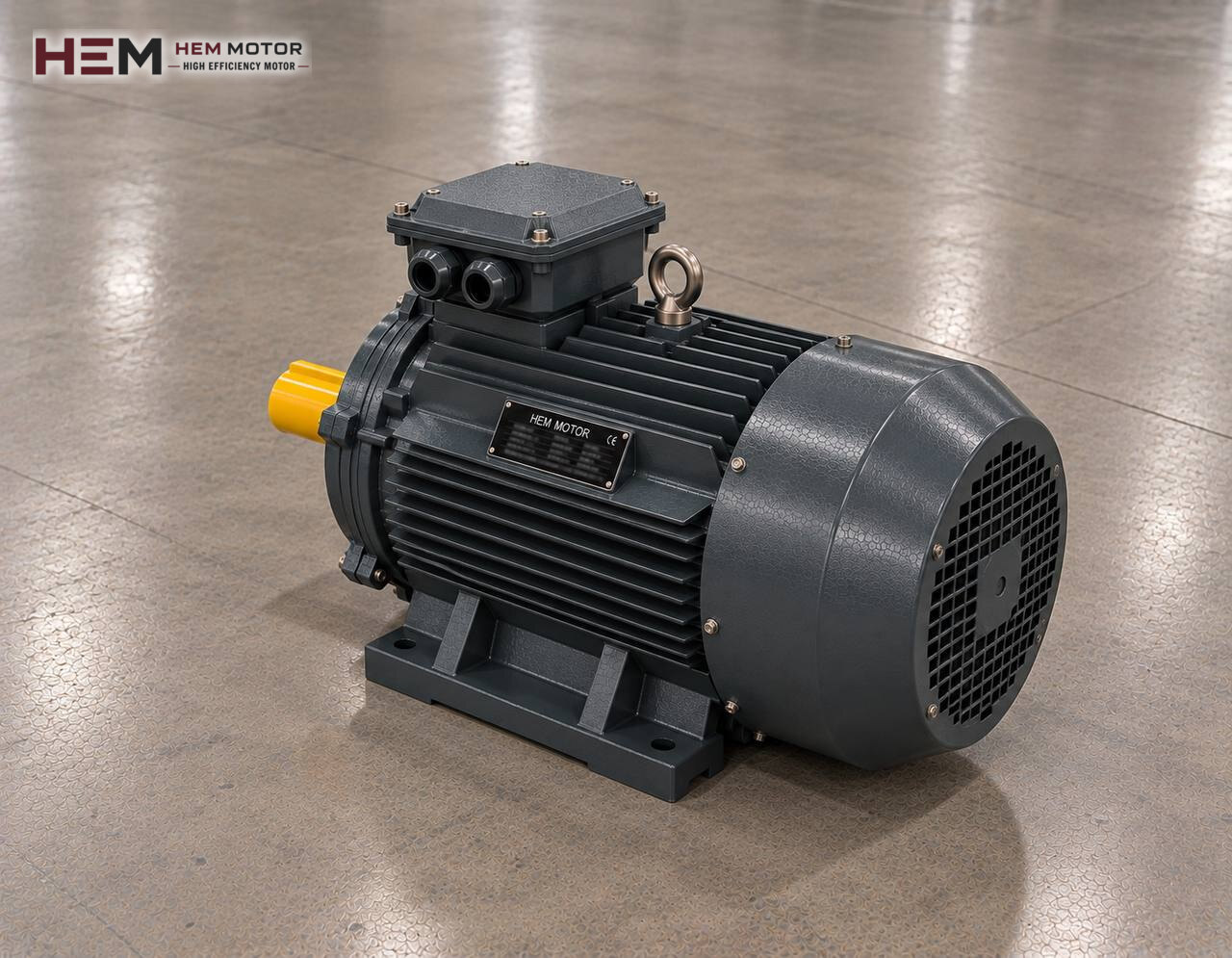
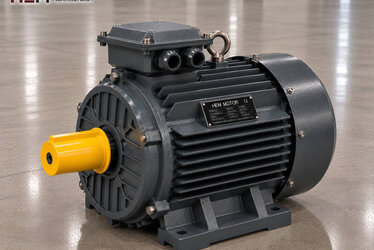
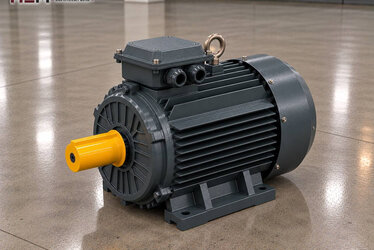
In a textile mill, switching to IE3 and IE4 electric motors makes sense when it starts with the drives that run the most hours: air-conditioning plant fans, dust and fibre extraction fans, compressors and jet dyeing pumps. On an auxiliary motor that is switched on only a few days a month, the class difference is not noticeable; on an extraction fan running three shifts, the difference in losses shows up on the bill every month. During the switch, speed, frame and drive compatibility must be checked as well as efficiency.
Why does the IE class make a difference in a spinning and weaving hall running three shifts?
Spinning mills mostly run non-stop, weekends included; a motor's annual running time can reach 7000–8000 hours. The losses add up every hour. With such long operation, the cost of winding and iron losses on the electricity bill overtakes the motor's purchase price within a few years.
IE classes rate how low motors of the same power keep these losses, according to the IEC 60034-30-1 standard.
What sets textiles apart is that a large share of the electrical load comes not from production machines but from the systems conditioning the hall air. If humidity and temperature are not kept constant in spinning and weaving, yarn breaks increase. Hall air matters as much as production. That is why air-conditioning plant fans and air washer pumps keep turning to maintain hall conditions even when the machines stop. These are usually the motors written at the top of the switch list.
Why do the air-conditioning plant and fibre extraction fan top the switch list?
These fans run at fixed speed, under near-constant load and for long hours; this is the profile where an efficiency class upgrade pays back most clearly. Textile air-conditioning plants blow humidified air into the hall with large axial or radial fans and pass return air through filters. Fibre extraction systems in carding, drawing and open-end rooms also draw air continuously from under the machines.
A hypothetical calculation: take a 15 kW, 4-pole extraction fan motor running 8000 hours a year at a shaft power of about 12.75 kW. In the IEC 60034-30-1 table, the IE3 minimum for this power and pole number is 92.1% and the IE4 minimum is 93.9%.
The power drawn from the grid is 13.84 kW at the IE3 minimum and 13.58 kW at the IE4 minimum; the 0.26 kW difference corresponds to about 2100 kWh per year. The calculation is purely hypothetical.
Actual values must be recalculated using the efficiency on the motor's nameplate and the fan's measured load. The fan and extractor motors page gives additional information on axial and radial fan drives.
What happens if a more efficient motor spins the fan faster?
Motors in higher efficiency classes usually have lower slip; in other words, for the same number of poles their rated speed may be a few revolutions higher. On a fan driven directly or through a fixed pulley, this small increase matters, because fan power varies roughly with the cube of speed (general knowledge). The fan moves slightly more air and the motor is loaded slightly more; part of the gain on paper can therefore be lost. A few revolutions look small.
The fix is simple but often forgotten: measure fan speed and motor current after the switch.
If the air volume needed for the hall is already being supplied, the old speed is restored by adjusting the pulley ratio or the frequency converter. Two current readings taken before and after the change are the plainest record of what the switch really delivered. Two readings are enough.
Circulation pump drive of a jet dyeing machine in the dyehouse (representative image).
How do temperature and humidity affect the motor in dyehouse pumps and stenter fans?
As the efficiency class rises, less energy turns into heat inside the motor, and in a steamy dyehouse the winding runs at a lower temperature. In the finishing department, jet dyeing pumps run throughout the batch, while the stenter's circulation fans work in hot air. IP55 enclosure protection and class F winding insulation are standard on HEM Motor series.
An anti-condensation heater for the dyehouse's damp corners and a PTC or PT100 sensor for tracking winding temperature can be written on the order.
Fan motors turning in the hot gas stream inside the stenter chamber are an entirely different matter. Such a location requires a special motor, which may go beyond the scope of the standard series in HEM Motor's 2026 catalogue; ask us about it by sending the nameplate data and the chamber temperature. Other power ratings suited to textile machinery are listed on the textile machinery electric motors page.
Prices and technical data are on the product pages; choose a model and order online.
What needs attention when switching with a frequency converter on ring and open-end machines?
When moving to the IE4 class, the current, speed and power values from the new nameplate must be entered into the drive. The main drive of ring spinning frames and the extraction fan of open-end rotor machines often run on a frequency converter; a drive left with the old motor's parameters can cancel out the efficiency gain. Old parameters wipe out the gain. HEM Motor's three-phase series are suitable for speed adjustment with a drive.
If the ring drive turns slowly for hours while demanding full torque, the shaft-mounted fan cannot keep the housing cool; in that case a separately powered cooling fan is added.
If the cable between panel and machine is long, fitting a dv/dt or sine filter at the output is considered to protect against voltage peaks that stress the winding. Stating these two conditions on the order is as important as the efficiency class.
Will a new IE class motor fit in place of the old frame?
The frame of an IE4 motor of the same power may differ in length from its IE3 counterpart; whether it fits is therefore shown by a dimension check. On textile machines the motor is often fixed inside a narrow casing, in line with a pulley or onto the flange of a fan scroll; so the dimension check must not be skipped during the switch. Even a few millimetres cause trouble.
The IEC frame number of the motor being removed is a sufficient clue to start with; however, the match is not final until the mounting arrangement, shaft thickness and length, the spacing between foot holes, flange type and electrical values have been compared one by one.
Alongside foot-mounted B3, flange-mounted B5 and B14 and combined B34 and B35 arrangements, vertical V1, V3, V5, V6 and V15 layouts are also provided depending on frame size; the flange size is settled when the order is placed. You can compare dimensions on the technical drawings page and have the match confirmed by sending photos of the old motor's nameplate and connection via WhatsApp. You can see the aluminium and cast-iron options for your chosen power side by side in our electric motor shop.
Textile drive
Typical operating profile
Switch priority
Air-conditioning plant fan
Non-stop, constant load
High
Fibre and dust extraction fan
Continuous with production
High
Jet dyeing circulation pump
Continuous through the batch
Medium-high
Stenter circulation fan
Continuous in hot surroundings
Medium-high
Fabric winding and auxiliary belt
Intermittent, low load
Low
Sample electric motor models for textile drives
The models below are typical power and speed pairings; you only need to state the IE class (IE3, IE4 or IE5) on the order, and the exact power is confirmed against your machine's data.
For the extraction fan of an open-end machine or a small air-conditioning plant, the 5.5 kW aluminium-frame 132S-4; its rated speed is 1460 rpm and its voltage 400/690 V.
For the 15 kW extraction fan in the hypothetical calculation above, the cast-iron 160L-4; it runs at 1465 rpm.
For a large air-conditioning plant fan or a central fibre collection system, the 22 kW 180L-4; its rated speed is 1470 rpm.
How is the switch spread across the shutdown calendar?
Rather than replacing all motors at once, fitting a higher-class model in place of motors that fail or are due for rewinding spreads the budget. A failed motor is a chance to upgrade. Holiday and annual maintenance shutdowns also offer a natural window for drives that are hard to replace, such as air-conditioning plants.
If current is measured and recorded before and after each change, next year's list is based on measurement rather than estimates.
The equivalents of the kilowatt values on your switch list are in the HEM Motor shop, grouped by number of poles. If you share the nameplate of the extraction fan or dye pump motor you plan to replace through the nameplate submission page, we will check the IE class, frame and flange match together.
Frequently Asked Questions
Which electric motors should be moved to IE4 first in a textile mill?
Drives with the most annual running hours and near-constant load come first: air-conditioning plant fans, fibre extraction fans and dye pumps. Small auxiliary motors that run intermittently can be left until last.
Why can a fan draw more current after an IE4 motor is fitted?
A low-slip motor can turn the fan a few revolutions faster, and since fan power rises quickly with speed, the load increases. To bring the fan back to its old speed, the pulley diameter is changed or the frequency on the drive is lowered.
Can the ring frame's drive be used unchanged with the new motor?
The drive can usually be kept, but the motor parameters must be entered according to the new nameplate values. If there is long low-speed operation, the need for an external fan is also stated on the order.
Is a standard electric motor enough for a stenter fan?
If the motor sits outside the hot air stream, next to the machine body, the standard series can be considered. If the fan motor goes directly into hot gas, a special motor is required.
HEM Motor Models Related to This Article
The cards show example models related to the topic. A suitable motor is not chosen by power alone: compare speed, voltage, mounting, shaft and connection dimensions on the product page; if unsure, send a photo of the existing motor’s nameplate on WhatsApp.
When choosing an electric motor for a feed dosing screw, the real goal is for every turn of the screw to carry the same amount at low flow; to achieve this, before moving on to mot... More Details
When choosing electric motors for a corrugated board line, two groups are thought about separately: the main drives that carry line speed and the many auxiliary drives around them.... More Details
In a rubber compound mixer the electric motor carries two loads at once: the continuous torque from the high viscosity of the compound and the impact peaks that occur every batch a... More Details
On a scrap metal separation belt the electric motor is chosen by the shaft power the belt load requires and by the type of magnet unit; a magnetic head pulley adds load to the belt... More Details
An electric motor for a PET bottle crusher works, in wet crushing, against a steadier load that the water cools and lubricates, and in dry crushing against a harsher, impact-heavy ... More Details
On a cable granulator the motor carries two separate loads: the continuous cutting load as the knives on the cutting rotor chop the cable, and the sudden impacts caused by cable bu... More Details
We use necessary and optional cookies to improve your experience, enhance content and analyse traffic. Under the GDPR, optional (analytics/marketing) cookies are only used with your explicit consent. Please choose your preference below.
Cookie Policy
 English
 Français
 Türkçe
 Español
 Русский
 العربية
 Deutsch
 Italiano