English
 Français
 Türkçe
 Español
 Русский
 العربية
 Deutsch
 Italiano

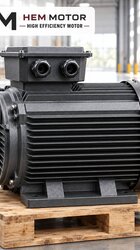

In a textile mill, the energy cost of electric motors drops fastest in the auxiliary systems that run day and night: the compressors feeding air-jet looms, the fans of the spinning-room air-conditioning plant, the circulation and exhaust fans of the stenter, and the circulation pumps of the dyeing machines. On these drives, matching speed to demand, bringing oversized motors closer to their real load and raising the efficiency class of the longest-running motors show up directly on the bill. Below we take spinning, weaving and finishing one by one and explain where to start on each motor.
From yarn to finishing: which motors write most of the electricity bill?
In a spinning mill running three shifts, the main drives of ring frames, open-end rotor machines and roving frames turn for almost the whole year. Yet the items whose share of the meter grows the most are often not the production machines themselves but the systems around them. Because cotton yarn is drawn at a set humidity and temperature, the air-conditioning plant never stops, and the fly-waste suction fans run as long as the machines do.
In the weaving hall, air-jet looms carry the weft yarn with compressed air, so the compressor room becomes one of the plant's largest consumers. In finishing and dyeing, dozens of fans run in the burner-heated chambers of the stenter, and circulation pumps move the liquor in the dyeing vessels. Which item is largest varies from plant to plant, so the first step is measurement, not guesswork.
| Department | Machine and electric motor duty | Load character | First energy item to check |
|---|---|---|---|
| Spinning | Ring and open-end main drives | Continuous, three shifts | Efficiency class, unnecessary idling |
| Spinning | Air-conditioning fans and humidification pumps | Variable by season | Speed control instead of dampers |
| Weaving | Air-jet loom compressors | Fluctuating with loom count | Air leaks, pressure setting, idle running |
| Finishing | Stenter circulation and exhaust fans | Variable by fabric type | Linking fan speed to the recipe |
| Dye house | Dyeing machine circulation pumps | Variable by process step | Speed profile instead of throttling |
| Common area | Fly and fibre suction fans | Continuous | Filter resistance, duct leaks |
How can you tell which drive is expensive without installing meters?
Even without a separate energy analyser, the panel team can read the current drawn by each large motor with a clamp meter several times per shift. Dividing the reading by the rated current on the nameplate roughly shows the load the motor is running at; written into a table together with daily running hours, the most expensive drives stand out on their own.
This method is not an exact power measurement, but it is enough to show where to begin.
A hypothetical example: if a 7.5 kW stenter fan runs 7,000 hours a year at an average 6 kW of grid power, its annual consumption is around 42,000 kWh. The sum is simple: power times hours. A compressor motor twice as large in the same table uses more than double that over the same period. The priority list is built from simple multiplications like these; the figures change with each plant's own readings.
Where does the compressor motor waste electricity in air-jet weaving?
A fixed-speed compressor draws power from the grid without producing air during its idle minutes; leaks in the line make this loss larger. On air-jet looms every weft insertion needs a certain amount of compressed air, and the number of running looms changes constantly with the shift, the article and stoppages. A fixed-speed screw compressor meets this fluctuation by switching between loaded and unloaded running; during the unloaded minutes the motor keeps drawing considerable power from the grid without producing air. Where the compressor room has several machines, a common arrangement is for one speed-controlled unit to absorb the fluctuation while the others run steadily at full load.
Just as important as the motor is keeping the air from getting lost on the way. Hose connections under the looms, solenoid valves and old fittings start leaking over time; a compressor that keeps running at the weekend while the looms are stopped is a clear sign of such leakage. Bringing network pressure closer to the lowest value the loom manufacturer requires also lightens the compressor motor's load. These settings and the compressor's own control should follow the compressor manufacturer's instructions.
How are fan and pump speeds in spinning-room air conditioning adapted to the seasons?
Spinning-room air-conditioning plants circulate large volumes of air with big centrifugal or axial fans to keep humidity and temperature in the hall constant. Winter needs less air than summer. In winter and spring the air volume needed is clearly lower than in summer; if the fan still turns at full speed and the volume is throttled with a damper, part of the energy the motor consumes turns into heat across the damper. When speed is reduced on fans and pumps, the power drawn falls not in proportion to speed but much faster (general information; confirm with the machine manufacturer).
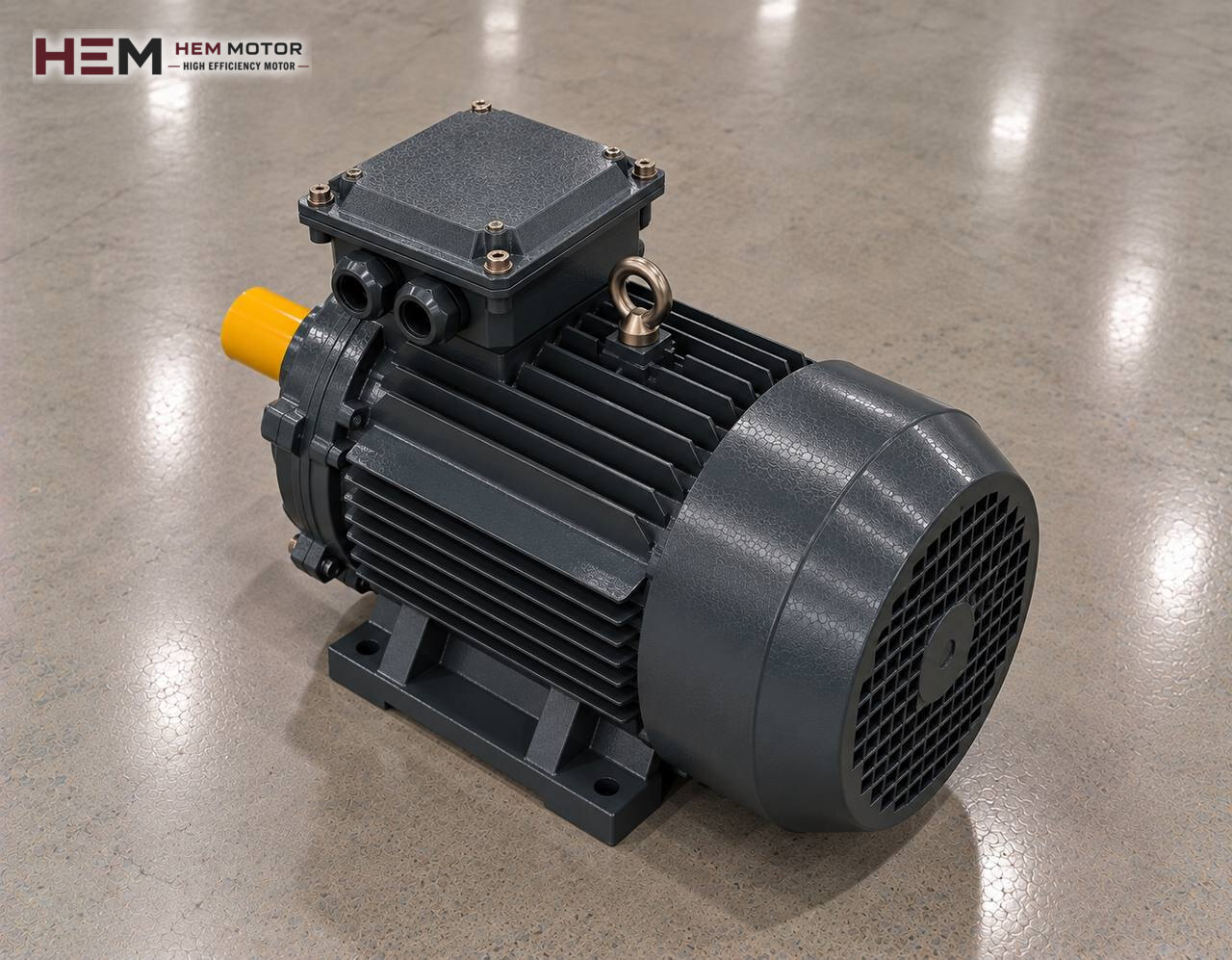
That is why speed control with a frequency converter on air-conditioning fans and air-washer pumps is often the step that pays back fastest. Our three-phase series are suitable for operation on a converter.
If a fan will spend long periods at very low speed under load, its own impeller may not cool the motor enough and a separately powered cooling fan may need to be added; if the cable between panel and motor is long, a dv/dt or sine-wave filter is considered. Telling us these operating conditions in the order is all we need to configure it correctly.
Motor options for air-conditioning and suction duties are gathered on the fan and extractor motors page.
How is stenter fan speed linked to the fabric recipe?
Stenter fan speed is set from the converter for each chamber as a parameter of the fabric recipe. Each stenter chamber contains circulation fans that blow hot air onto the fabric and exhaust fans that remove humid, oily air. A thin tulle and a heavy upholstery fabric do not need the same air volume; even so, in many plants the fans run at the same speed for every article. If the exhaust pulls too hard, heated air also leaves through the stack. This wastes both the fan motor's electricity and the burner's fuel.
Making fan speeds a parameter of the fabric recipe, that is, setting each chamber's speed from the converter according to fabric weight and line speed, is a common approach in finishing.
Stenter fan motors work close to the hot chamber wall in an atmosphere of lint and finishing vapours. Our factory-standard models have IP55 protection and class F winding insulation; for hot spots very close to the chamber wall, a higher insulation class and IP56 protection can be discussed as special-order options.