How to Cut the Energy Cost of Electric Motors in Livestock Facilities

How to Cut the Energy Cost of Electric Motors in Livestock Facilities

The quickest way to lower the energy cost of electric motors on a livestock farm is to find the few consumers that really drive the bill and tie their running time and speed to what the animals actually need. On a dairy farm these consumers are usually the barn fans, the milking vacuum pump, the milk cooling unit and the feed hammer mill; in beef sheds and poultry houses, ventilation and the feeding line take the lead. Replacing a motor with a new one is the last step in this sequence, not the first.

Which electric motors use the power in barns and poultry houses?

Planning savings without splitting the electricity bill machine by machine is like weighing feed in the dark. The table below ranks the motor groups of a typical dairy or beef unit by operating pattern and by where the loss comes from.

MachineTypical operating patternSource of lossFirst thing to check
Barn and poultry house ventilation fansDay and night in summer, short intervals in winterFull speed even in cool hours, dusty blades, slack beltsTemperature-based speed control, cleaning blades and shutters
Milking vacuum pumpContinuously throughout each milkingFixed speed that bleeds surplus air through the regulatorSpeed control according to vacuum demand
Milk cooling tank and agitatorFor hours after each milkingMilk entering the tank warm, dirty condenserPre-cooling, ventilation of the condenser
Feed hammer mill and grinderA few hours, several days a weekWorn hammers, finer screen than needed, running at peak hoursHammer and screen maintenance, tariff periods
Feed auger, manure scraper, water pumpShort but frequent cyclesJamming, dry chain, idlingRunning on timers and level sensors

A hypothetical example: if twenty fans in a free-stall barn run for more than twenty hours a day throughout July, fans are the busiest line on the summer bill. If the mill on the same farm runs only a few days a month, effort spent on its efficiency class pays back less than effort spent on the fans.

Efficiency investment goes first to the fans that run longest.

Why is temperature-based speed control the first step for barn fans?

In centrifugal and axial machines such as fans and pumps, absorbed power falls very quickly with speed; it is generally taken to vary roughly with the cube of speed (general information; confirm with the fan manufacturer). Running a fan at half speed on a cool morning therefore needs far less energy than running it at full speed and then switching it off. If heat stress in the cows does not begin in the early morning, the whole fan group does not need to be at full speed before sunrise. Full speed before sunrise is unnecessary.

There are two ways to link speed to barn temperature and humidity: switching fans on in stages as groups, or driving them with a frequency converter. HEM Motor's three-phase ranges are suitable for speed control with a drive. If a fan will stay at very low speed for long hours, the motor's own cooling fan may not be enough and a separate fan may be needed; if the drive panel is at the far end of the barn, a dv/dt or sine filter is considered for the long motor cable. Please tell us about both conditions with your order. A long cable needs a filter.

Maintenance is as effective as speed control. Dust on the blades, feathers and cobwebs in poultry houses, and shutters stuck half-closed all make the fan push the same air with more effort.

For a medium-sized barn fan, the 1.1 kW aluminium-frame 90S-4 can be considered; its rated speed is 1445 rpm and its voltage 230/400 V. Other options for barn and poultry fans are gathered on the ventilation electric motors page.
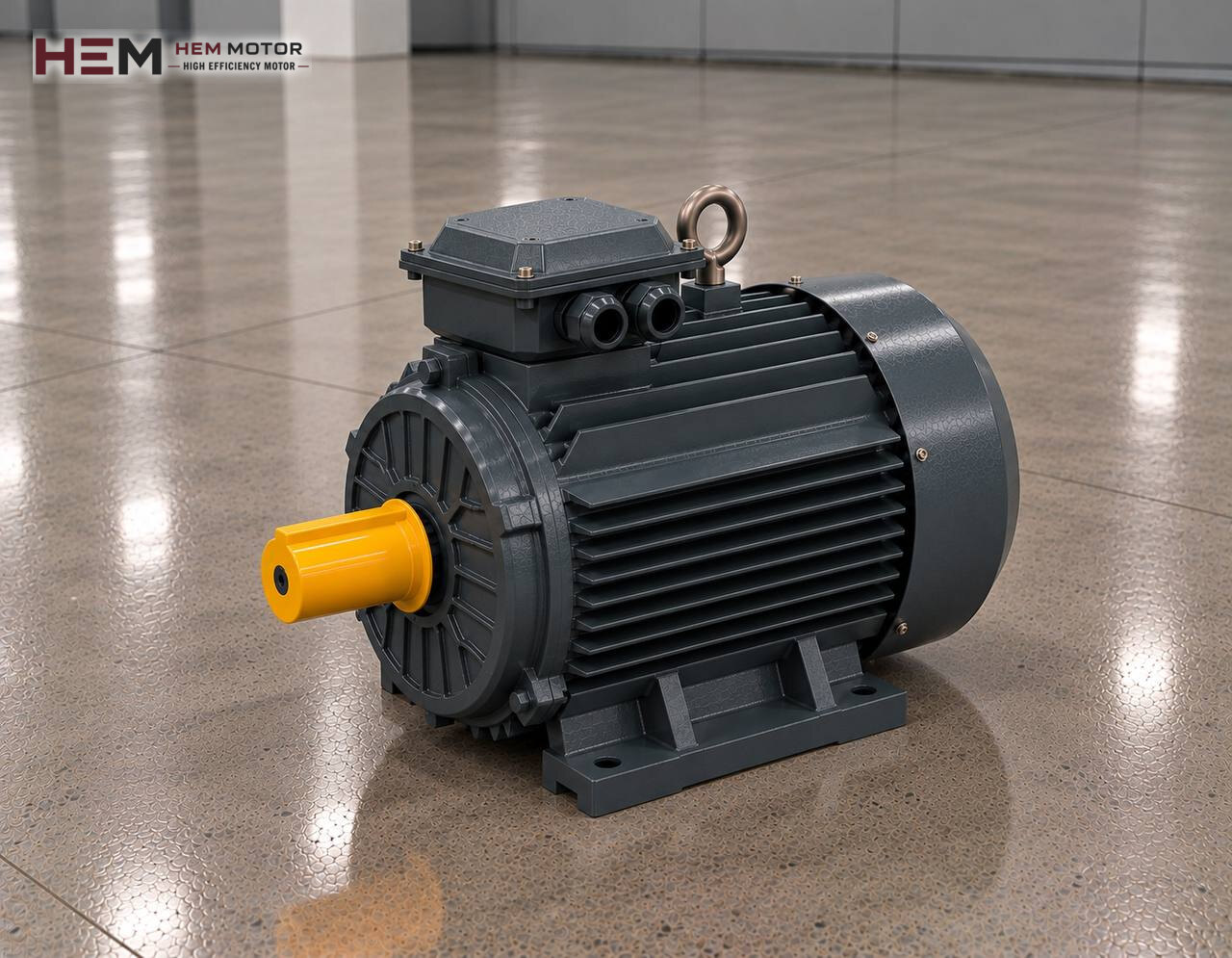
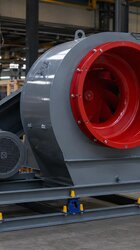
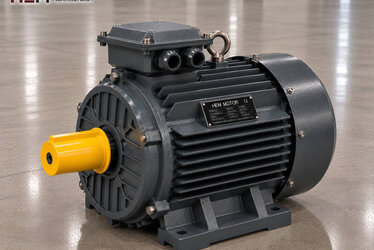
Fan electric motor used for poultry house and barn ventilation
Ventilation fan drive whose speed is adjusted to temperature in animal housing (representative image).

Where does the wasted power of a milking vacuum pump go?

In a conventional milking installation the vacuum pump runs at fixed speed throughout each milking, and surplus air is admitted back into the system by the regulator opening. The pump thus always works for the worst moment: even when most clusters are not attached, the motor consumes energy as if it were fully loaded. A speed-controlled vacuum system holds the vacuum level by changing pump speed and reduces the air escaping through the regulator.

Because vacuum stability directly affects udder health, this conversion should be planned together with the milking machine manufacturer; a poorly tuned drive can cause clusters to fall off. For the pump of a medium-sized milking parlour, the 3 kW aluminium-frame 100L2-4 is one example; it turns at 1450 rpm. Whether it is connected to the pump by coupling or belt, and whether the motor is foot- or flange-mounted, is the first question in a replacement. The pump runs for the worst moment.

Speed control cuts the escaping air, but the setting is done with the manufacturer.

When does the milk tank compressor run longer than necessary?

The biggest factor in the cooling unit's load is the temperature at which milk enters the tank. When a plate pre-cooler running on well or mains water is added to the milk line, milk reaches the tank cooler and the compressor's work is shortened. If the condenser is squeezed into a sunny, dusty corner or next to the feed store, it struggles to reject heat, which lengthens running time.

The tank compressor is often a sealed (hermetic) unit; in that case the electric motor is not selected separately and the gain comes from the unit's operating conditions. The tank agitator motor, on the other hand, is small and should be set to run at intervals rather than continuously. For the pump feeding water to the pre-cooler and for the farm's general water pumps, see the options on the agricultural machinery electric motors page. Cooler milk means shorter compressor time. The agitator should run in intervals.

Prices and technical data are on the product pages; choose a model and order online.

How are tariff timing and maintenance set up for the feed mill and feed line?

First the hammers and screen are maintained, then milling moves outside peak hours. As hammer tips wear in a feed hammer mill, the motor stays loaded longer to crush the same amount of barley or maize. Using a screen with finer holes than required also raises the electricity used per tonne; the particle size required by the ration should be set together with the animal nutritionist. Starting the mill empty and opening the feed gate afterwards both eases the starting current and spares the motor unnecessary strain.

On farms with a multi-period tariff, moving the weekly milling outside peak hours changes the cost without touching the motor (general information; check the valid time bands in your distribution company's tariff). Where there is room to keep enough ground feed in front of the silo, the mill can be run in the evening or at night. For a medium-capacity hammer mill, the 15 kW cast iron-frame 160L-4 can be considered; its rated speed is 1465 rpm and its voltage 400/690 V.

Options for mixer, mill and auger drives are on the feed machinery electric motors page, and all power and speed combinations are listed in our electric motor store.

When should an old or oversized electric motor be renewed?

A motor that has been rewound several times over the years, or chosen larger than needed, loses both efficiency and power factor at low load. It is right to base the renewal decision on running hours: fans running day and night in summer and the vacuum pump running at every milking are the groups that benefit most from efficiency class. On a manure scraper that runs a few minutes a day, the same investment takes a very long time to pay back. HEM Motor offers options in the IE3, IE4 and IE5 efficiency classes.

Fans and the vacuum pump are renewed first, the manure scraper last.

In the barn, ammonia, high humidity and pressure washing strain the motor frame and terminal box. Standard models have IP55 protection and class F insulation; IP56 can be considered as a special order for points that receive direct washing, and an anti-condensation heater as an order option for motors that gather moisture during long standstills. Submersible mixers and pumps lowered into the slurry pit, and drives working in the gas zone of a biogas unit, require a special motor; these may fall outside the standard range in our 2026 catalogue, so consult us with the nameplate and application details. Night milling changes the bill, not the motor. The biogas zone needs a special motor.

When connecting the new motor in place of the old one, the frame number is only the starting point. Foot-mounted B3, flange-mounted B5 and B14, combined B34 and B35, and vertical V1, V3, V5, V6 and V15 versions are supplied according to frame size, and we confirm the flange size with the order. Compatibility cannot be claimed before comparing shaft diameter and length, the distance between foot holes and the electrical ratings; a photo of the nameplate and the mounting point speeds up this comparison.

How is the energy plan tied to the milking and feeding calendar?

In livestock farming the energy cost shifts with the season: fans in summer, the vacuum pump and cooling all year round, and the mill on milling days. Putting temperature control on the fans, speed control on the vacuum pump and tariff timing on the mill first, and then renewing the longest-running old motors, puts the investment in the right order.

When you send the nameplates of your fan, pump and mill motors together with their running hours through the nameplate submission page, we work out together which unit to tackle first and the matching power. For spare and renewal purchases you can browse the three-phase and single-phase models in the store, and use our contact page for quotes and technical questions.

Frequently Asked Questions

Will the motor overheat if I drive barn fans with a frequency converter?

Since fan load drops rapidly as speed falls, overheating at low speed is rare. Even so, if the fan will stay at very low speed for a long time, the need for an external cooling fan should be stated in the order.

Does adding speed control to the vacuum pump affect milking quality?

When set correctly, the vacuum level stays more stable. The conversion should follow the vacuum values recommended by the milking machine manufacturer and be checked by measurement during commissioning.

Does replacing the feed mill motor with a smaller one lower the electricity bill?

A smaller motor grinds the same feed over a longer time or becomes overloaded; energy per tonne often does not fall. Savings should first be sought in hammers, screens and the running schedule.

Can single-phase fan motors be used in small poultry houses?

On small farms without a three-phase supply, 220 V single-phase models in the 0.18–5.5 kW range can be considered. If many fans and speed control are planned, a three-phase supply offers a more flexible solution.

HEM Motor Models Related to This Article

The cards show example models related to the topic. A suitable motor is not chosen by power alone: compare speed, voltage, mounting, shaft and connection dimensions on the product page; if unsure, send a photo of the existing motor’s nameplate on WhatsApp.

1.1 kW 1500 rpm Aluminium Frame Electric Motor 90S-4

90S-4

1.1 kW · 1500 rpm

  • Aluminium frame · IEC 90S
  • 1445 rpm · IP55
  • Mounting: B3 foot; flange (B5/B14/B35) depending on frame, confirmed with the order

US$116.16 (€106.32)

View product
3 kW 1500 rpm Aluminium Frame Electric Motor 100L2-4

100L2-4

3 kW · 1500 rpm

  • Aluminium frame · IEC 100L
  • 1450 rpm · IP55
  • Mounting: B3 foot; flange (B5/B14/B35) depending on frame, confirmed with the order

US$190.83 (€174.65)

View product
15 kW 1500 rpm Cast Iron Frame Electric Motor 160L-4

160L-4

15 kW · 1500 rpm

  • Cast iron frame · IEC 160L
  • 1465 rpm · IP55
  • Mounting: B3 foot; flange (B5/B14/B35) depending on frame, confirmed with the order

US$665.08 (€608.69)

View product

Similar Articles