In the technical facilities of hotels, hospitals and shopping centres, the switch to IE3 and IE4 electric motors starts with the longest-running drives: the operating theatre and intensive care air handling units of hospitals, hot water circulation pumps running all year, the fresh air and exhaust fans of shopping centres that run until after closing time, and the chiller and condenser pumps that run without a break throughout the summer season. A fire pump that runs a few hours a year, or a smoke fan that only starts in an emergency, stays off the list as far as efficiency class is concerned.
Why does efficiency class in the basement plant room depend on the type of building?
An air handling unit fan of the same kilowatt rating runs very different hours depending on how the building is used. In a hospital, air is conditioned 24 hours a day for operating theatres, intensive care, isolation rooms and laboratories; the fans of these units can exceed 8,000 hours a year. In a city hotel, the systems serving guest floors also run at night, but the conference hall unit is only in service on event days.
In a shopping centre, the picture depends on store opening hours: common area units switch on in the morning with the cleaning crew and shut down towards midnight. Annual running hours are usually between 5,000 and 6,000. For this reason, the return on switching the same fan to IE4 is fastest in a hospital, medium in a shopping centre and slowest in a seasonal resort hotel.
Which hospital drives are moved to a higher efficiency class first?
Air handling unit fans and the circulation pumps that run all year are switched first.
Hospital air handling unit fans are mostly 4-pole and in the 7.5–30 kW range; because filter resistance is high, the fan constantly works against considerable pressure. The circulation pumps of the heating and cooling circuits also run all year in a similar way. These two groups form the first lines of the hospital technical department's switch list.
The hardest part of switching in a hospital is when to make the change.
If an operating theatre unit is to be stopped even for a few hours, this must be planned with the surgery schedule; for the intensive care unit, with a standby unit or a temporary ventilation solution. Where pumps are duplicated, the load is transferred to the standby and the change is made without affecting patient care.
Which drives use the most energy in a shopping centre?
The most energy-intensive drives of a shopping centre are the common area air handling units, food court hood exhaust fans, chiller plant pumps and enclosed car park ventilation fans. Food court exhaust fans run close to full capacity as long as the restaurants are open; since they carry greasy, hot air, maintenance and cleaning of the motor are a separate matter.
Car park fans run in stages during the day, controlled by CO sensors. On fans that only provide daily ventilation, an efficiency class upgrade makes sense together with a frequency converter; fans that also take on smoke extraction duty require a special motor because they need a high-temperature classification; these fans may fall outside the standard series in HEM Motor's 2026 catalogue.
You can consult us separately about these fans with the nameplate and project details.
Which pumps and fans run all year in a hotel?
In city hotels, the circulation pumps supplying hot water to guest rooms, the kitchen and laundry exhaust fans and the pumps of fan-coil systems run all year. In seaside hotels, pool filtration pumps and chiller pumps turn almost non-stop during the season and stand idle for most of the winter. The switch decision in a resort hotel should therefore be based on seasonal, not annual, running hours.
The best time to replace motors in a hotel is the pre-season maintenance period. If pool pumps, chiller pumps and air handling unit fans are removed and moved to the new class during this period, no shutdown affecting guest comfort occurs during the season.
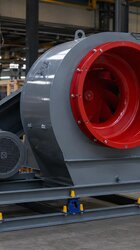
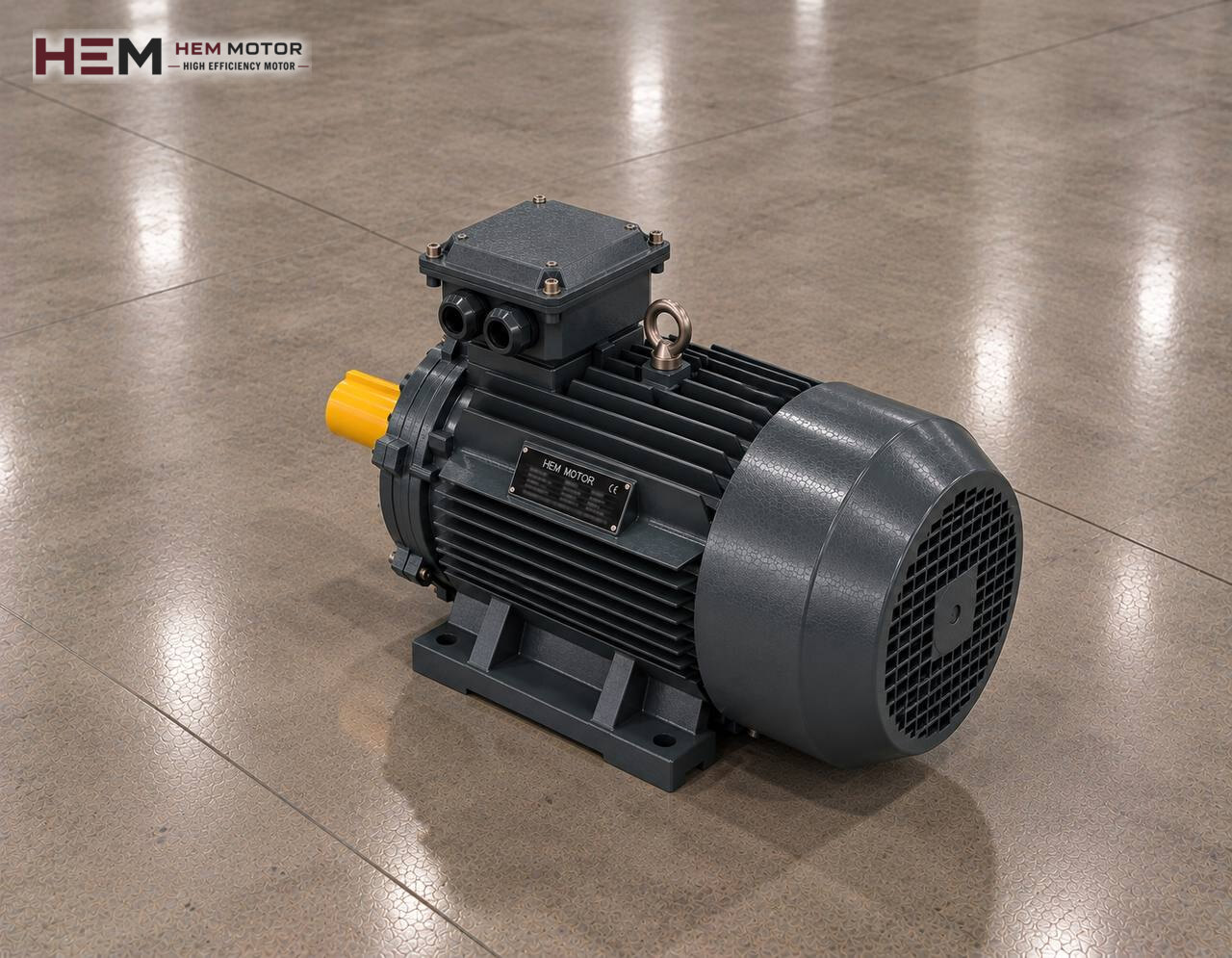
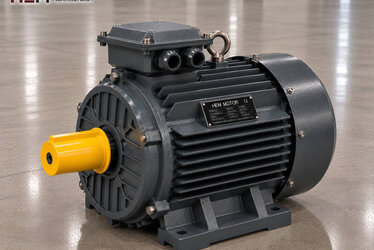
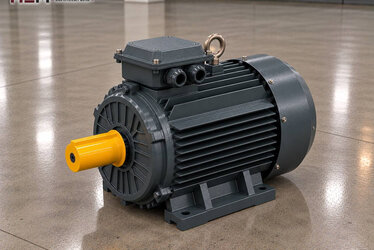
Air handling unit fan drive (representative image).
Prices and technical data are on the product pages; choose a model and order online.
First; operating theatre and intensive care 24 hours
First; throughout store hours
Guest floor unit first, hall unit later
Heating and hot water circulation pump
First; all year
Medium; in the winter months
First; hot water all year
Chiller and condenser pump
High; equipment cooling all year
High; heavy in summer
Seasonal; all summer in a resort hotel
Kitchen and food court exhaust
Medium
High
High
Booster pump set
Medium; variable consumption
Low
Medium
Fire pump, smoke fan
Outside the switch list
Outside the switch list
Outside the switch list
Why does a higher-efficiency motor turn an air handling unit fan faster?
A motor in a higher efficiency class has low rotor losses, which can make it turn a few rpm faster than the old motor at the same number of poles. An air handling unit fan connected directly to the grid delivers more air and draws more energy at this extra speed; the gain may turn out smaller than expected. This is general information; confirm it with the fan or pump manufacturer.
In units run by frequency converters, the difference is corrected via the speed reference.
Our three-phase series are suitable for speed control with a converter; if the unit fan will turn at slow speed under full load for hours, an independent cooling fan is considered, if the drive line to the rooftop unit is long a dv/dt or sine filter comes up, and these points are written on the order form. General options for building drives are on the HVAC sector electric motors page.
Which electric motor models suit the technical facility?
The models below are examples for typical duties; verify them against your own nameplates and project operating points. You can compare the other ratings in your plant room by kilowatt and number of poles in the HEM Motor electric motor shop.
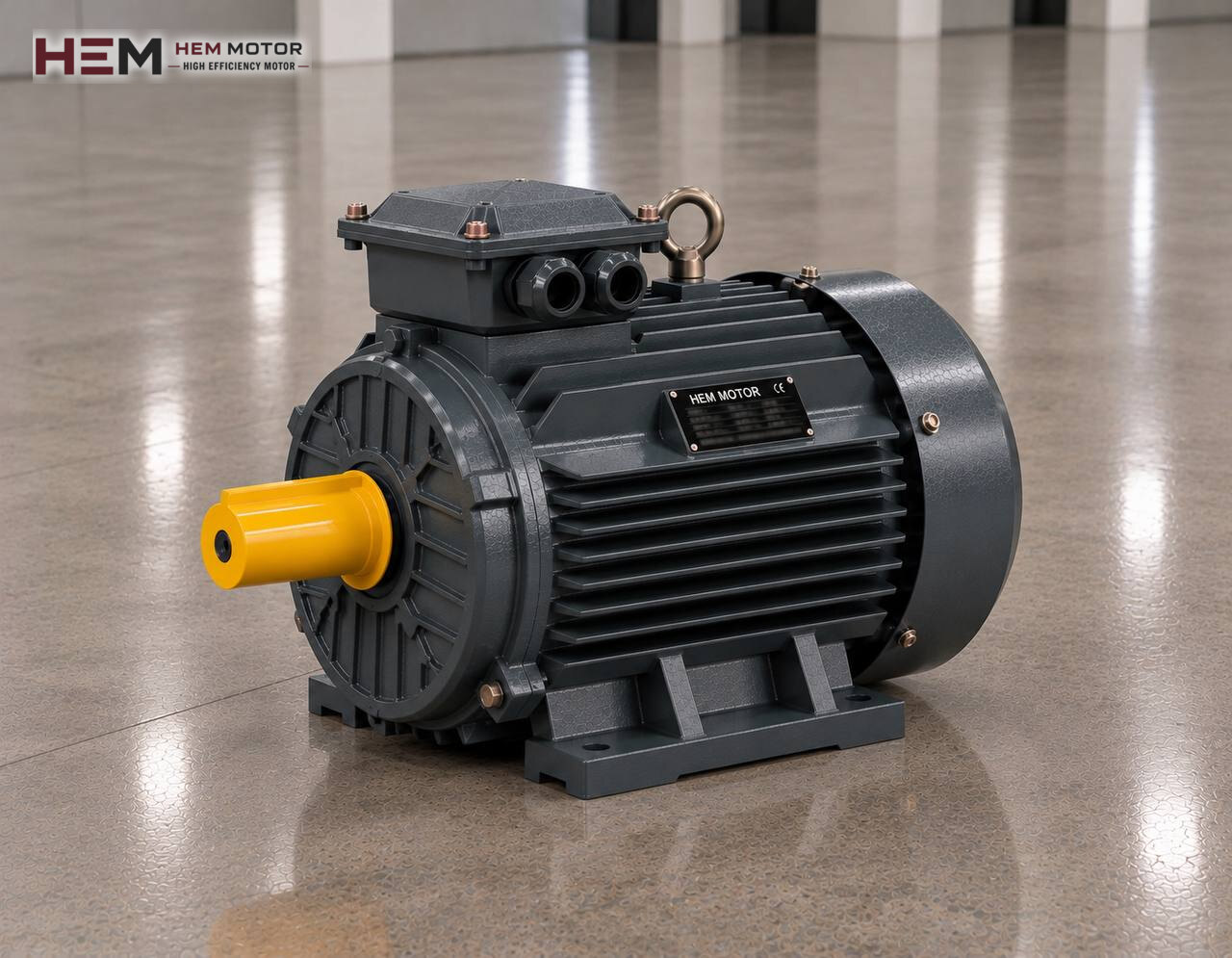
For an operating theatre or shopping centre common area air handling unit fan, the 15 kW, 4-pole cast iron 160L-4; rated speed 1465 rpm, connection 400/690 V.
For a chiller or condenser water pump, the 37 kW, 2-pole 200L2-2; it runs at a rated speed of 2960 rpm.
For a hotel kitchen exhaust fan or a small circulation pump, the 2.2 kW aluminium-frame 100L1-4; rated speed 1450 rpm, voltage 230/400 V.
Our series are offered in the IE3, IE4 and IE5 efficiency classes; standard equipment is IP55 protection and insulation class F. If the new motor is to go on the old base, the IEC frame number is the first piece of comparison data; the fit is confirmed by checking foot or flange design, shaft dimensions, foot hole spacing, flange and nameplate values together. For air handling and chiller pumps, you can also look at the pump electric motors page.
How is the switch tied to the operating calendar and budget period?
When the switch is matched with the surgery schedule and redundant systems in a hospital, with night hours and low-footfall periods in a shopping centre, and with pre-season maintenance in a hotel, guests, patients and visitors notice no change. Once the inventory is drawn up and each motor's annual running hours are written down, it becomes clear which motor will be renewed in the first budget period and which when it fails.
If you share the nameplates of the air handling unit fans and pumps in your plant room through the find-an-equivalent-from-the-nameplate page, we can rank together which drives to renew first for your building type and the matching models.
You can find the ratings on your technical facility's switch list one by one in our product shop.
Frequently Asked Questions
Can the motor of a hospital operating theatre unit be replaced on surgery days?
The change should be made when the surgery schedule is clear or while a standby unit is in service. The plan is prepared together with the technical department and the infection control team.
Does it make sense to move shopping centre car park fans to IE4?
It can make sense if the fan only provides daily ventilation and runs long hours. Fans that also take on smoke extraction duty require a separate classification and a special motor.
Why does IE4 take longer to pay back in a seasonal resort hotel?
Pool and chiller pumps run only part of the year. As annual running hours fall, the monetary value of the efficiency difference also decreases; the calculation should be based on seasonal hours.
Should the fire pump motor also be moved to a high-efficiency class?
Since a fire pump runs only for test periods each year, efficiency class is not decisive for this motor. What matters here are fire regulations and project conditions.
HEM Motor Models Related to This Article
The cards show example models related to the topic. A suitable motor is not chosen by power alone: compare speed, voltage, mounting, shaft and connection dimensions on the product page; if unsure, send a photo of the existing motor’s nameplate on WhatsApp.
When choosing an electric motor for a feed dosing screw, the real goal is for every turn of the screw to carry the same amount at low flow; to achieve this, before moving on to mot... More Details
When choosing electric motors for a corrugated board line, two groups are thought about separately: the main drives that carry line speed and the many auxiliary drives around them.... More Details
In a rubber compound mixer the electric motor carries two loads at once: the continuous torque from the high viscosity of the compound and the impact peaks that occur every batch a... More Details
On a scrap metal separation belt the electric motor is chosen by the shaft power the belt load requires and by the type of magnet unit; a magnetic head pulley adds load to the belt... More Details
An electric motor for a PET bottle crusher works, in wet crushing, against a steadier load that the water cools and lubricates, and in dry crushing against a harsher, impact-heavy ... More Details
On a cable granulator the motor carries two separate loads: the continuous cutting load as the knives on the cutting rotor chop the cable, and the sudden impacts caused by cable bu... More Details
We use necessary and optional cookies to improve your experience, enhance content and analyse traffic. Under the GDPR, optional (analytics/marketing) cookies are only used with your explicit consent. Please choose your preference below.
Cookie Policy
 English
 Français
 Türkçe
 Español
 Русский
 العربية
 Deutsch
 Italiano