Electric Motors in Harsh Conditions: Three-Phase Induction Choice for Dust, Damp, Heat and Frequent Starts

Electric Motors in Harsh Conditions: Three-Phase Induction Choice for Dust, Damp, Heat and Frequent Starts

When choosing a three-phase asynchronous motor for harsh conditions, the real task is to break the word "harsh" into its parts: is there dust, moisture, a hot environment, or does the motor start dozens of times an hour? Each one strains a different weak point of the motor and requires a different piece of information to be written in the order. HEM Motor's standard series comes with IP55 protection, class F insulation and 50 Hz; the cast iron frame covers the 0.55–355 kW range. This specification is sufficient on many demanding sites, but it does not meet every harsh condition on its own.
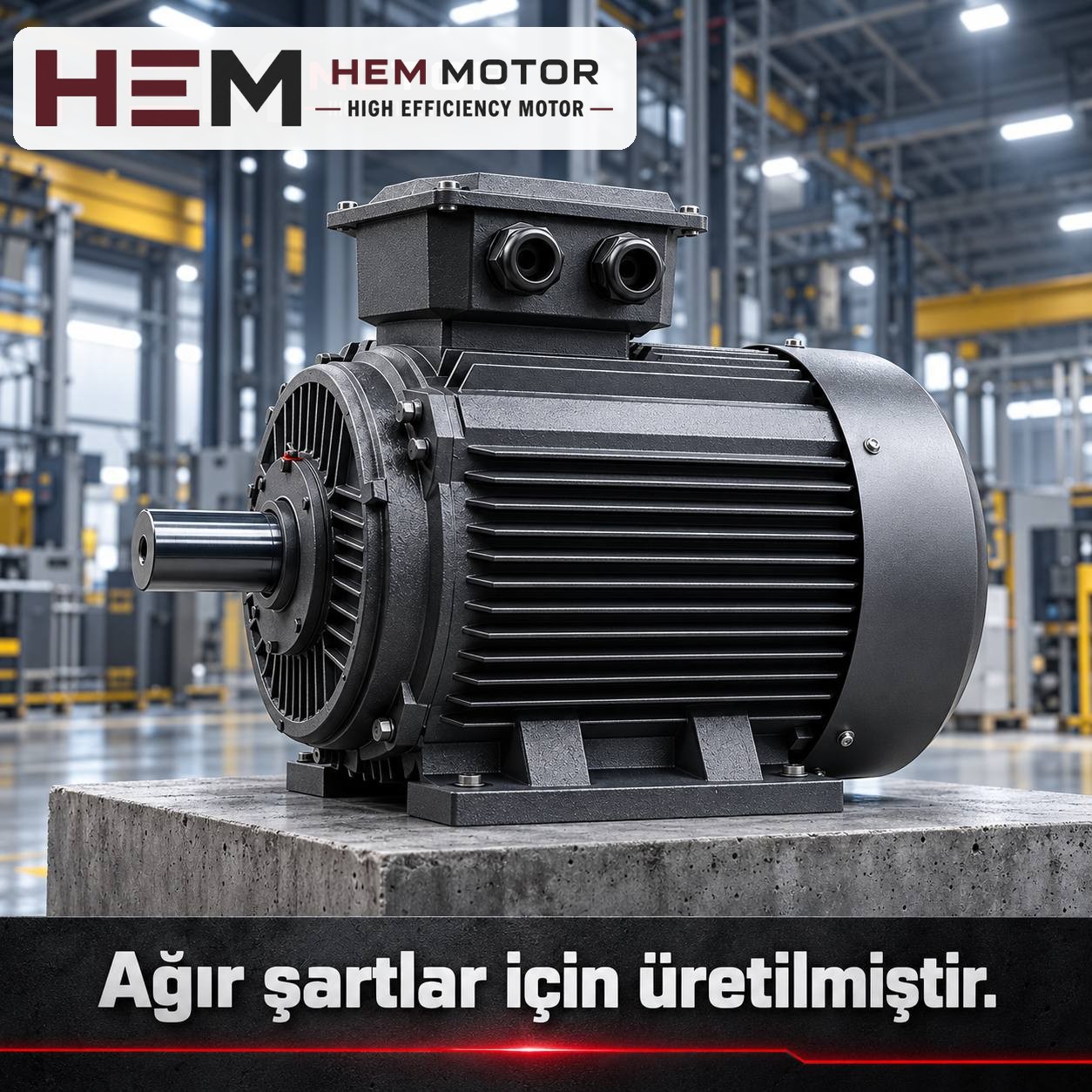
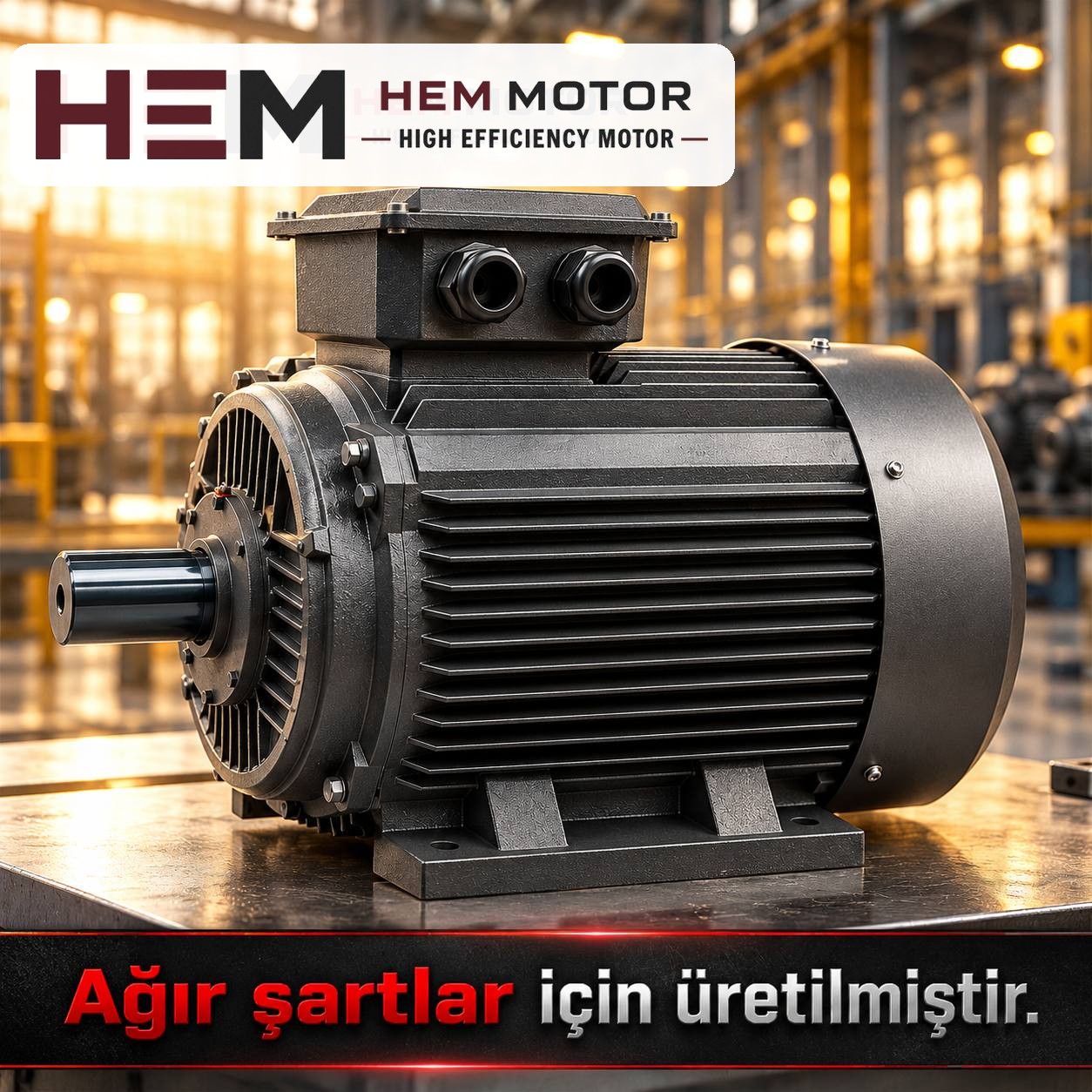
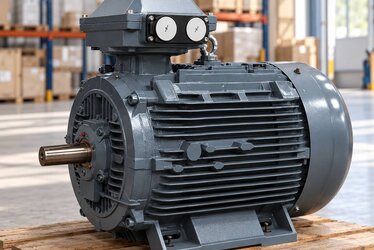
Cast iron frame three-phase electric motor in a factory setting
Harsh conditions are defined less by the motor frame than by the environment and duty it works in (representative image).

"Harsh conditions" are not a single situation

When people on site hear "heavy-duty electric motor", most picture a big motor with a thick frame. Yet what wears a motor out is usually not its size but the type of condition it faces. Thinking in six separate headings makes the job easier:

  • Dust: Quarries, cement, marble cutting, foundry sand, wood shavings.
  • Moisture and water: Washing areas, open air, pump rooms with condensation.
  • High ambient temperature: Around furnaces, closed and poorly ventilated machine rooms, under roofs.
  • Frequent starting: Presses, hoists, dosing and filling systems switching on and off many times an hour.
  • Shock load: Machines where the load jumps suddenly, such as crushers, shredders and grinders.
  • Long, uninterrupted running: Fans, pumps and conveyors that run for weeks without stopping.

A site may experience several of these at once. A crushing and screening plant combines dust, shock load and outdoor exposure. That is why writing "harsh conditions" in the order is not enough; which condition is present, and to what degree, must be described.

Dust: protecting the cooling path and the sealing

The first digit, 5, in IP55 describes a level of protection that prevents harmful amounts of dust from entering the motor. The problem usually starts outside the motor rather than inside it. A self-ventilated (IC411) motor cools its frame with air blown between the fins. When the spaces between the fins and the fan cover grille fill with dust, the motor runs hotter at the same load.

On a dusty site it helps to state the following in the order:

  • The type of dust: abrasive mineral dust, sticky, or fibrous?
  • The motor's distance from the dust source and the possibilities for cleaning.
  • The orientation of the terminal box and from which side the cable entries will be made.

Areas with combustible dust are a separate matter. Zones where flour, feed, sugar or coal dust can form an explosive atmosphere require a special motor classified for that zone; this duty may fall outside the scope of the standard series in HEM Motor's 2026 catalogue. On such a site, always state the zone classification and ask us.

Moisture and water: water from outside versus condensation inside

The second digit of IP55 describes protection against water jets from any direction. Rain and splashing water fall within this definition. Water sprayed at close range by a pressure washer, or a motor being submerged, falls outside it. If stronger protection is needed, IP56 is an option that can be requested when ordering; we assess whether it is suitable together with the application details.

On damp sites, the second factor that determines motor life is condensation forming inside rather than water coming from outside. In plants that stop at night or close at weekends, the motor draws in humid air every time it cools down. In the order, state whether the motor will stand in the open or under a canopy, the length of the stoppages and the mounting orientation. In vertical mounting, whether the shaft points up or down also matters for how water runs off.

High ambient temperature and altitude

Class F insulation defines the temperature limit the winding can withstand. The motor's rated power, however, is given for a specific ambient temperature and altitude above sea level. If the environment exceeds these conditions, the motor cannot deliver its rated power with the same thermal margin; it is either used with derated power or the next power rating up is chosen.

Here you need to measure rather than guess a figure. In the order, state the highest ambient temperature at the motor's location, the altitude of the site and the air circulation around the motor. Running the motor directly in hot gas or attached to a furnace body is not a standard application; the motor should be moved outside the hot zone to a place where it can be cooled by clean air.

Frequent starting and duty type

An asynchronous motor draws several times its rated current while starting, and the heat of this current builds up mainly in the winding and the rotor. A few starts an hour do not strain the motor; but as starts become more frequent, the motor cannot cool down between them. Frequent starting is therefore a type of burden distinct from continuous load.

IEC 60034-1 describes this difference through duty types: S1 is continuous duty, S3 is intermittent periodic duty, and S4 is intermittent duty in which starting also contributes to heating. The following information in the order allows the right motor and the right starting method to be determined:

  • The number of starts per hour and the length of each running period.
  • Whether starting takes place under load or at no load.
  • The rotating mass of the load (such as a flywheel, drum or large fan impeller).
  • The planned starting method: direct-on-line, star-delta, soft starter or frequency inverter.

A frequency inverter softens the current surge with frequent starting. Our three-phase series are suitable for speed control with a frequency inverter; for prolonged operation at low speed with full torque, an external fan may be required, and if the cable between the drive and the motor is long, a dv/dt or sine filter is considered; these conditions are stated when ordering.
Prices and technical data are on the product pages; choose a model and order online.

Shock load and long running: the mechanical side

Under shock load the motor torque jumps momentarily, and this jump is passed on to the shaft, key, bearings and base. A cast iron frame offers a more rigid structure than aluminium and is preferred on vibrating foundations. But the frame alone is not the answer. A solid, level base, a well-aligned coupling and a correctly tensioned belt reduce the share of the shock that reaches the bearings. You can find stone-crushing applications on the crusher and stone-crushing motors page and use in mining on the mining sector motors page.

In motors that run for weeks without stopping, what determines life is how much margin the winding temperature leaves. Instead of running the motor constantly at the limit of its rated power, measuring the load and choosing the power according to the real need preserves this margin. Browse suitable HEM Motor models and current prices.

What does the standard series cover, and when should you ask us?

ConditionCovered in the standard seriesTo be stated in the order
DustIP55 enclosure protection, cast iron frame optionType of dust, cleaning possibilities; zone classification if combustible dust is present
Moisture, rainIP55; IP56 as an option on requestOutdoors or not, washing or not, stoppage times, mounting orientation
High ambient temperatureClass F insulationHighest ambient temperature at the motor, altitude
Frequent startingOperation with a suitable starting methodNumber of starts, loaded/unloaded start, rotating mass, starting method
Shock loadRigid cast iron frameMachine type, drive arrangement (coupling/belt), condition of the base
Long continuous runningRatings based on S1 continuous dutyActual load, operating hours, use of a frequency inverter

If any of the information in the right-hand column goes beyond standard conditions, whether a special solution is needed is assessed by looking at the application. Rather than making a general promise of a "special motor for harsh conditions", we prefer to talk using the data from your site.

Hypothetical example: a dusty, outdoor screening belt

The following scenario is for illustration only and is not a real customer application. In a crushing and screening plant, an outdoor belt runs two shifts a day and starts loaded at the beginning of each shift. The existing motor is 22 kW, 4-pole. The environment is dusty, the motor is exposed to rain and stands in the sun in summer.

In this situation, instead of blindly increasing the motor power, the following order is followed: first the current drawn by the existing motor is measured and the starting time observed; then a simple sunshade and rain cover over the motor is considered; the starting method is reviewed for loaded starts. If the measurements show that the load margin is sufficient, a cast iron frame motor of the same power is used; if the starting and thermal margins are tight, the next rating up is considered.

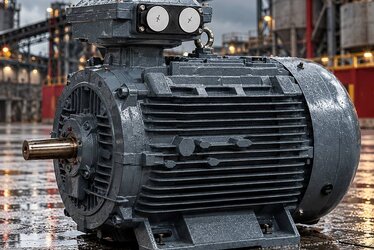
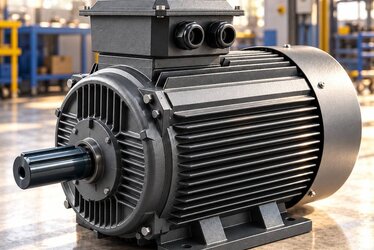
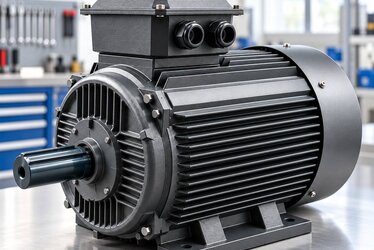
Example models that can be used on such sites (cast iron frame, IP55, class F, 400/690 V (Δ/Y), 50 Hz; current price on the product page):

You can see all power ratings on the cast iron frame models page.

Conclusion and the information needed for a quote

A durable electric motor for harsh conditions is not the motor with the thickest frame but the one chosen with knowledge of the site's real conditions. When you describe dust, moisture, temperature, frequent starting, shock load and running time separately, it becomes clear where the standard series is sufficient and where additional measures are needed. When asking for a quote, state the power, speed, mounting arrangement, voltage, application and the conditions above; if possible, add a photo of the existing motor's nameplate.

Browse suitable models and current prices in the shop. Send the nameplate photo, speed and mounting details of your current motor through the nameplate submission page and ask for a quote for a suitable model.

Frequently Asked Questions

Is a cast iron frame better than aluminium in every harsh condition?

On sites with vibrating foundations, shock loads and a risk of mechanical impact, a cast iron frame is the more rigid choice. Protection against dust and moisture, however, depends less on the frame material than on the IP rating, the gaskets and correctly made cable entries.

Can an IP55 motor be used outdoors?

IP55 protects against rain and splashing water, so it can be used outdoors. Sun, condensation and mounting orientation should also be considered; a simple cover contributes to the motor's life.

Is choosing the next power rating up enough for frequent starting?

Not always. The number of starts, the rotating mass and the starting method must be assessed together; sometimes a controlled start with a frequency inverter is a better solution than increasing the power.

What should I do if the ambient temperature is high?

State the highest temperature at the motor's location and the altitude of the site in the order. Whether the motor will run at its rated power, with derated power or with the next rating up is determined from this information.

HEM Motor Models Related to This Article

The cards show example models related to the topic. A suitable motor is not chosen by power alone: compare speed, voltage, mounting, shaft and connection dimensions on the product page; if unsure, send a photo of the existing motor’s nameplate on WhatsApp.

22 kW 1500 rpm Cast Iron Frame Electric Motor 180L-4

180L-4

22 kW · 1500 rpm

  • Cast iron frame · IEC 180L
  • 1470 rpm · IP55
  • Mounting: B3 foot; flange (B5/B14/B35) depending on frame — confirmed with the order

US$908.94 (€815.54)

View product
30 kW 1500 rpm Cast Iron Frame Electric Motor 200L-4

200L-4

30 kW · 1500 rpm

  • Cast iron frame · IEC 200L
  • 1475 rpm · IP55
  • Mounting: B3 foot; flange (B5/B14/B35) depending on frame — confirmed with the order

US$1,220.88 (€1,095.42)

View product
45 kW 1500 rpm Cast Iron Frame Electric Motor 225M-4

225M-4

45 kW · 1500 rpm

  • Cast iron frame · IEC 225M
  • 1485 rpm · IP55
  • Mounting: B3 foot; flange (B5/B14/B35) depending on frame — confirmed with the order

US$1,669.20 (€1,497.67)

View product

Similar Articles