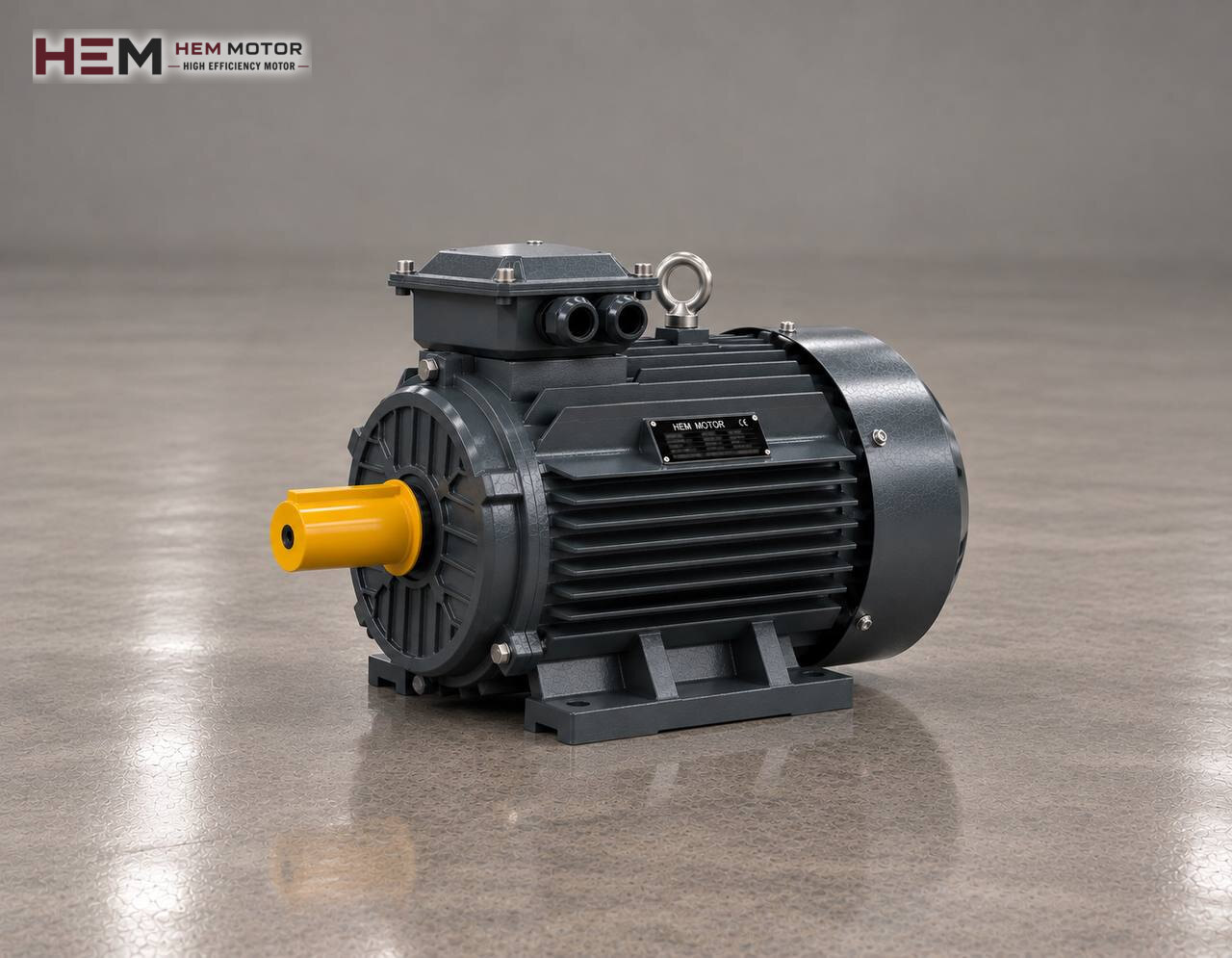
An electric motor for an olive oil malaxer works in front of a gearbox that turns the paste at low speed for hours without a break; the choice is therefore decided less by the kW figure on the plate than by the torque the mixing arm demands, S1 duty lasting the whole season, and a damp, oily environment that is washed often. Most lines use a four- or six-pole asynchronous motor together with a worm or helical gearbox.
Why does the malaxer motor run continuously at low speed?
Malaxation is the stage in which the paste coming from the crusher is stirred slowly so that the oil droplets join together, and the mixing arm makes only a few to around twenty turns per minute. If the arm speeds up, an emulsion forms and oil separation in the decanter becomes harder.
An electric motor does not turn that slowly. A motor with a synchronous speed of 1500 or 1000 is brought down to arm speed with a high-ratio gearbox. A tank is usually mixed for 30 to 60 minutes, emptied and refilled; during the harvest this cycle runs day and night. From the motor's point of view the duty is, in practice, S1 continuous running.
The season is short. Between November and January the machine runs for weeks without stopping, then waits for months, and that waiting is when the motor takes in moisture.
How is the required torque carried from the gearbox output back to the motor?
The calculation starts at the output. The torque the arm needs to turn the paste is divided by the gearbox ratio and efficiency to bring it to the motor shaft:
Tmotor = Toutput / (i × ηgear)
A hypothetical example: an arm needing 1,800 Nm at the output is driven by a worm gearbox with a ratio of 80, and gearbox efficiency is taken as 0.65. The torque needed at the motor shaft is 1,800 / (80 × 0.65) ≈ 34.6 Nm. On a 4-pole motor at around 1450 rpm this corresponds to roughly 5.3 kW of shaft power (P = T × n / 9550).
The efficiency of worm gearboxes varies with ratio and temperature; at a cold morning start, with thick oil, it is clearly lower (general information; confirm with the gearbox manufacturer's catalogue). With a helical or bevel gearbox efficiency is higher, so the same output torque can be met with a smaller motor. Settling the gearbox type before choosing the motor removes the most common cause of picking the wrong size.
What load is expected at start-up?
The hardest moment is starting a full tank for the first time in the morning. Paste that has cooled overnight thickens, the gearbox oil gets heavier and the arm asks for clearly more torque on its first turn.
On site this shows up as current staying high for a long time in the first seconds. If you measure once with a clamp meter how long the starting current takes to fall to rated current, you have real data for the thermal relay threshold and the starting arrangement. With a Y/Δ arrangement, the torque the motor can deliver in the first seconds falls to roughly a third of direct-on-line (general information; confirm with the machine manufacturer); with a full tank the motor may not accelerate in star.
A common solution is a slow ramp and adjustable arm speed with a frequency converter. Our three-phase series are suitable for speed control with a frequency converter; for long periods of full torque at low speed an external fan may be needed; if the drive-to-motor cable is long, a dv/dt or sine filter is considered; these conditions are stated with the order. When speed is lowered with a drive on a malaxer, the motor fan slows too, while the torque demand does not drop; that turns the external fan question into a real one.
Prices and technical data are on the product pages; choose a model and order online.
How do a damp environment and washdowns affect motor choice?
In an olive oil plant the motor faces warm water, vegetable oil vapour and pressure washing at the end of the day. Standard motors have IP55 protection; this class is designed to withstand water splashing onto the frame from various angles, but not a high-pressure washing gun aimed straight at the terminal box.
IP56 protection and an anti-condensation heater for the off-season standstill are order options. Instead of covering the machine and leaving it at the end of the season, energising the motor's heater at low power or running the motor briefly every few weeks limits moisture in the winding. The first job at the start of the season is to measure winding insulation resistance with a megger and compare it with the previous year's record.
In areas in direct contact with food, a stainless, hygienic-design motor may be requested. This task requires a special motor; it may fall outside the scope of the standard series in HEM Motor's 2026 catalogue, so ask us with the nameplate and application details. On most malaxers the motor sits outside the tank body, above the gearbox, so the standard series is sufficient; the decision follows the plant's hygiene plan.
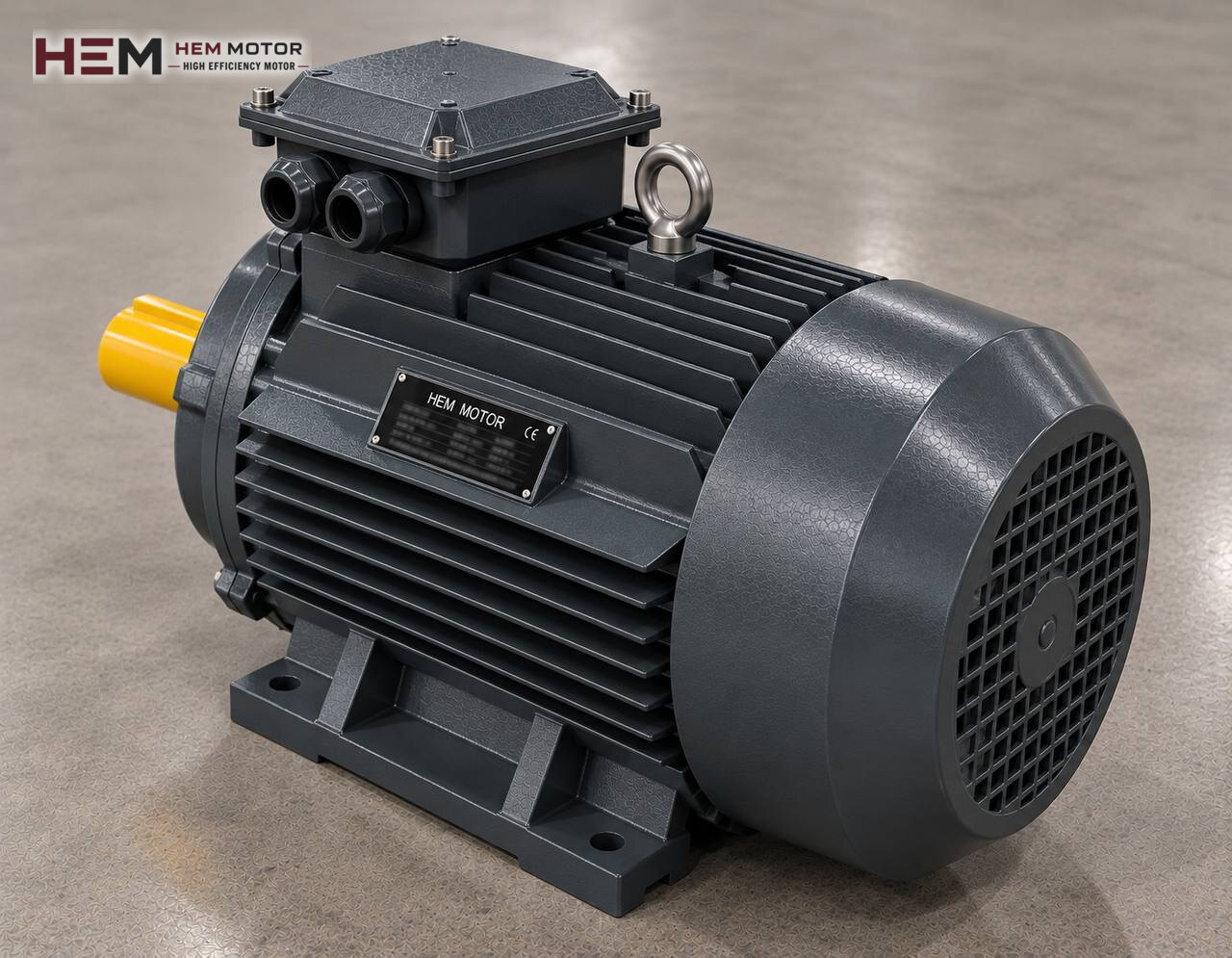
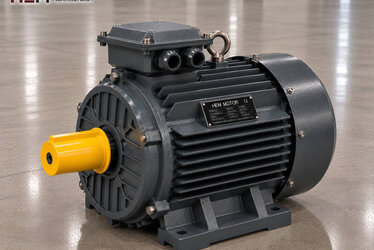
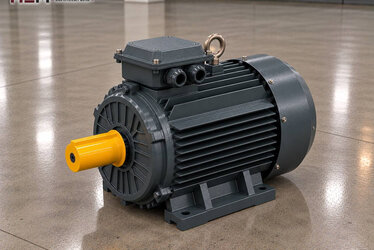
On a malaxer the motor turns the mixing arm at low speed through a high-ratio gearbox (representative image).
Which checks during the season prevent failures?
A weekly round is enough to prevent a line stopping mid-season. Go in order.
Check
How it is done
Act if you see
Frame temperature
Non-contact thermometer on fan end and top of frame, at the same time of day
Clear rise compared with the previous week
Fan cover
Visual check for paste and pit build-up on the cover grille
More than half of the grille blocked
Current
Clamp meter with a full tank, in the middle of mixing
Value approaching rated current or diverging between phases
Terminal box
The cover's rubber gasket, the gland at the cable entry
Traces of moisture inside the cover, loose gland
Connection to the gearbox
Listening by ear, coupling or flange bolts
Knocking, oil leakage reaching the motor flange
Paste stuck to the fan cover is the most overlooked cause of overheating.
Which example models suit this task?
For the roughly 5.3 kW shaft power in the hypothetical calculation and continuous duty, sizes suitable for the gearbox input line up as follows in the cast iron series. The frame holds up well in damp surroundings; the mounting is ordered as B5 or B14 according to the gearbox input flange. B3, B5, B14, B34, B35 and vertical V1/V3/V5/V6/V15 are offered depending on frame; flange size is confirmed with the order. You can see the options in our electric motor shop:
132S-4, 5.5 kW, 1460 rpm, 36 Nm rated torque, 10.7 A. The size closest to the example calculation with a worm gearbox.
132M-4, 7.5 kW, 1460 rpm, 49.1 Nm, 14.3 A. For lines where the cold start is heavy or the tank is large.
132M1-6, 4 kW, 968 rpm, 39.5 Nm, 8.99 A. The 6-pole option if the gearbox ratio is to be kept low.
The models have IP55 protection and class F insulation. All powers of the cast iron frame series are on the cast iron series page, and examples for other factory machines on the industrial electric motors page.
Send the gearbox plate, the arm speed and the existing motor's nameplate before the season starts through our equivalent-from-nameplate page, and we will work back from the output torque together and settle the flange and frame for that gearbox. Aluminium-frame and 2-pole equivalents are also on our sales list.
Frequently Asked Questions
Is a four-pole or a six-pole motor preferred on a malaxer?
The decision depends on the gearbox ratio. A six-pole motor reaches the same arm speed with a lower-ratio gearbox; a four-pole one fits a smaller frame at the same power.
What changes if the malaxer motor runs on a drive?
Starting becomes softer and arm speed can be changed according to the olive variety. If full torque is needed for hours at slow speed, the fan question is discussed with the order.
How is the motor protected outside the season?
If there is an anti-condensation heater it is fed at low power; otherwise the motor is run briefly every few weeks. At the start of the season, do not go to full load before measuring insulation resistance.
Should the motor be covered during washing?
It is enough not to aim pressurised water straight at the terminal box and fan cover. Washing a hot motor with cold water increases condensation inside.
HEM Motor Models Related to This Article
The cards show example models related to the topic. A suitable motor is not chosen by power alone: compare speed, voltage, mounting, shaft and connection dimensions on the product page; if unsure, send a photo of the existing motor’s nameplate on WhatsApp.
When choosing an electric motor for a feed dosing screw, the real goal is for every turn of the screw to carry the same amount at low flow; to achieve this, before moving on to mot... More Details
When choosing electric motors for a corrugated board line, two groups are thought about separately: the main drives that carry line speed and the many auxiliary drives around them.... More Details
In a rubber compound mixer the electric motor carries two loads at once: the continuous torque from the high viscosity of the compound and the impact peaks that occur every batch a... More Details
On a scrap metal separation belt the electric motor is chosen by the shaft power the belt load requires and by the type of magnet unit; a magnetic head pulley adds load to the belt... More Details
An electric motor for a PET bottle crusher works, in wet crushing, against a steadier load that the water cools and lubricates, and in dry crushing against a harsher, impact-heavy ... More Details
On a cable granulator the motor carries two separate loads: the continuous cutting load as the knives on the cutting rotor chop the cable, and the sudden impacts caused by cable bu... More Details
We use necessary and optional cookies to improve your experience, enhance content and analyse traffic. Under the GDPR, optional (analytics/marketing) cookies are only used with your explicit consent. Please choose your preference below.
Cookie Policy
 English
 Français
 Türkçe
 Español
 Русский
 العربية
 Deutsch
 Italiano