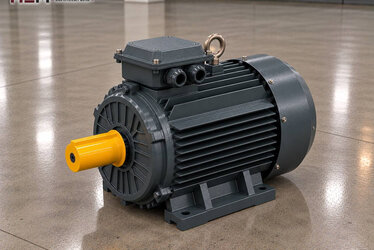
On construction sites, the energy cost of electric motors is brought down first by looking at what feeds them: on a site powered by a generator, every kilowatt-hour is paid for in diesel, so a conveyor running empty, a dewatering pump throttled by a valve or a tunnel fan turning at full speed around the clock goes straight onto the fuel bill. The second step is to size each motor to its job, manage starting current and, for motors that move from site to site, judge the efficiency class over the whole life of the fleet rather than one project. Below we go through the equipment used in excavation, foundation, tunnelling and structural work one by one.
What is the real price of a kilowatt-hour on a generator-fed site?
The real price is the diesel the generator burns, its service hours and its rental. On dam, motorway, viaduct or tunnel sites outside town, the permanent grid connection often arrives months later. In the early phase the whole load is carried by diesel generators. The cost of the energy an electric motor uses is then made up not of a grid tariff but of the generator's fuel consumption, service hours and rental fee. A large generator turning at half its capacity burns more fuel for every kilowatt-hour it produces than a smaller unit running close to full load. A big, lightly loaded generator wastes diesel.
That is why a motor list should be drawn up when the site electrical plan is prepared: which machine has how many kW, how many run at the same time, which ones also turn at night. This list stops the generator capacity from being inflated and also forms the basis of the application to the distribution company for a temporary grid connection. On the day the site switches to the grid, generator fuel drops off the bill.
On most sites, speeding up that connection has a bigger effect than any improvement made to the motors themselves.
Why does starting current make the generator bigger?
An asynchronous electric motor started by connecting it straight to the supply climbs many times above its nameplate current in the first seconds. That inrush strains the generator. When a 30–45 kW tunnel fan or the hydraulic unit of a concrete pump starts this way on site, the generator voltage collapses and the welding machines and lighting on the same line are affected. The usual fix is to hire the next size of generator up. Yet that generator then spends the rest of the day at low load, at an inefficient operating point.
With a star-delta connection, starting current and torque fall to roughly one third of their direct-on-line values (general information; confirm with the machine manufacturer). The generator copes with this surge more easily. With a soft starter or a drive, the current rises along an even gentler curve. Even a simple timer relay that starts the large motors one by one, a few seconds apart, is enough to bring the generator size down. When choosing the starting method, what decides it is how much torque the machine needs at start, in other words whether it starts with a loaded conveyor or an unloaded fan.
Why should a tunnel ventilation fan run to demand?
Reducing fan speed to match demand cuts power consumption much faster than the drop in speed, according to the fan laws (qualitative general information). In tunnels advanced by drill-and-blast or by an excavating machine, the ventilation fan pushes fresh air to the face through a duct that grows longer as the face advances. While blasting fumes are being cleared the fan must run at full capacity. During shift changes, maintenance stops or hours when only shotcrete is being sprayed, the same airflow is not needed.
If you are thinking of connecting the fan motor to a frequency converter, note this: HEM Motor's three-phase series are suitable for speed control with a drive. Where the fan is to run slowly but under load for hours, the motor's own cooling fan may not be enough and a separately powered cooling fan is added. If the panel at the tunnel portal is far from the fan, fitting a dv/dt or sine-wave filter at the drive output is considered. Stating these two conditions when you order is all it takes.
Why should dewatering pump flow be set by speed rather than a valve?
On a throttled pump the motor turns at full speed while part of the energy is turned into heat at the valve. In foundation excavations with a high water table, pumps run day and night to keep the pit dry. On centrifugal pumps installed at the surface, flow is usually adjusted by throttling a valve. Because the water level changes with the season and the depth of excavation, speed control linked to a level sensor, or bringing pumps in one after another according to level, is an effective measure here.
Submersible pumps lowered into a well belong to a different class. A drive that works under water needs a motor of its own kind. This job may fall outside the standard series in HEM Motor's 2026 catalogue. If you share the pump nameplate and the well depth, we can look at the options together. Follow the same route for machines that need a braked drive, such as the hoist drum of a tower crane or a site goods lift.
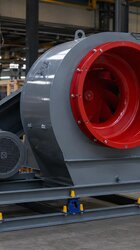
Belt conveyor drive used for carrying excavated material (representative image).
Prices and technical data are on the product pages; choose a model and order online.
Where is energy lost on conveyors, compressors and mixers?
On a construction site, most energy is lost in the hours when a machine is running but doing no work. The spoil conveyor runs empty while waiting for trucks, the air compressor keeps refilling because of leaks while the breaker gun is not in use, and the mortar mixer is left on over lunch. All of it burns diesel for nothing. Most of these losses need no investment. They are reduced with a named person, a timer and a simple rule for stopping idle machines.
Site equipment
Where the energy escapes
Practical measure
Spoil and tunnel conveyor
Running empty while waiting for trucks or excavation
Control that starts when load is detected, stop after a set waiting time
Air compressor
Hose and coupling leaks, pressure higher than needed
Weekly leak round, lowering pressure to what the tool requires
Dewatering pump
Throttled valve, oversized pump
Level-linked speed or staged start-up
Tunnel ventilation fan
Full airflow every hour
Speed adjustment according to the blasting and shift plan
Site concrete batching plant
Mixer and belts running when there are no orders
Operation according to the pour schedule, sequential start
The power of the motors in this equipment should also be reviewed. If a hired machine or one brought from another site carries a motor far larger than it needs, both efficiency and power factor drop at low load. On a generator this comes back as reactive load. Comparing models you can filter by power and speed in the HEM Motor store helps you base the replacement decision on figures.
How is the efficiency class of a motor that moves between sites assessed?
The extra cost of the efficiency class is assessed over the total time the motor will work across several sites. In contracting companies, drainage pumps, tunnel fans and belt drives go into the depot when a project ends and then move on to another site. Dividing the extra cost of choosing IE3, IE4 or IE5 over the length of the current project alone is therefore misleading. If the motor will work across several sites, the return from higher efficiency is spread over that total running time. Dewatering and ventilation motors that run day and night come out ahead in this calculation, while auxiliary machines used a few days a month fall behind. The motor that runs around the clock pays back.
The second issue with motors that move around is the mounting arrangement. Foot-mounted B3, flange-mounted B5 and B14, B34 and B35 combining feet and flange, and the vertical V1, V15, V3, V5 and V6 arrangements are supplied depending on frame size; the flange dimension is clarified when ordering.
For a motor going from one site to another, the IEC frame number is the first piece of information to check for compatibility. The final decision is made by placing the shaft end diameter and length, the distance between the foot holes, the flange and the nameplate values of the new machine side by side with the old motor. You can see the dimensions in the 2D dimension drawings arranged by frame number. The standard IP55 enclosure protection and class F winding insulation are sufficient on a dusty, rain-exposed site. An anti-condensation heater can be added at order for motors that will sit in the depot for weeks.
Which electric motors can be used for site equipment?
The models below can be used for a dewatering pump, a tunnel fan and a spoil conveyor. They are examples chosen for drive powers commonly seen on construction sites; the exact power and speed must be confirmed with the pump, fan or machine manufacturer's data.
For a surface-mounted dewatering centrifugal pump, the 15 kW 160M2-2 can be considered; it turns at a rated speed of 2945 rpm and is supplied at 400/690 V.
For the ventilation fan of a medium-length tunnel, the 45 kW 225M-4 with its cast iron frame is a suitable candidate; it runs at a rated speed of 1485 rpm.
For a spoil conveyor, mortar plant or screw compressor drive, the 11 kW 160M-4 can be considered; its rated speed is given as 1465 rpm.
Why should the motor list be added to the temporary power plan?
The motor list shows the generator size, the fuel budget and which motors should be renewed, all at once. Before a new site opens, the motor power, starting method and daily running hours of the machines going to site are collected in a single table. You can match the pump and fan motors you decide to renew by power and speed on the electric motor purchase page. If you share your site list and the nameplate photos of the old motors through the channels on our contact page, we will work out together which model fits which machine according to your site programme.
Frequently Asked Questions
Does starting motors one after another on a generator-fed site really reduce fuel?
Yes, indirectly. When large motors do not start at the same moment, a smaller generator is enough and it runs within its efficient load range for most of the day.
Is it necessary to choose a different series to run a tunnel fan from a frequency converter?
No; the standard three-phase series is suitable for speed control with a drive. If the fan will run slowly and under load for hours, a separate cooling fan comes into play, and an output filter if the panel is far away; write these into your order.
Does moving to IE4 on a dewatering pump motor make sense for a short-term site?
Yes, if the motor will also work on other sites after the project; the return from the efficiency difference is spread over the total running time. If it will be used for only a few months and then sold, IE3 is usually enough.
Can a tower crane hoist motor be chosen from the standard series?
The hoist drum needs a braked drive, and this job requires a motor of its own kind. You can ask about a suitable solution by sharing the crane nameplate and lifting details.
HEM Motor Models Related to This Article
The cards show example models related to the topic. A suitable motor is not chosen by power alone: compare speed, voltage, mounting, shaft and connection dimensions on the product page; if unsure, send a photo of the existing motor’s nameplate on WhatsApp.
When choosing an electric motor for a feed dosing screw, the real goal is for every turn of the screw to carry the same amount at low flow; to achieve this, before moving on to mot... More Details
When choosing electric motors for a corrugated board line, two groups are thought about separately: the main drives that carry line speed and the many auxiliary drives around them.... More Details
In a rubber compound mixer the electric motor carries two loads at once: the continuous torque from the high viscosity of the compound and the impact peaks that occur every batch a... More Details
On a scrap metal separation belt the electric motor is chosen by the shaft power the belt load requires and by the type of magnet unit; a magnetic head pulley adds load to the belt... More Details
An electric motor for a PET bottle crusher works, in wet crushing, against a steadier load that the water cools and lubricates, and in dry crushing against a harsher, impact-heavy ... More Details
On a cable granulator the motor carries two separate loads: the continuous cutting load as the knives on the cutting rotor chop the cable, and the sudden impacts caused by cable bu... More Details
We use necessary and optional cookies to improve your experience, enhance content and analyse traffic. Under the GDPR, optional (analytics/marketing) cookies are only used with your explicit consent. Please choose your preference below.
Cookie Policy
 English
 Français
 Türkçe
 Español
 Русский
 العربية
 Deutsch
 Italiano