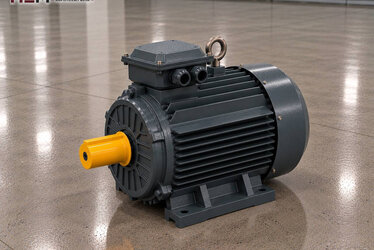
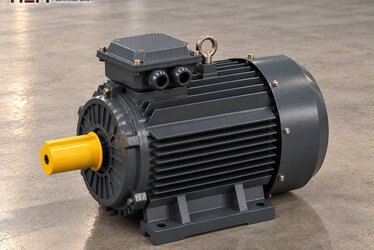
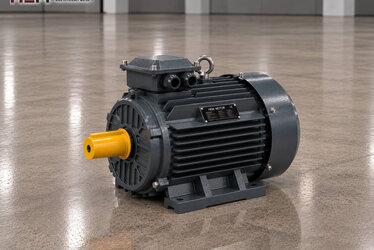
The energy cost of electric motors in crushers and mills comes down first by feeding the machine steadily and fully, and then by cutting wasted power in auxiliary drives such as fans, dust extraction and bucket elevators. The motor's efficiency class is only one part of the picture. The real loss usually hides in a crusher running empty, in worn hammers and in a fan throttled by a damper. Below we go through the machines that reduce stone, clinker, grain and feed one by one and list the items you can actually measure.
Which drives draw the electricity in a crushing and grinding line?
In size reduction, energy is spent on making particles smaller, and consumption per tonne rises sharply as the product gets finer. That is why the final grinding stage usually takes the largest share of a line, while the jaw crusher does the coarse work with comparatively little energy. Auxiliary drives look small one by one, but because they run day and night they add up to an item that cannot be ignored.
Machine
Typical duty
Load behaviour
Common source of energy loss
Jaw crusher
Primary crushing
Shock loading, fluctuating with feed
Idling when the hopper runs empty
Cone and impact crusher
Secondary and tertiary crushing
Sensitive to feed level
Crushing chamber running half empty
Ball mill
Fine grinding
Continuous, heavy starting
Wrong ball charge, worn liners
Hammer mill
Grinding feed, grain, minerals
High speed, sensitive to feed
Worn hammers, clogged screen
Roller mill
Milling flour and semolina
Steady, long running hours
Badly set roll gap, slipping belts
Extraction fan, elevator, screw
Dust collection and conveying
Steady, continuous
Damper throttling, empty conveying
How much energy does a crusher motor burn when the hopper is empty?
A crusher's electric motor draws power to turn the flywheel, eccentric shaft and bearings even when there is no stone inside. This no-load draw depends on motor rating and the machine's mechanical design; if the crusher empties several times a day, you also pay for hours that produce nothing.
Intermittent feed lowers crushing efficiency as well, because a full chamber lets stone break stone and reduces the energy spent per tonne.
A hypothetical example: a primary crusher waiting for a quarter of the shift because the feeder has stopped covers only friction and windage losses during that time. The fix is not a new motor but steadier flow through a hopper level sensor and feeder speed adjustment. Stopping the crusher during long feed gaps can be considered; however, every restart heats the winding, and the permissible starts per hour should be agreed with the machine manufacturer.
The ammeter is the least expensive measuring tool here. Logging crusher motor current together with feeder speed shows directly how long the crushing chamber is kept full.
How do ball charge and liner wear change the load in a ball mill?
In a ball mill the electric motor lifts the drum and the ball charge inside it; grinding happens as the balls fall and strike the material. When the charge is too high or too low, the cascade trajectory is disturbed, and the motor spends similar power while producing less fine product.
Worn liner plates change how high the balls are lifted and lead to the same result.
For energy tracking, kilowatt-hours per tonne should therefore be followed instead of instantaneous kilowatts. If maintenance events such as ball top-ups and liner changes are noted next to this figure, it becomes easy to see after which intervention consumption went up. Since the mill is a heavy-starting load, the starting method also needs its own decision; we come back to it below.
Ball mill drive; grinding efficiency depends on the ball charge and liner condition (representative image).
How do worn hammers and a clogged screen raise consumption in a hammer mill?
In hammer mills grinding feed and grain, the rotor spins at high speed and the product stays in the grinding chamber until it passes through the screen holes. When hammer tips wear, the material is beaten for longer; when the screen holes clog, ground product cannot leave the chamber and is broken again and again.
In both cases motor current rises while capacity falls.
Linking hammer turning and replacement intervals to the tonnage processed, and checking screens for tears and blockage at the start of each shift, keeps this loss in check. With moist grain, a properly working extraction fan on air-assisted mills also helps product flow. Options suited to drive duties in flour and feed plants are collected on the flour mill electric motors page.
Prices and technical data are on the product pages; choose a model and order online.
When does speed control pay off on extraction fans and elevators?
Fans collecting dust in the crusher house and mill aspiration fans are often oversized with a reserve margin at the design stage, and the surplus airflow is throttled with a damper. The damper reduces airflow. The motor keeps drawing almost the same power. On fans, absorbed power falls much faster than speed (affinity laws; general information, confirm with the fan manufacturer), so a frequency converter is a serious option on a fan that is permanently throttled.
Our three-phase range is suitable for speed control with a frequency converter. If the motor will run for long periods at low speed with full torque, its own shaft fan may not cool it sufficiently and a separate forced-ventilation fan may be needed; if the cable between drive and motor is long, a dv/dt or sine-wave filter is considered. Stating these operating conditions in the order is enough.
On bucket elevators and screw conveyors the gain comes less from speed control than from cutting idle running. A sequencing logic that stops automatically some time after the feed stops eliminates the consumption of an elevator carrying empty buckets all night.
Why are the starting method and reactive power a separate cost item?
As a jaw crusher flywheel or a ball mill drum accelerates from standstill, the motor draws high current for many seconds. With direct-on-line starting this current can cause voltage dips on the network and, in some plants, exceed the contracted demand. With star-delta starting, current and torque drop to roughly one third (general information; confirm with the machine manufacturer); since that torque may not be enough for a mill starting loaded, a soft starter or drive is weighed according to the machine.
The power factor of an induction motor running at low load also deteriorates. If the crusher often runs at part load, the compensation panel may struggle to cover reactive energy; in plants billed for reactive power, the compensation settings should be reviewed against the crusher's operating pattern. Cable cross-section and protective devices are calculated by the panel engineer from motor current, starting time, line length and installation conditions.
On which crusher or mill motor does an efficiency upgrade make sense?
The return on an efficient motor depends on running hours. On a seasonal crusher running a few hundred hours a year, moving up a class pays back slowly; on a ball mill running three shifts or a continuous extraction fan, the difference accumulates on every monthly bill. IE3, IE4 and IE5 efficiency classes are offered in our three-phase range; we finalise the choice for each model together with you in the order.
An oversized motor is also a loss. A crusher motor chosen one size larger in anticipation of a capacity increase runs permanently at low load, so both its efficiency and power factor drop. If a replacement is on the agenda, the measured current values and the crusher manufacturer's power recommendation should be assessed together.
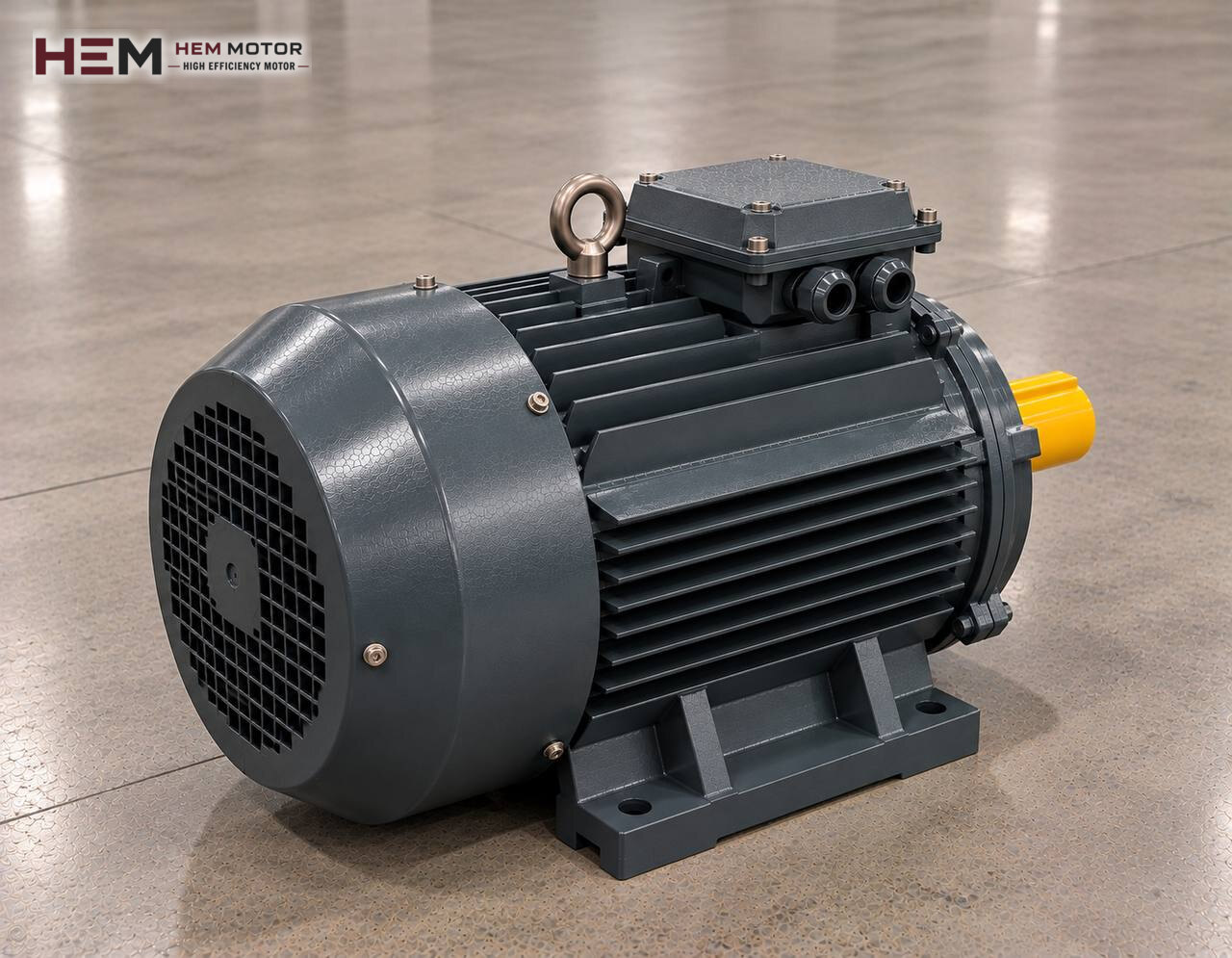
Example pairings (general suggestion; actual power must be confirmed with the machine manufacturer): for a medium-sized ball mill or secondary crusher, the 75 kW cast iron 280S-4 with a rated speed of 1486 rpm; for a hammer feed mill or cone crusher, the 45 kW, 1485 rpm 225M-4; for extraction fans and bucket elevators, the 15 kW, 1465 rpm 160L-4. All three are rated 400/690 V, with IP55 protection and class F insulation.
Crusher and mill motors are mostly foot-mounted with belt and pulley; the B3, B5, B14, B34, B35 and vertical V1/V3/V5/V6/V15 designs needed for geared screws and feeders are offered according to frame size, and the flange size is confirmed in the order.
The IEC frame number gives a first indication of mechanical fit with the existing motor; for a firm decision, the shaft, foot hole spacing, flange and electrical data are compared, and the dimensions are on the technical drawings page. Vibrator motors on vibrating screens and feeders, as well as brake drives, need a special motor; as these duties may fall outside the standard range in our 2026 catalogue, please consult us with the nameplate and application details.
Why start the crusher house energy plan with measurement?
The sequence can be kept simple: first crusher and mill currents are logged together with feed, then fans throttled by dampers and idling conveyors are listed, and finally efficiency class and motor size are addressed. This order separates corrections that cost nothing from those that need investment.
If you share the nameplate and annual running hours of the crusher, mill or fan motor you plan to renew via the nameplate submission page, we can weigh up a sensible counterpart in terms of efficiency class and power together.
To compare ready models side by side, the shop page can be filtered by power and speed.
Frequently Asked Questions
Does a crusher consume electricity when running empty?
Yes. The motor draws power to turn the flywheel, eccentric shaft and bearings even without stone; on a crusher that empties often, these periods add up to significant consumption.
Which indicator shows the energy status of a ball mill most quickly?
Kilowatt-hours per tonne. If this value is tracked together with the dates of ball top-ups and liner changes, it becomes clear when grinding efficiency deteriorated.
Does fitting a frequency converter to a hammer mill save energy?
Because rotor speed directly affects product fineness, changing the speed of the mill itself is a process decision. The energy return of speed control is usually more evident on the extraction fan in the same line.
Is it always sensible to move a crusher motor up one efficiency class?
No, it depends on annual running hours. On a seasonal crusher the payback is long; on continuously running mills and fans a higher class pays back faster.
HEM Motor Models Related to This Article
The cards show example models related to the topic. A suitable motor is not chosen by power alone: compare speed, voltage, mounting, shaft and connection dimensions on the product page; if unsure, send a photo of the existing motor’s nameplate on WhatsApp.
An electric motor suited to harsh conditions in mining is one that can run without overheating or losing its insulation while dust, vibration, moisture, temperature swings and heav... More Details
An electric motor suited to the harsh conditions of cement and building materials plants is one that can withstand fine clinker and raw meal dust, high ambient temperature around t... More Details
In cement and building materials plants, the switch to IE3 and IE4 electric motors starts with the drives that never stop as long as the kiln runs: bag filter and kiln ID fans, cli... More Details
When moving crushers and mills to IE3 and IE4 electric motors, the first question is how long the machine actually spends crushing material: a grinder that turns at steady load all... More Details
Switching to IE3 and IE4 electric motors in mining operations does not mean replacing every motor at once; it is a renewal plan that starts with the drives running the most hours u... More Details
A spare electric motor plan for a crushing and milling line means finding which machines cut off the entire flow when they stop, and then setting up either a ready motor on the she... More Details
We use necessary and optional cookies to improve your experience, enhance content and analyse traffic. Under the GDPR, optional (analytics/marketing) cookies are only used with your explicit consent. Please choose your preference below.
Cookie Policy
 English
 Français
 Türkçe
 Español
 Русский
 العربية
 Deutsch
 Italiano