In cement and building materials plants, the switch to IE3 and IE4 electric motors starts with the drives that never stop as long as the kiln runs: bag filter and kiln ID fans, clinker cooler fans, separators and air slide blowers. On these motors, which run loaded 7,500–8,000 hours a year, even a single-point improvement in efficiency turns into thousands of kilowatt-hours every year. Intermittent drives such as the quarry belt, the packing machine and the cutting table in a brick plant go to the end of the list and are renewed together with a failure or overhaul.
Motors that turn as long as the kiln turns: where does energy go in a cement plant?
In an integrated cement plant, most of the electricity is spent on grinding and gas handling. The raw mill, coal mill and cement mill form the grinding side; the kiln ID fan, cooler fans and filter fans form the gas side. Alongside these there are bucket elevators, air slide blowers, rotary feeders and dozens of small screw conveyors.
The kiln stops once a year, usually during the winter overhaul. The rest of the time the fans on the gas line and the clinker conveying drives run continuously. Mills, on the other hand, may be run heavily at night and less at peak hours depending on the electricity tariff. So two motors with the same installed power can show very different figures on the annual meter: one 8,000 hours, the other 5,000.
The switching order is therefore set by annual energy, not by power.
Why do the large mill drives stay outside this list?
The reason is the size of these drives. The main drives of raw and cement mills and the kiln rotation motor are often megawatt-class, medium-voltage units designed together with a special gearbox. Renewing these drives is a separate project carried out with the mill or kiln manufacturer. The low-voltage series in HEM Motor's 2026 catalogue should not be planned as replacements for these main drives.
The real field for the switching programme is the auxiliary drives supplied at 400 V: fans, blowers, elevators, separator motors, compressors and pumps. In a plant they number in the hundreds, and their total energy is large enough to rival the main mills.
How many kilowatt-hours is a one-point efficiency gap worth on a bag filter fan?
Take the bag filter fan at the cement mill outlet. Assume the fan draws an average of 110 kW at the shaft and the plant runs this mill 8,000 hours a year. A motor with 95.6 percent efficiency draws 110 / 0.956 ≈ 115.1 kW from the grid, while one with 96.6 percent efficiency draws 110 / 0.966 ≈ 113.9 kW.
The difference is about 1.2 kW. Multiplied by 8,000 hours, it gives a gap of around 9,500 kWh a year. Multiplying this by the unit price in your own tariff gives the annual amount, and comparing it with the motor price difference gives the payback period. The efficiency values here are only examples. Actual values should be taken from the nameplate and data sheet of the model to be ordered.
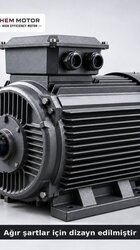
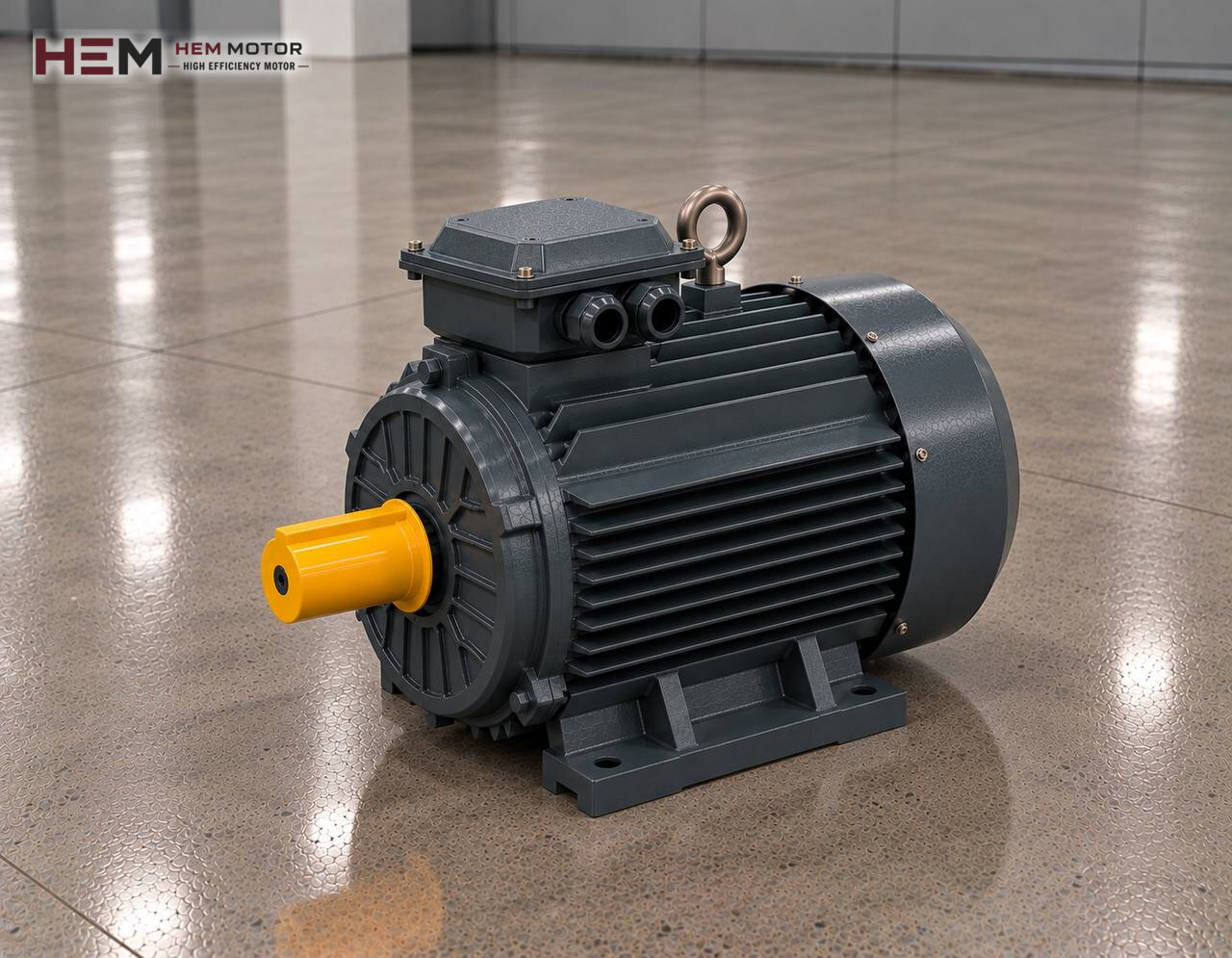
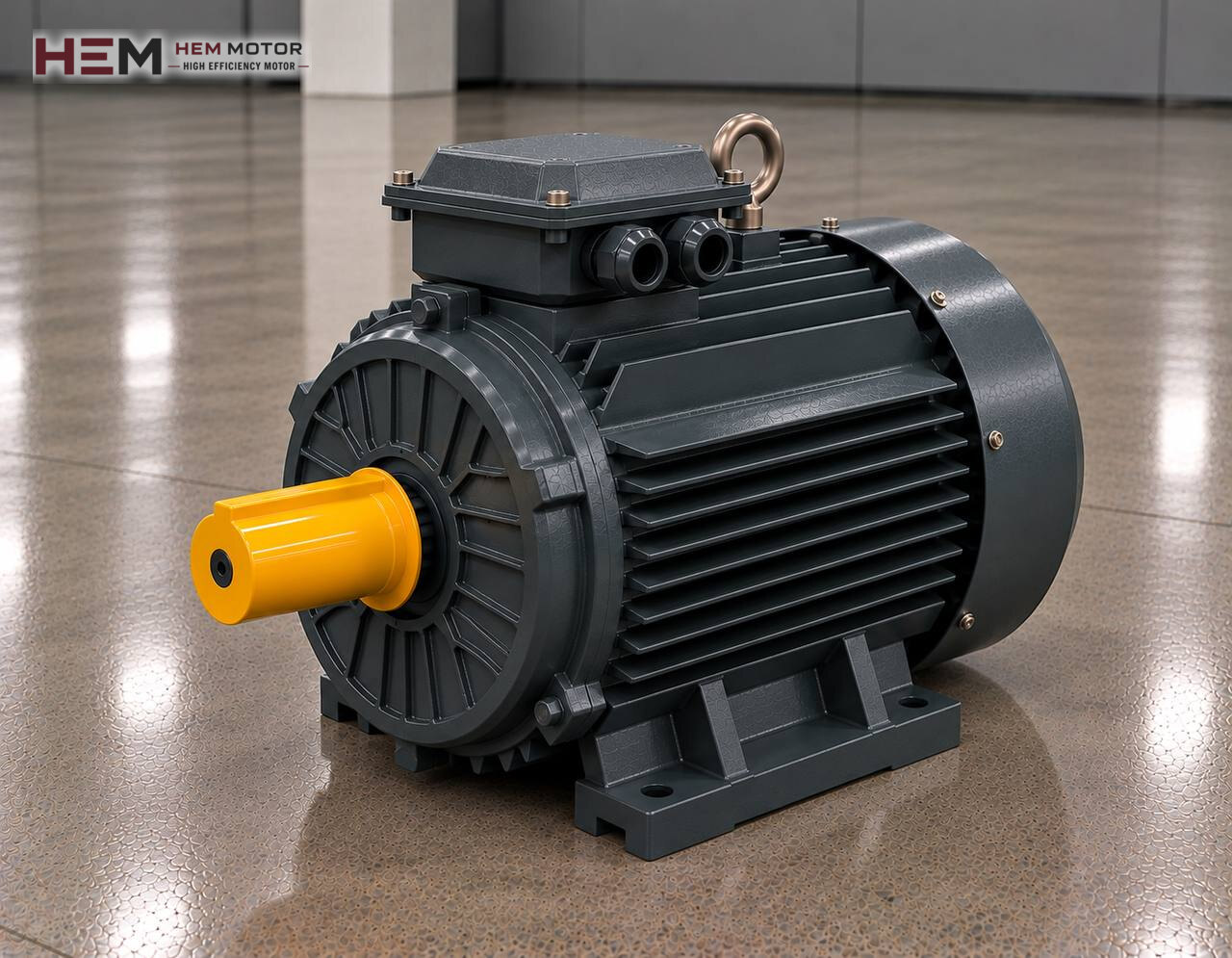
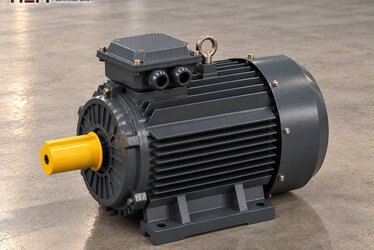
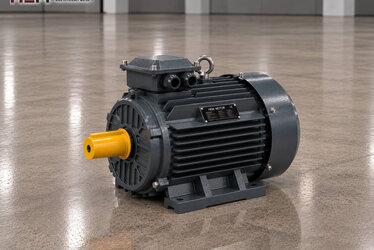
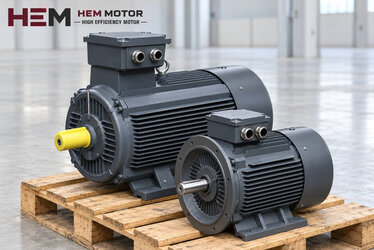
Auxiliary drive motors in a cement plant (representative image).
What does a speed increase upset on the clinker cooler and kiln ID fan?
Higher-efficiency motors usually have slightly less rotor slip. The new motor may turn a few rpm faster than the old one. Since the power a centrifugal fan demands grows with the cube of speed, this small increase pushes the fan to deliver a little more air and therefore to load the motor more. On a damper-controlled cooler fan the operator absorbs the difference by closing the damper slightly, but part of the saving is lost that way.
A large share of kiln ID fans and cooler fans already run on frequency converters. On these fans speed is tied to process control, so the slip difference corrects itself and the gain from the efficiency class shows more clearly. On a damper-controlled fan, adding a drive first often brings a bigger saving than raising the efficiency class. Doing both in the same shutdown makes the most sense.
Where do elevators, separators and air slide blowers stand in the ranking?
These three groups sit on the middle step of the ranking. Bucket elevators carry raw meal to the silo, clinker from the cooler to storage and cement from the mill to the silo. They turn whenever the mill turns. Dynamic separators also turn with the mill, and since their speed sets fineness, almost all of them run on drives. Air slide blowers used in silos and the packing feed line are small in power but numerous.
In this group the switch is made when a motor fails or when the rewinding cost approaches the price of a motor. A sound motor keeps waiting. Removing a sound 18.5 kW elevator motor purely for efficiency is usually an investment with a long payback. Buying IE3 or IE4 to replace a failed motor, however, is a choice with small extra cost and a lasting gain. Options for elevators and screw conveyors are listed in the belt and conveying motors group.
Prices and technical data are on the product pages; choose a model and order online.
How does the ranking change in brick, tile and precast concrete plants?
In brick and tile plants the longest-running drives are the tunnel kiln and dryer fans. The vacuum extruder, clay preparation rolls and cutting tables run by shift. So fans are again at the top of the list.
In ready-mix and precast element plants, the mixer drum, the belt carrying aggregate and the screw under the silo start and stop frequently during the day. With low annual hours, the effect of the efficiency class is limited. Here starting torque and durability come to the fore. Motors for such plants are gathered under concrete plant drives.
Crushers working in the aggregate quarry and the clinker crushing unit are assessed in a similar way; for these, see the options on the crusher motors page.
What do cement dust and kiln hall heat demand from the new motor?
They demand regular frame cleaning, power selection corrected for temperature and suitable protective equipment. When cement dust meets moisture it hardens between the cooling fins on the frame and blocks the fan cover grille. A dirty frame takes back the advantage of a high-efficiency motor as winding temperature. Linking fan cover and frame cleaning to routine maintenance should therefore also be part of the switching programme. Motors around the kiln and cooler also run at high ambient temperature; at these points power selection should follow the manufacturer's temperature derating.
On the standard frame, protection is IP55 and winding insulation class F. IP56 can be requested in places such as the wash-down area under the packing plant and the open storage hall; an embedded PTC sensor to monitor winding temperature is also added at the order. If a separator or fan motor is to turn slowly on a drive for hours, a separately powered fan instead of its own fan should be discussed. A long MCC cable calls for a dv/dt or sine filter.
How is a new-class motor chosen to replace the removed fan motor?
The new-class motor is chosen with the same IEC frame number as the old one. The frame number alone is not enough. Foot or flange construction, shaft dimensions, foot hole positions, flange type, terminal box orientation and the current and voltage values on the nameplate must be compared one by one with the old motor. Foot-mounted B3, flange-mounted B5 and B14, combined B34 and B35 and vertical V1, V3, V5, V6, V15 constructions can be supplied depending on frame size; the flange dimension is finalised at ordering. For dimensional details, see the technical drawings.
Sample electric motors for cement and building materials plants
The matches below are for typical tasks; the choice of IE3, IE4 or IE5 is written in the order, and actual power should be compared with the motor inventory in your plant. The full cast iron range is sorted by power and speed in our electric motor shop.
For gas line drives around 132 kW, such as the cement mill bag filter fan, the 4-pole cast iron 315M-4 can be considered; it runs at a rated speed of 1488 rpm and is supplied at 400/690 V.
For one of the clinker cooler fans, the 55 kW cast iron 250M-4 is a suitable candidate; its rated speed is 1485 rpm.
For a raw meal or cement bucket elevator, the 18.5 kW cast iron 180M-4 is worth considering; it turns at 1470 rpm.
Other ratings suitable for kiln and filter fans are found in the fan and extractor motors group.
When should motor replacement be done?
The best time for motor replacement in a cement plant is the annual overhaul, when the kiln is cold. A few months before the overhaul, listing the gas line fans, cooler fans and large blowers and writing down each one's annual running hours and measured current makes clear which motors will be changed in this shutdown. For intermittent drives a note in the failure records is enough. That motor will be replaced with a higher class at its next failure.
If you send nameplate photos and running hours of your plant's motors through the find-an-equivalent-from-nameplate page, we can work out with you the frame and which IE class makes sense for each drive on the overhaul list. You can filter ratings outside the list by kilowatt in the HEM Motor product catalogue.
Frequently Asked Questions
Which motor should an IE4 switch start with in a cement plant?
Start with the gas line fans that run the most loaded hours per year: bag filter, kiln ID and cooler fans. Intermittent belt and packing drives are renewed upon failure.
Does the main mill drive also enter this programme?
Megawatt-class medium-voltage main drives are a separate project. They should be handled together with the mill manufacturer.
What should be done if the new motor turns the fan faster?
Because slip is lower, speed may rise by a few rpm. On a drive-controlled fan this corrects itself; on a damper-controlled fan, flow and current should be checked after commissioning.
Does cement dust affect a high-efficiency motor?
Dust building up on the fins impairs cooling and heats the winding. The fan cover and frame should be cleaned regularly.
HEM Motor Models Related to This Article
The cards show example models related to the topic. A suitable motor is not chosen by power alone: compare speed, voltage, mounting, shaft and connection dimensions on the product page; if unsure, send a photo of the existing motor’s nameplate on WhatsApp.
An electric motor suited to harsh conditions in mining is one that can run without overheating or losing its insulation while dust, vibration, moisture, temperature swings and heav... More Details
An electric motor suited to the harsh conditions of cement and building materials plants is one that can withstand fine clinker and raw meal dust, high ambient temperature around t... More Details
When moving crushers and mills to IE3 and IE4 electric motors, the first question is how long the machine actually spends crushing material: a grinder that turns at steady load all... More Details
Switching to IE3 and IE4 electric motors in mining operations does not mean replacing every motor at once; it is a renewal plan that starts with the drives running the most hours u... More Details
A spare electric motor plan for a crushing and milling line means finding which machines cut off the entire flow when they stop, and then setting up either a ready motor on the she... More Details
Spare electric motor planning in mining operations means determining how much production would be lost, and for how long, if each drive at the mine stopped, and deciding in advance... More Details
We use necessary and optional cookies to improve your experience, enhance content and analyse traffic. Under the GDPR, optional (analytics/marketing) cookies are only used with your explicit consent. Please choose your preference below.
Cookie Policy
 English
 Français
 Türkçe
 Español
 Русский
 العربية
 Deutsch
 Italiano