Spare Electric Motor Planning in Mining Operations

Spare Electric Motor Planning in Mining Operations

Spare electric motor planning in mining operations means determining how much production would be lost, and for how long, if each drive at the mine stopped, and deciding in advance on that basis which motor will wait ready on the shelf, which will be covered from a common frame group and which requires special procurement. A belt or dewatering pump motor that fails at a remote site can halt the whole chain until its replacement is on the road. Spare decisions at a mine reach from the ore line to mine water, from ventilation to the workshop.

If a motor stops at a remote site, which link in the chain breaks?

In a mining operation, electric motors do not work alone but as a linked chain. In an open pit, material from drilling and blasting goes to the feeder, then to the primary crusher, belts, screens and stockyard; underground, the sump pumps and the main ventilation fan are added. When one link breaks, every unit before it must also stop within a short time.

Unlike a factory, mines are often far from towns, roads become difficult with the seasons and getting to the site can take hours. For this reason a spare plan at a mine must be built not only on the question “which motor fails” but also on “if it fails, how many hours until the replacement is on site”. Some drives are also directly linked to safety: when the mine water pump or the ventilation fan stops, the priority becomes the crew underground, not production.

Which priority classes do mine motors fall into?

Ore flow gives four classes: safety-critical, line-critical, shareable within a group and deferrable. The first step in building a sound spare list is to list every motor on site with its nameplate and classify each by the impact of its stoppage. The table below offers a sample classification for a mine; each operation should rearrange it according to its own flowsheet.

Priority classExample drivesSpare approach
Safety criticalMain mine water pumps, main underground ventilation fanA second unit running on site or a motor ready for installation
Line criticalPrimary crusher, main ore belt, mill feed beltA ready spare of the same frame on the shelf
Shareable within a groupScreen drives, transfer belts, flotation agitatorsOne spare covering several drives with a common frame and speed
DeferrableWorkshop compressor, washing pumps, sample preparationProcurement after failure, nameplate data kept ready

In the safety-critical group, even leaving a spare motor on the shelf is sometimes not enough; a second pump or fan must be connected and tested on site. In the line-critical group, preparing the base, coupling and cable connection in advance is decisive for shortening motor change time.

For pumps and fans a shelf motor may not be enough. The second unit must be connected and tested.

Why rely on the same frame for crusher, belt and mill drives?

A common frame lets one shelf motor cover a whole group. Because machines are bought from different suppliers over the years, motors of the same power but with different frames, shafts and mounting types can accumulate at a mine site. Keeping a separate spare for each is heavy in terms of both storage and capital. The solution is to gather motors into a few common power-frame groups whenever a renewal opportunity arises: for example, if all transfer belts run at the same kilowatt and the same speed with the same IEC frame number, a single motor on the shelf protects the entire group.

When standardising, mounting fit should be checked carefully. B3, B5, B14, B34, B35 and vertical V1, V3, V5, V6, V15 arrangements are offered depending on frame size; the flange size is confirmed with the order. The IEC frame number is the first indicator of fit, but two motors should not be assumed interchangeable until shaft diameter and length, foot hole spacing, flange and nameplate values have been compared. For dimensions by frame you can use the technical drawings. To see power and frame groups for crusher and screening drives, the crusher and stone crushing motors page is a good starting point.
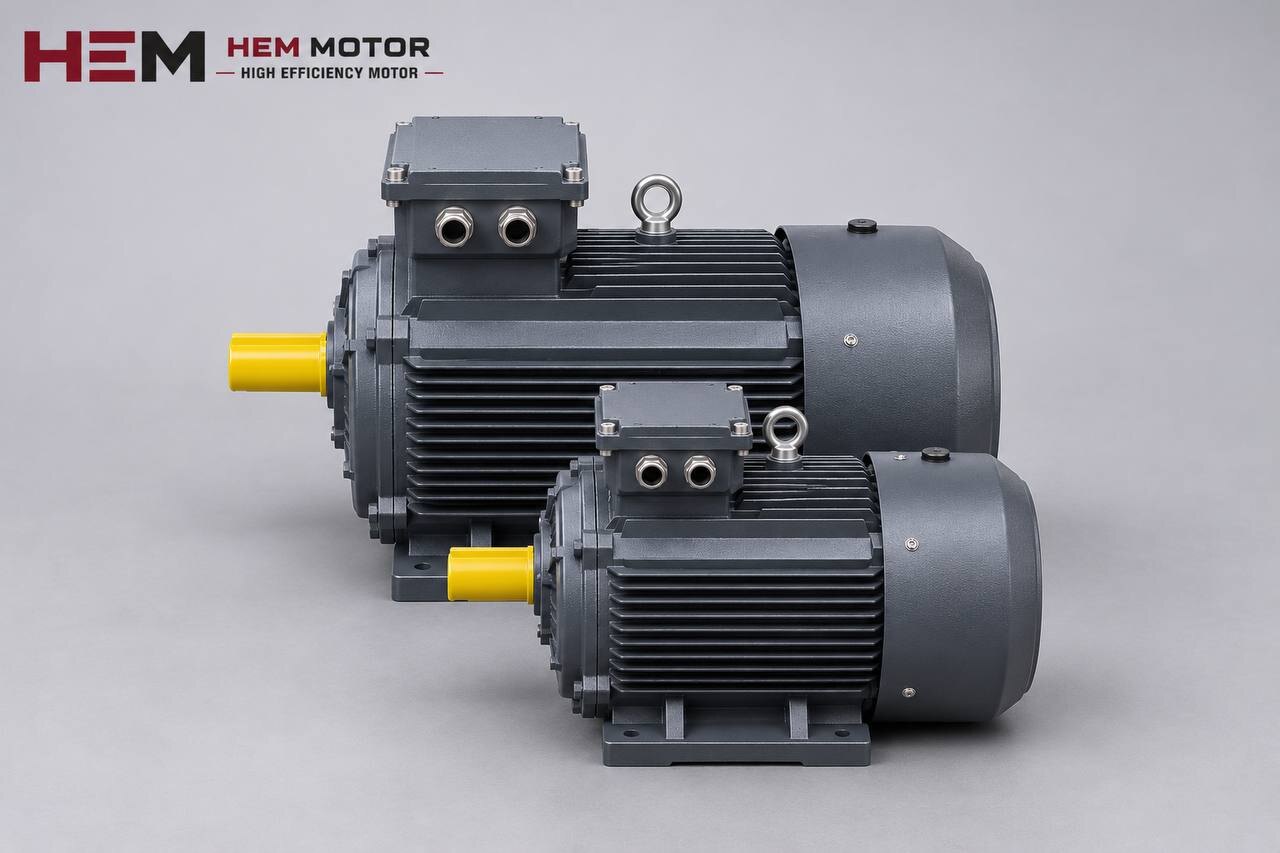
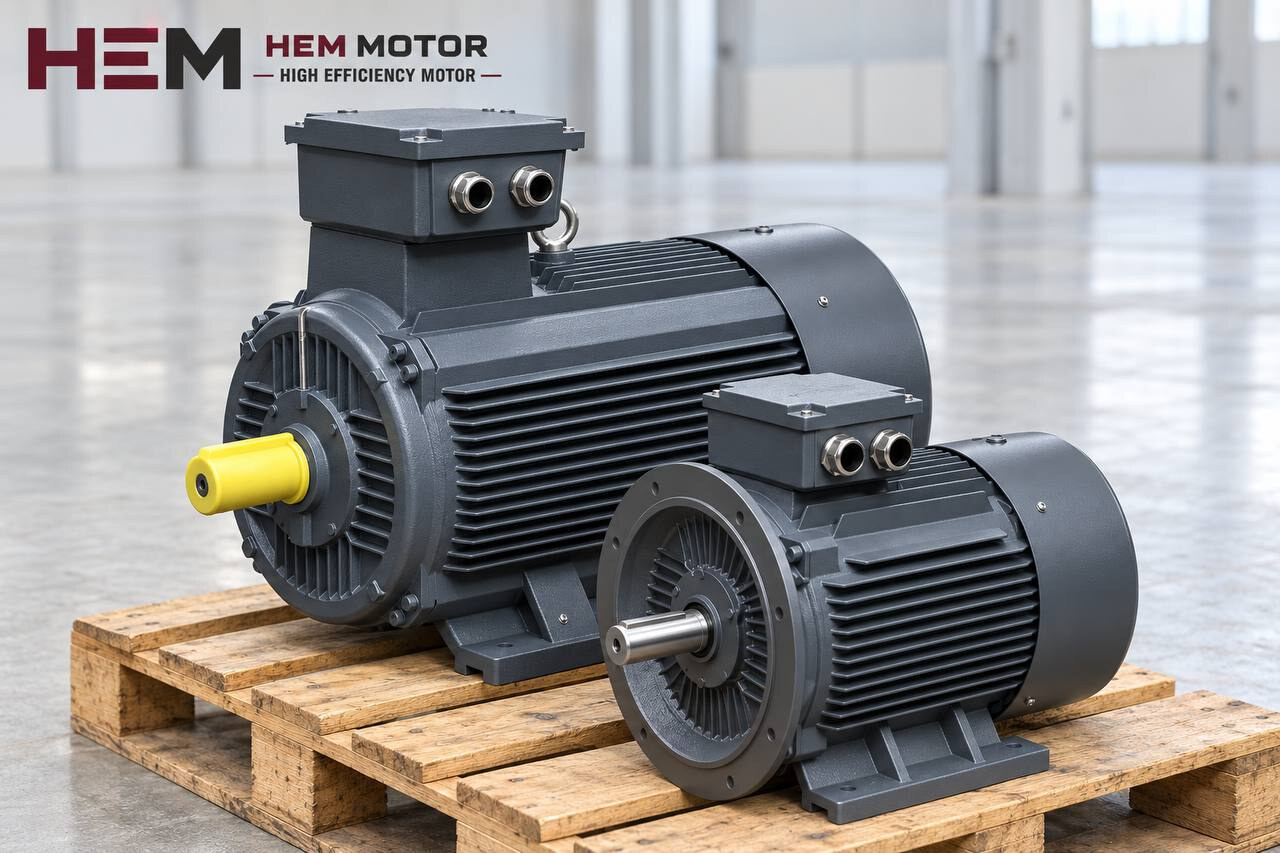
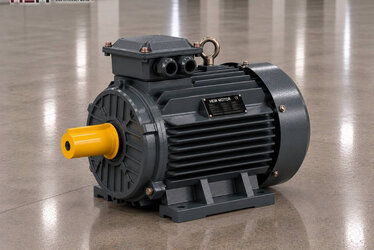
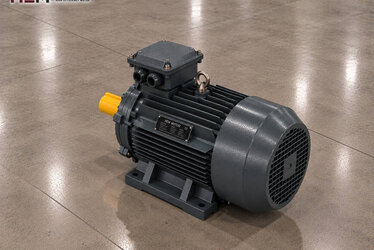
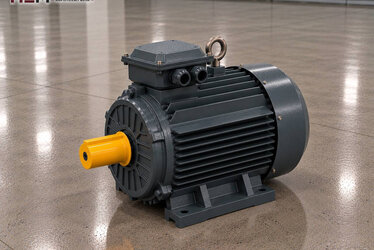
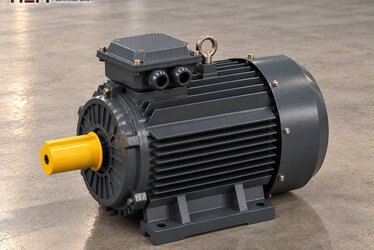
Three-phase electric motors in two different frame lengths for a mine site spare plan
Common frame groups reduce the number of spares: three-phase electric motors in two different frame lengths (representative image).

A second unit or a shelf motor for the mine water pump and main fan?

In underground mines, the pumps lifting mine water to the surface and the main ventilation fan are the drives least tolerant of downtime. Here the spare decision is not only about the motor: the pump station usually has a duty-standby arrangement, and the two units are run alternately at regular intervals. This way the standby unit's bearings and gland do not deteriorate during long waits, and it has been proven that it will actually run when needed.

Where a second unit cannot be installed, a motor is kept on the shelf; this motor should have its coupling half fitted, cable lugs ready and an up-to-date insulation measurement. Submersible pumps lowered into a shaft, or drives working in zones with an explosive gas risk, require a special motor; such a duty may fall outside the standard series in HEM Motor's 2026 catalogue, so consult us with the existing motor's nameplate and operating environment. In operations where the main fan is driven by a frequency converter, the spare motor must also be prepared for this use. HEM Motor's three-phase series are suitable for drive operation; if the motor will run at low speed under full load for long periods an external fan is considered, and if there is a long cable between drive and motor a dv/dt or sine filter is evaluated, and this information is passed on with the order.

Submersible pumps and gas-zone drives need special motors. Consult us with the nameplate.
Prices and technical data are on the product pages; choose a model and order online.

How is a spare stored in a dusty, damp warehouse kept ready to run?

A dry shelf, a shaft end protected from rust and regular turning by hand keep the spare ready. Warehouses at mine sites are usually dusty, and cold and damp in winter. Moisture settles into the winding of a motor that waits in its crate for months, and stationary bearings can be marked by shocks from vibrating floors. Placing spare motors on a dry shelf away from floor vibration, protecting the shaft end against rust and turning the shaft by hand every few weeks reduce these risks.

Hanging a card on each spare motor showing which drives it suits prevents confusion on the day of a breakdown. After a long wait, insulation resistance must be measured before installation and the motor dried if necessary. For sites with long winter shutdowns an anti-condensation heater can be added to the order; operations wanting to monitor winding temperature can also consider the PTC or PT100 sensor option. Standard IP55 enclosure protection is a good baseline against mine dust; at points washed with pressurised water, IP56 can be considered as a special order. You can compare power and speed options for models to keep on the shelf in our store by frame material.

How can the motor change be sped up on the day of failure?

A short change card prepared for each critical drive speeds up the job. Having a spare motor on the shelf does not mean the change will be quick. At mines, most time is lost transporting the motor, removing the old one and aligning. A short change card should be prepared for each critical drive: which crane or forklift will be used, which tool removes the coupling, which alignment method is used, whether the connection is star or delta.

At the first start after the change, direction of rotation, current and vibration should be checked and the results entered in the shift log. Cable cross-section and protective device settings are determined by the operation's electrical engineer according to motor power, line length, starting method and ambient temperature; if the spare motor has a different power, these settings must be reviewed again. For a general overview of mining drives you can also look at the mining sector electric motor page.

Which spare models can serve as examples for a mine site?

The 280S-4 for the main belt, the 200L-4 for transfer belts and the 180M-4 for agitators are good examples. The models below are chosen as examples based on power ratings often seen at a medium-sized open pit and processing plant. The final choice should be made with the existing motor's nameplate and the machine manufacturer's data.

  • For the main ore belt after the primary crusher or the mill feed drive, the 75 kW 280S-4 with a rated speed of 1486 rpm can be kept on the shelf; it is supplied at 400/690 V.
  • As a common spare for transfer belts and vibrating screen drives, the 30 kW 200L-4 can be considered; its rated speed is 1475 rpm.
  • For flotation agitators, washing pumps and stockyard belts, the 18.5 kW 180M-4 can be a shareable spare; it runs at a rated speed of 1470 rpm.

When should the spare list be completed?

The list should be finished before the next planned shutdown. The annual maintenance shutdown is the best time to test spare motors, prepare their bases and move to standard frame groups. Updating the nameplate inventory and identifying gaps by the four priority classes before the shutdown makes the shutdown week productive. You can find equivalents for missing spares by power and speed in the HEM Motor electric motor store. For a crusher or belt motor nameplate made unreadable by dust and mud, follow the photo steps on the page for finding an equivalent from the nameplate, and let us settle your mine's spare shelf together.

Frequently Asked Questions

Is a separate spare needed for every motor at a mine?

No. When motors are gathered into common power, speed and frame groups, a single spare can protect several drives; safety-critical drives are assessed separately.

Is keeping a motor on the shelf enough for the mine water pump?

In most cases a second pump unit connected on site and run alternately is safer. If a shelf motor is kept, it should be ready for installation with its insulation measured.

How often should a spare motor on the shelf be checked?

The shaft should be turned by hand every few weeks and insulation resistance must be measured before installation. If the warehouse is damp, drying and condensation measures are needed.

Can a standard motor be used as a spare in an underground zone with explosive gas risk?

No, such zones require a special motor. You should consult us with the existing motor's nameplate and environment details.

HEM Motor Models Related to This Article

The cards show example models related to the topic. A suitable motor is not chosen by power alone: compare speed, voltage, mounting, shaft and connection dimensions on the product page; if unsure, send a photo of the existing motor’s nameplate on WhatsApp.

75 kW 1500 rpm Cast Iron Frame Electric Motor 280S-4

280S-4

75 kW · 1500 rpm

  • Cast iron frame · IEC 280S
  • 1486 rpm · IP55
  • Mounting: B3 foot; flange (B5/B14/B35) depending on frame, confirmed with the order

US$2,860.77 (€2,618.24)

View product
30 kW 1500 rpm Cast Iron Frame Electric Motor 200L-4

200L-4

30 kW · 1500 rpm

  • Cast iron frame · IEC 200L
  • 1475 rpm · IP55
  • Mounting: B3 foot; flange (B5/B14/B35) depending on frame, confirmed with the order

US$1,211.23 (€1,108.54)

View product
18.5 kW 1500 rpm Cast Iron Frame Electric Motor 180M-4

180M-4

18.5 kW · 1500 rpm

  • Cast iron frame · IEC 180M
  • 1470 rpm · IP55
  • Mounting: B3 foot; flange (B5/B14/B35) depending on frame, confirmed with the order

US$856.68 (€784.05)

View product

Similar Articles