English
 Français
 Türkçe
 Español
 Русский
 العربية
 Deutsch
 Italiano


In mining operations, the energy cost of electric motors is cut by starting with the three consumers that inflate the bill most: underground main ventilation fans, the dewatering pumps that lift mine water to the surface, and the grinding and flotation drives in ore processing. In these three groups, linking speed to demand, reducing the hours spent idling and at part load, and managing reactive power and peak-hour consumption pay off before any motor is replaced. Motor renewal comes later. The next step is to reassess the efficiency class and power of motors that run day and night.
Where do the kilowatt-hours on a mine's bill go?
In an underground coal or metal mine, the breakdown of electricity consumption differs clearly from that of an open pit and a processing plant. Underground, main fans and pumps run 24 hours a day; even when production stops, the workings must be ventilated and water must be pumped out. In an open pit, the crusher, belt and screen line follow the shift pattern; in the processing plant, mills, flotation cells, thickeners and slurry pumps turn under constant load.
Before starting an energy study, the motor inventory should be split by these three areas, with each motor's power, annual running hours and actual load placed side by side. A few days of current and power logging at the panel or transformer outlet shows far more clearly than any estimate which drive accounts for most of the consumption. Estimates mislead here. The inventory also becomes the basis for every investment decision made later.
| Mine area | Large consumers | Operating pattern | First thing to check |
|---|---|---|---|
| Underground workings | Main and auxiliary ventilation fans, mine water pumps | Continuous, also outside production | Linking airflow to shift and manning levels |
| Open pit | Primary crusher, long belts, screens | Shift-based, frequent stop-start | Belts running empty and a crusher left without feed |
| Ore processing | Ball mill, flotation agitators, slurry pumps | Continuous, high load | Mill filling ratio and pump throttling valves |
| Auxiliary facilities | Compressed air compressors, workshop, canteen and offices | Mixed | Air leaks and unnecessarily high pressure |
How is airflow linked to the shift on the underground main fan?
When people and machines underground decrease, airflow is reduced within the limits allowed by gas measurements. For most mines the main ventilation fan is on its own the largest electricity consumer, and it is usually set to deliver the same airflow every hour. Yet on the night shift, on maintenance days or when some panels are closed, the number of people and machines underground falls. At night the workings need less air.
Reducing airflow to demand, within the limits allowed by regulations and gas measurements, cuts consumption far more than the reduction in airflow itself, according to the fan laws (qualitative general information; confirm with the ventilation engineer).
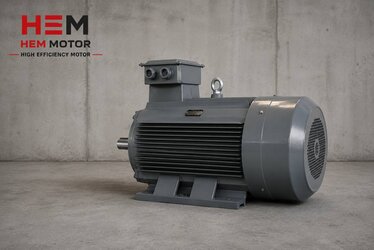
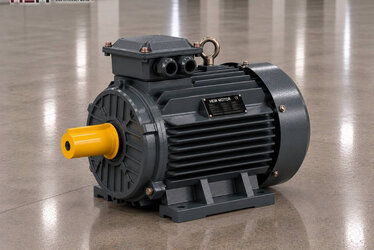
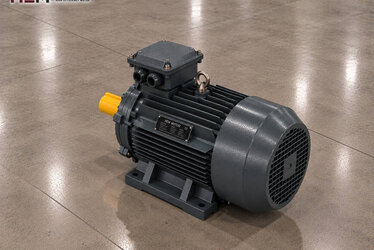
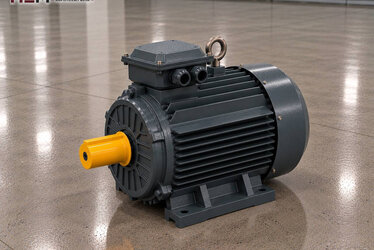
If you want to manage airflow by speed rather than blade angle, the fan motor is connected to a frequency converter; HEM Motor's three-phase series are suitable for this kind of drive operation.
Where the fan is to run slowly but under strain for weeks, the motor's own fan may not provide enough cooling and a separately powered fan unit is added. If the drive stays in the transformer building at the surface while the fan is installed far from the shaft collar, fitting a dv/dt or sine-wave filter at the output becomes a consideration because of the cable length; it is enough to state these conditions in your order.
In sections with firedamp or explosive dust risk, however, the fan needs a motor of its own kind, and this job may fall outside the standard series in HEM Motor's 2026 catalogue; send us the zone classification and the nameplate of the existing motor.
How are head, stages and night tariff assessed on mine water pumps?
The pump is matched to the actual water inflow and the sumps are emptied before peak hours. In deep mines, water is pumped hundreds of metres upwards through staged pump stations, each stage filling the tank of the next. The water inflow on the day the pumps were selected is often not the same as today's; if a pump has been left larger than needed, flow is throttled with a valve. Part of the motor power is wasted this way. By re-measuring head and flow, the impeller diameter or speed of the pump can be matched to the actual need.
The volume of the sumps at the mine bottom and at intermediate levels also makes it possible to choose when the pumps run. In operations on time-of-use tariffs, the sumps are emptied before peak hours, the pumps are kept on standby during the peak and are brought back in during the night. This approach lowers the unit price rather than the number of kilowatt-hours and requires no change to the pump motor. Power options for pump drives are summarised on the mining sector electric motor page.
How is the energy of mill and flotation drives in processing reduced?
Ball additions are linked to power measurement and oversized motors are stepped down at renewal. The ball mill is the highest-power drive in a processing plant. It is the first place to look. The power the mill draws depends on the ball charge, ore hardness, feed size and pulp density; when the charge runs low or the feed becomes coarser, more energy is spent for the same tonnage.
Linking ball additions to power measurement rather than the calendar and regularly checking the crusher product size bring down the energy the mill motor uses for each tonne of ore.
The agitators and air blowers in the flotation cells, thickener rakes and slurry pumps may look small one by one, but they are numerous and all run continuously. On these drives the motor is often found to be working far below its rated power. At low load, efficiency and power factor fall together. When their turn for renewal comes, stepping down oversized motors identified by measurement to the next lower power reduces both the reactive power drawn from the grid and the operating cost.
How are empty running and loaded starts reduced on open pit belts?
Feed is linked to bunker level and the belts are stopped in reverse order once material runs out. In open pits, the belts running from the primary crusher to the stockpile or plant can be kilometres long. When truck flow is interrupted the crusher empties, but the belt line keeps running. If the line is stopped at the end of the shift without being emptied, the next morning brings a heavy start with a loaded belt.
Feed linked to bunker level, and stopping the belts in reverse order once material runs out, reduce both empty running and the current surge that comes with a loaded start.
On long belts, soft starting extends the life of the belt and pulley and also reduces the sudden load on the transformer.
Drive options for long belt lines are grouped under conveyor belt electric motors, while powers suited to primary and secondary crushers are collected on the crusher and stone crushing motors page. All models for sale, filterable by power and speed, are listed in the HEM Motor store.