Fitting a Replacement 55 kW Electric Motor to the Existing Base

Fitting a Replacement 55 kW Electric Motor to the Existing Base

When replacing a 55 kW motor, the electrical side rarely causes trouble: power, speed and voltage can be read from the nameplate. What drags the job out is whether the new motor will sit on the base, frame or concrete plinth left by the old one. On a motor of this size, if the foot holes are off by a few millimetres you have to drill the base, weld on an adapter plate or rebuild the coupling alignment from scratch, and that can stretch downtime by days. In this article we use HEM Motor's three 55 kW models as examples and explain, step by step, how to check base compatibility before ordering.
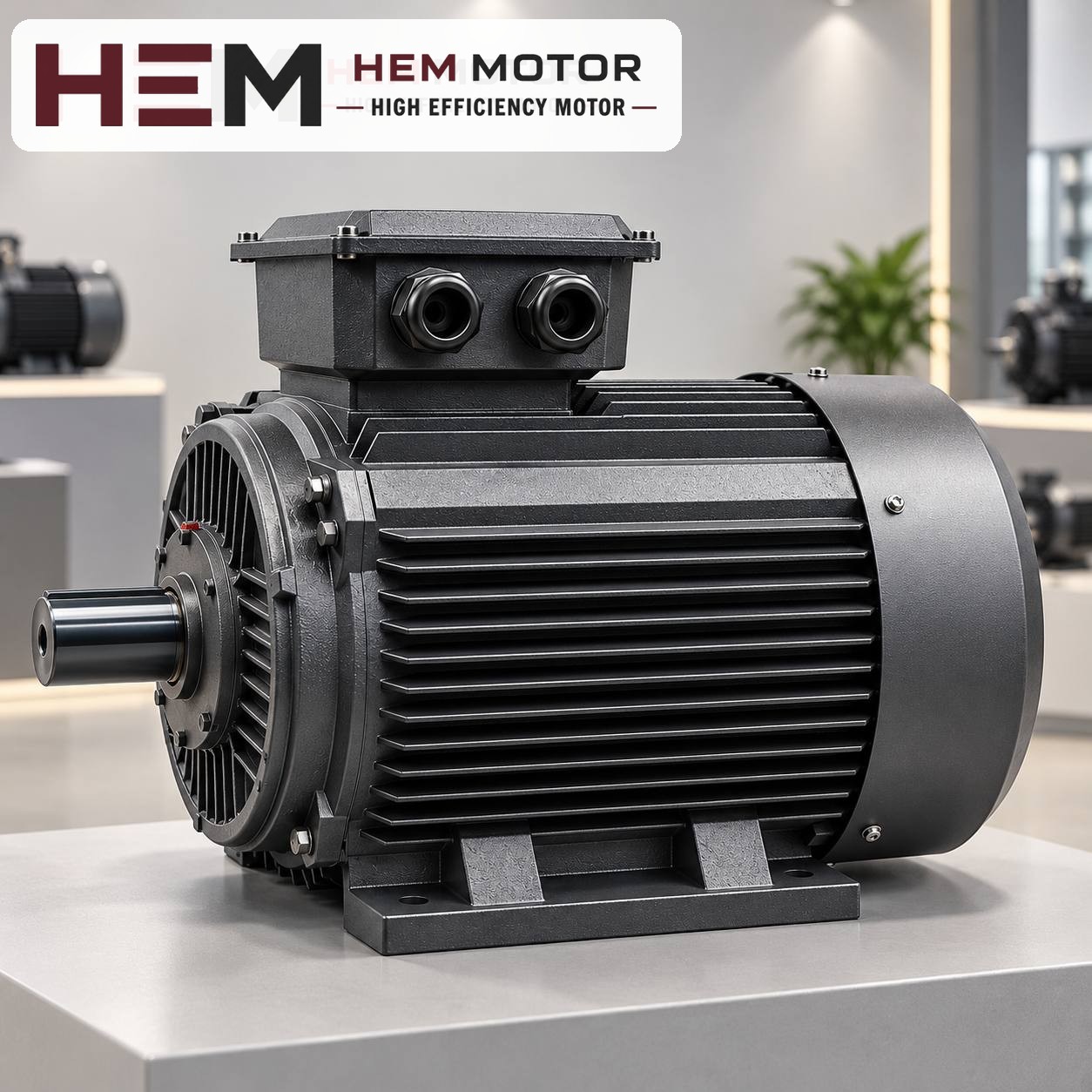
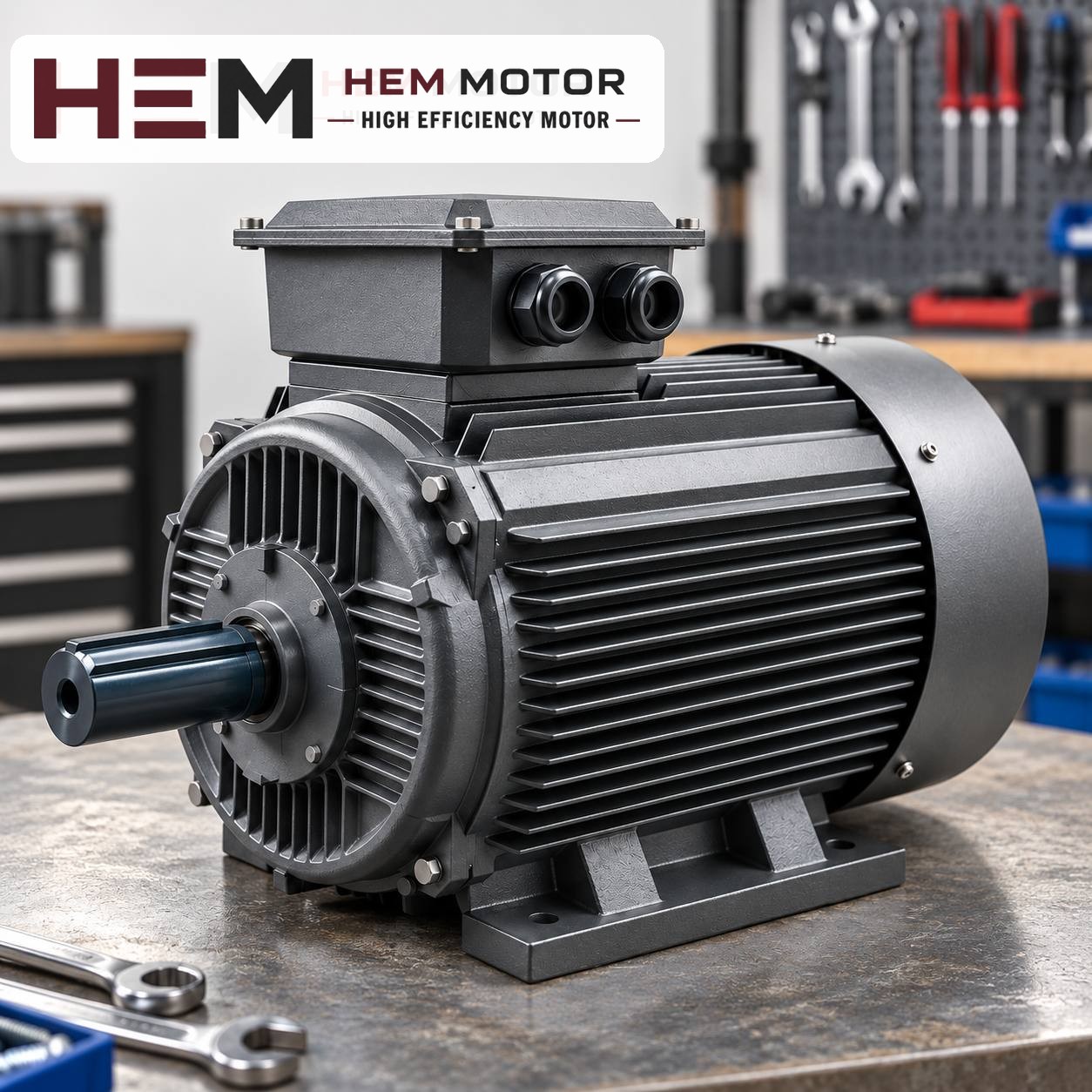
Foot-mounted three-phase electric motor standing on a base
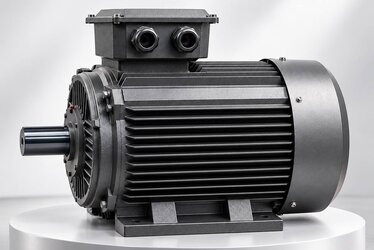
On a foot-mounted motor, base compatibility is set by the shaft height and the foot hole spacing (representative image).

HEM Motor's 55 kW models and their frame sizes

At HEM Motor, 55 kW is offered only with a cast iron frame and at three different speeds. All three are IP55, insulation class F and supplied at 400/690 V (Δ/Y), 50 Hz. The column that matters for the base is the IEC frame size:

Model codeSynchronous / rated speedIEC frameRated current (400 V)Rated torque
280M-61,000 / 985 rpm280M98.1 A533.2 Nm
250M-41,500 / 1,485 rpm250M97.6 A353.7 Nm
250M-23,000 / 2,970 rpm250M93.5 A176.9 Nm

The first conclusion from the table is this: the 1,500 and 3,000 rpm models share the same 250M frame, while the 1,000 rpm model is one frame size up, at 280M. So if you are thinking of changing speed, the base will change too. If you stay at the same speed, finding out the old motor's frame size solves half of the base question.

The dimensions that decide base compatibility

In the IEC frame system, the dimensions by which a motor connects to the machine are referred to by standard letters. If the base is to stay unchanged, the following must be the same on the old and the new motor. We do not give the values here; for each frame they are in the 2026 technical and product catalogue and the 2D technical drawings.

  • H – shaft height: The distance from the bottom of the feet to the shaft centre; the number in the frame size expresses this. The difference between 250 and 280 means that in a coupled drive the shaft no longer lines up with the pump or gearbox shaft.
  • A and B – foot hole spacing: A is the transverse spacing, B the longitudinal one. The letter in the frame size (S, M, L) indicates the class of dimension B; 250M and 250S have the same height but their holes are in different places.
  • C – distance from the shaft shoulder to the first foot hole: It sets the gap between the coupling hubs. If C differs, the coupling gap will not match even if the motor fits on the base.
  • D and E – shaft end diameter and length, key: They show whether the coupling or pulley hub will go onto the new shaft.
  • K – foot bolt hole diameter: It decides whether the existing anchor bolts can be reused.

Is the same frame size enough on its own?

Most dimensions follow from the frame size, but the shaft end is the exception. In the same frame, a 2-pole and a 4-pole motor may have different shaft end diameters, because the 4-pole motor transmits roughly twice the torque at the same power. The 250M-2 and 250M-4 in the table are a typical case: the foot holes are in the same place, yet the coupling hub may not be the same. Check the shaft end separately against its row in the catalogue.

What information to collect from the old motor

Spending a few minutes on site before removing the motor prevents a wrong order.

  • Nameplate: Power, speed, voltage, current and, if present, the frame size. If the plate has faded, photograph it anyway; every readable line helps.
  • Measurements on site: The transverse and longitudinal distance between foot hole centres, the height from the base surface to the shaft centre, the shaft diameter and the key width.
  • Mounting arrangement: Is the motor fixed by its feet only (B3), or does it also sit on the machine through a flange (B35)? If there is a flange, its size is confirmed separately with the order.
  • Terminal box position and cable entry: Whether the box is on top or on the side, which direction the cable comes from, and whether the cable will reach without being strained.
  • Surrounding clearances: Enough space behind the fan cover for air intake and access to the lifting eyes for a crane.

If the old motor was built to a non-IEC frame standard, its dimensions may not match one to one. In that case do not order just because the frame size looks similar; compare the dimensions with the technical drawing.
Prices and technical data are on the product pages; choose a model and order online.

What to do if the frame size does not match

When the dimensions turn out to be different, the solution is to adapt the base, not to downsize the motor. If the power requirement has not changed, switching to a smaller-frame but lower-power motor only moves the problem elsewhere. Common approaches on site are:

  • Adapter plate or adapter frame: A steel plate is made for the new hole pattern and fixed to the existing anchors. A difference in shaft height is also taken up by the plate thickness or by shims.
  • Motor slide rails: In belt-and-pulley drives a longitudinal hole difference can be absorbed by slide rails; however, the pulleys must stay in the same plane and the belt tension must be readjusted.
  • Coupling replacement: If dimension C or the shaft diameter differs, a new coupling with suitable hubs may be quicker than adapting the base.
  • Renewing the base: If the concrete base is cracked or the anchors have loosened, renewal is on the agenda anyway; building it to the new motor's drawing is the cleanest long-term route.

Alignment after positioning

Once the motor sits on the base, make sure all four feet bear evenly on the surface. A foot left hanging (soft foot) strains the frame when the bolts are tightened and causes vibration; it is corrected with shims. Then the angular and parallel misalignment of the coupling is measured and the drive is aligned. At a power such as 55 kW, alignment by eye quickly wears out the bearings and the coupling.

Example scenario: renewing a 1,500 rpm motor at a pumping station

The following sequence is hypothetical; it does not describe a real customer application. Suppose a centrifugal pump at a water pumping station runs with a coupled 55 kW, 1,500 rpm motor, and the frame size on the old motor's nameplate reads 250M.

  • Since power and speed stay the same, the candidate is the 55 kW cast iron motor with model code 250M-4; its nameplate will show 1,485 rpm.
  • Because the frame size matches, the foot holes and shaft height will most likely not change; even so, dimension C and the shaft end are compared with the catalogue and it is confirmed that the coupling hub will fit.
  • The terminal box position and the cable length are checked; on a 400 V network the motor is connected in delta (Δ), and the existing star-delta starter can be kept.
  • If the owner considers moving to 1,000 rpm "to make it quieter", the 280M-6 comes into play. In that case the pump's flow and head change with the speed, and the taller frame requires adapting the base; this route is not taken without a pump calculation.

The logic is the same for a fan or pump running at 3,000 rpm: the 250M-2 carries the same frame size, but since its shaft end may differ from the 4-pole model, the coupling is checked separately.

What to check on the electrical side

Once the base is sorted, the electrical connection usually goes quickly, but do not skip three points. First, the motor is rated 400/690 V (Δ/Y); on a 400 V network it is connected in delta and is suitable for star-delta starting. Second, the thermal protection is set to the new motor's nameplate current, not the old one's; for selecting the protective device see our article on thermal relays and fuses. Third, the direction of rotation and the insulation should be checked before the first start; the steps are summarised in the commissioning checklist.

What to send before ordering

So that we can identify the 55 kW model that fits your base in one go, send the following together:

  • Power and speed (1,000, 1,500 or 3,000 rpm)
  • A photo of the old motor's nameplate and, if readable, its frame size
  • The foot hole spacing, shaft height and shaft diameter you measured on site
  • Mounting arrangement (B3 foot-mounted or B35 foot-and-flange) and, if there is a flange, its size
  • Supply voltage, starting method and the driven machine (pump, fan, crusher, etc.)

You can see suitable models and current prices on the buy electric motors page, and all cast iron options in the cast iron frame motors list. If you are unsure about your old motor's dimensions, send us the motor nameplate and we will identify the model that fits the base together; for other questions you can use our contact page.

HEM Motor Models Related to This Article

The cards show example models related to the topic. A suitable motor is not chosen by power alone: compare speed, voltage, mounting, shaft and connection dimensions on the product page; if unsure, send a photo of the existing motor’s nameplate on WhatsApp.

55 kW 1500 rpm Cast Iron Frame Electric Motor 250M-4

250M-4

55 kW · 1500 rpm

  • Cast iron frame · IEC 250M
  • 1485 rpm · IP55
  • Mounting: B3 foot; flange (B5/B14/B35) depending on frame — confirmed with the order

US$2,052.56 (€1,831.77)

View product
55 kW 3000 rpm Cast Iron Frame Electric Motor 250M-2

250M-2

55 kW · 3000 rpm

  • Cast iron frame · IEC 250M
  • 2970 rpm · IP55
  • Mounting: B3 foot; flange (B5/B14/B35) depending on frame — confirmed with the order

US$2,167.09 (€1,933.98)

View product
55 kW 1000 rpm Cast Iron Frame Electric Motor 280M-6

280M-6

55 kW · 1000 rpm

  • Cast iron frame · IEC 280M
  • 985 rpm · IP55
  • Mounting: B3 foot; flange (B5/B14/B35) depending on frame — confirmed with the order

US$2,788.04 (€2,488.13)

View product

Similar Articles