English
 Français
 Türkçe
 Español
 Русский




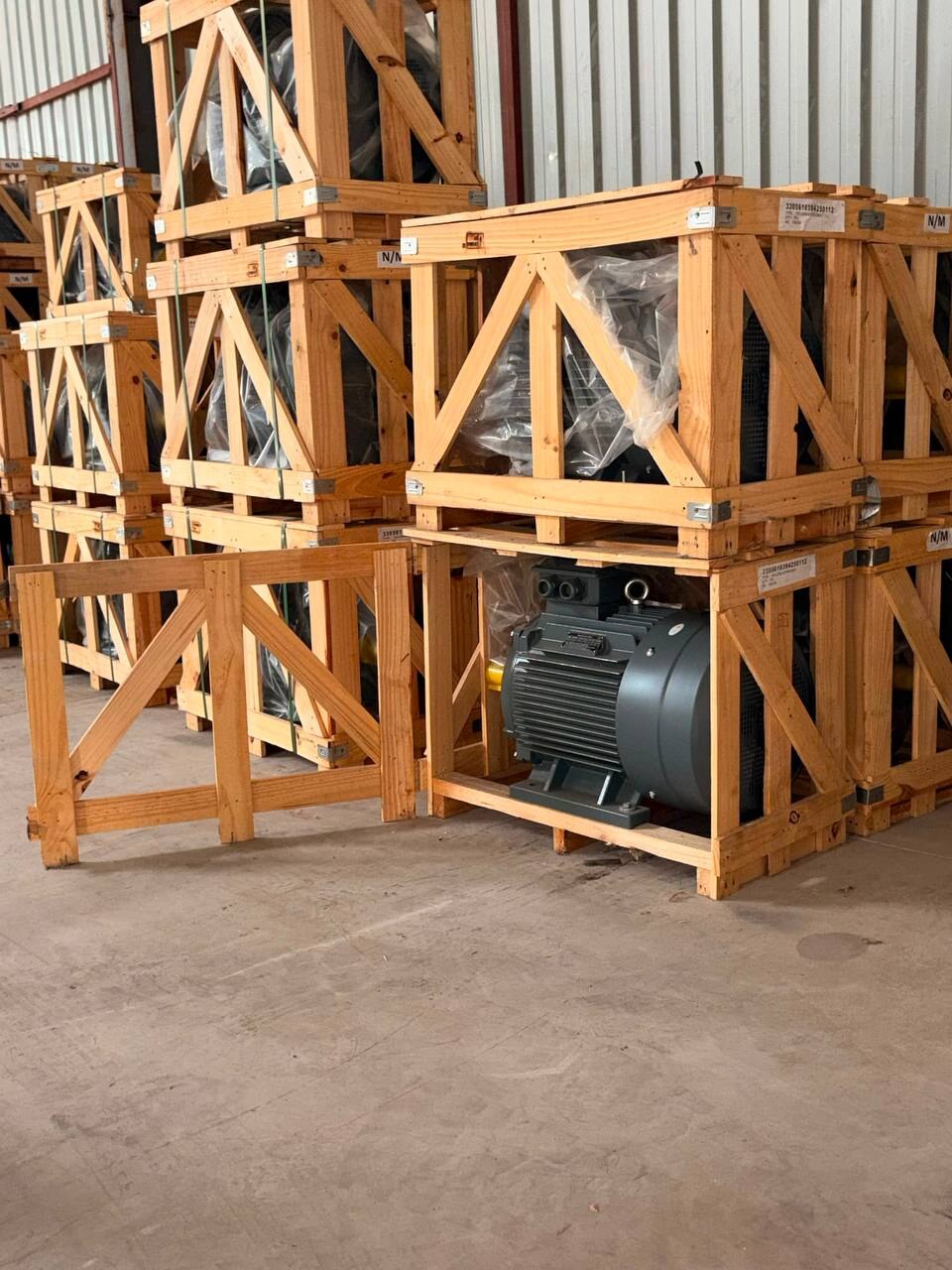

In IEC frames between 132 and 355, the frame number also gives the height from the foot base to the shaft centre in millimetres. What makes replacement difficult in this range is not reading the code; it is that the motor gets heavier, the base is fixed to concrete or a steel skid, and the alignment margin becomes smaller. Because the same power can fall into a completely different frame depending on speed, the price of a wrong choice on a large motor is tearing out and rebuilding the base.
This article focuses on replacement in large frames: the power–speed–frame relationship, the base, coupling alignment, lifting and terminal box orientation. The power list for all frames is on the IEC frame–power table page; we do not repeat that list here.

Same power, different speed, different frame
When selecting at high power, first ask this question: what speed does the machine require? What really determines the frame is the torque requirement. A 1,000 rpm motor delivers the same power with roughly three times the torque of a 3,000 rpm motor; that torque needs a larger rotor and a larger frame.
The table below shows how the frame changes with the number of poles at five power steps selected from HEM Motor product records:
| Power | 2 poles (3,000 rpm synchronous) | 4 poles (1,500 rpm synchronous) | 6 poles (1,000 rpm synchronous) |
|---|---|---|---|
| 18.5 kW | 160L-2 | 180M-4 | 200L1-6 |
| 37 kW | 200L2-2 | 225S-4 | 250M-6 |
| 75 kW | 280S-2 | 280S-4 | 315S-6 |
| 160 kW | 315L1-2 | 315L1-4 | 355M1-6 |
| 250 kW | 355M-2 | 355M-4 | 355L-6 |
Two practical conclusions follow from the table. First, at 37 kW moving from 2 poles to 6 poles takes the frame from 200 to 250; in other words, a change of speed also changes the shaft height. Second, at 75 kW and above, 2-pole and 4-pole models often share the same frame number. In that case, even though the frame looks the same, the shaft end and bearing arrangement may differ according to the number of poles; compare the technical drawing before fitting a 2-pole motor in place of a 4-pole one as "the same frame".
What do the letters S, M and L change on a large frame?
Frame 315 comes in three different lengths marked S, M and L. In the HEM Motor list at 4 poles, 315S-4 is 110 kW, 315M-4 is 132 kW and 315L1-4 is 160 kW. The shaft height is the same for all three; what changes is the frame length and, with it, the longitudinal spacing of the foot holes.
A common situation on site is this: the old motor is 315S, the new requirement is one power step higher and a 315M arrives. The coupling side stays in place, but the rear foot holes do not match the base. New holes must be drilled in the base or an adapter plate fitted. If you are planning a power increase, check on the drawing before ordering whether it creates base work. You can review suitable HEM Motor models and current prices in the online store.
The base: the same frame number is only half the job
On large motors the base is usually a steel skid or a plate anchored onto a concrete plinth. If the frame number matches, the shaft axis comes to the same height; even so, the following points are checked separately:
- Flatness of the foot surfaces: If one of the four feet is left unsupported, the frame flexes as the bolt is tightened. This "soft foot" condition comes back later as vibration and bearing heating; each foot is checked with feeler gauges before tightening.
- Shim pack: The shims under the old motor are not transferred to the new motor as they are. Each motor has a different foot height tolerance; the shims are rearranged according to the alignment measurement.
- Anchor and bolt condition: If a base that has run for years has cracks, loose anchors or damaged threads, the new motor will suffer the same vibration.
- Longitudinal position: The shaft end of the new motor may sit further forward or back than the old one. The distance between coupling hubs must stay within the range given by the coupling manufacturer.
Coupling alignment: tighter tolerance on a large motor
At high power the torque carried by the shaft is high; even a small misalignment wears coupling elements, bearings and seals quickly. Alignment is done on two axes: parallel offset and angular misalignment between the shafts. It is measured with a dial indicator or a laser alignment tool, and the motor side is corrected with shims and side adjustment bolts.
There are two more details to watch. On machines that run hot, such as pumps or fans, thermal expansion can raise the shaft axis; if the machine manufacturer gives an allowance for cold alignment, follow it. Also, alignment is checked one last time with the pipe and duct connections attached; connection strain can shift the motor. For first start-up steps, see the motor commissioning article.