English
 Français
 Türkçe
 Español
 Русский

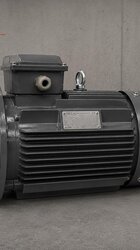
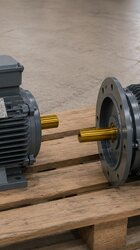
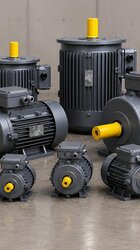

The IEC frame number gives the height from the motor's foot base to the shaft centre in millimetres. In the HEM Motor sales range, the small frames between 63 and 112 mostly carry three-phase models from 0.25 kW to 4 kW. The real factor that decides which power ends up in which frame is speed: the same power sits in a smaller frame at 2 poles and in a larger frame at 6 poles.
This article covers topics specific to small frames: how the code is read, the aluminium frame, small flanges and the mistakes most often made during replacement. If you want to see the power distribution of all frames on one page, the IEC frame–power table is available as a separate guide.

Reading the frame code piece by piece
An expression such as "90L-4" on the nameplate or in the model code carries three pieces of information at once. The leading number is the shaft centre height; it is also the only dimension we give as a figure in this article. The letter shows the length class of the frame at that height: S means short, M medium and L long frame. The digit after the hyphen is the number of poles and determines the synchronous speed.
Some codes have an extra digit after the letter. In HEM Motor codes, pairs such as 71M1-4 and 71M2-4 or 100L1-4 and 100L2-4 distinguish two different power packages in the same frame with the same number of poles. From the outside they look almost identical, but the rated power and current differ; that is why ordering simply "a 71M motor" is not enough.
| Model code | Shaft centre height | Length letter | Poles / rated speed | Power |
|---|---|---|---|---|
| 63M2-2 | 63 mm | M | 2 poles / 2,730 rpm | 0.25 kW |
| 71M1-4 | 71 mm | M (1st package) | 4 poles / 1,340 rpm | 0.25 kW |
| 71M2-4 | 71 mm | M (2nd package) | 4 poles / 1,340 rpm | 0.37 kW |
| 80M1-6 | 80 mm | M (1st package) | 6 poles / 890 rpm | 0.37 kW |
| 90S-4 | 90 mm | S | 4 poles / 1,445 rpm | 1.1 kW |
| 90L-4 | 90 mm | L | 4 poles / 1,445 rpm | 1.5 kW |
| 100L1-4 | 100 mm | L (1st package) | 4 poles / 1,450 rpm | 2.2 kW |
| 100L2-4 | 100 mm | L (2nd package) | 4 poles / 1,450 rpm | 3 kW |
| 112M-4 | 112 mm | M | 4 poles / 1,450 rpm | 4 kW |
The values in the table are taken from HEM Motor product records; they are examples chosen to show how the code is decoded, not a complete list.
How are power and speed distributed across small frames?
Taking 4 poles (1,500 rpm synchronous) as the basis, the order is as follows: frame 71M carries 0.25 and 0.37 kW, frame 80M carries 0.55 and 0.75 kW; 90S has 1.1 kW and 90L has 1.5 kW; frame 100L is reserved for 2.2 and 3 kW, and frame 112M for 4 kW.
At 2 poles the same powers shift one step down: the 0.25 kW 2-pole model is in frame 63M, 0.75 kW is in 80M1-2 and 3 kW sits in 100L-2. At 6 poles the opposite happens; 0.75 kW moves up to 90S-6, 1.5 kW to 100L-6 and 2.2 kW to 112M-6. The reason is simple: delivering the same power at a lower speed requires higher torque, and torque grows with the diameter and length of the rotor stack.
This distribution gives a useful clue during replacement. If your old motor has a 90L frame and its nameplate says 1.1 kW, it is most likely 6-pole. If you try to cover the same power with a 4-pole motor, the frame drops to 90S; the foot holes no longer match and the machine speed changes as well.
Aluminium frame or cast iron?
All standard HEM Motor codes in the 63–112 range are offered with an aluminium frame. The cast iron option starts at 0.55 kW; all 0.25 and 0.37 kW models are aluminium-only. From 0.55 kW upwards, the same code being sold with two frame materials lets you choose based on the operating environment rather than on the connection.
The aluminium frame is light; it makes work easier in bench-top or suspended installations such as fans, small pumps and gearboxes. The cast iron frame offers a sturdier outer shell against impacts, vibrating floors and rough operating conditions. Both options have IP55 protection and insulation class F, and for the same code the electrical values are identical. All aluminium models are listed on the aluminium frame electric motors page.
Flanges on small frames: why do you see B14 so often?
Small motors often run without feet, bolted directly to a machine. On pump housings, small worm gearboxes or fan plates, the B14 flange type is common: on this flange the holes are tapped holes drilled into the front face of the end shield, and the bolt is screwed into the motor from the machine side. On a B5 flange, by contrast, the holes are on the outer rim of the flange and are clearance holes.
The point to watch with B14 is that more than one flange size exists on the market for the same frame number. Saying "frame 71 B14" does not by itself define the spigot diameter or the bolt circle. In HEM Motor series, B3, B5, B14, B34, B35 and vertical V1/V3/V5/V6/V15 mountings are offered depending on the frame; the flange size is confirmed when ordering. You can review suitable HEM Motor models and current prices in the online store.