English
 Français
 Türkçe
 Español
 Русский


Open up a CNC machining centre and you may find three motor families in one machine: a plain three-phase induction motor driving the chip conveyor, servo motors positioning the axes to within fractions of a millimetre, and a small motor turning the coolant pump. All of them turn electrical energy into rotation, yet none can stand in for another. Knowing how the types of electric motor differ turns the vague question of which motor to buy into a sharper one: which family does this job belong to?
The first split: AC or DC?
Motors are first grouped by the kind of current they use.
- DC motors run on direct current. Because their speed is easy to control through voltage, they long dominated variable-speed drives, cranes and rolling mills. Brushed types have a commutator and brushes that wear and need regular maintenance. In industry they have largely given way to AC motors on frequency converters, but they remain common in battery vehicles, forklifts and small devices.
- AC motors can run straight from the alternating-current mains. With no brushes or commutator, they make up the great majority of industrial motors.
Within AC: induction and synchronous
What separates AC motors is whether the rotor turns at the same speed as the rotating magnetic field.
Induction (asynchronous) motor
The stator's rotating field induces current in the rotor and drags it round. The rotor lags slightly behind the field; that lag is called slip. There are two rotor designs:
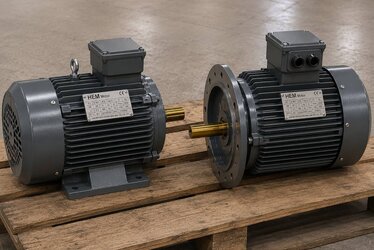
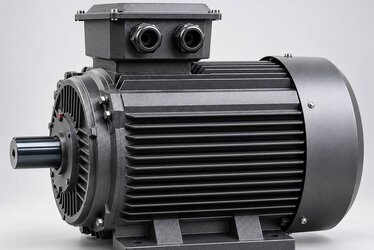
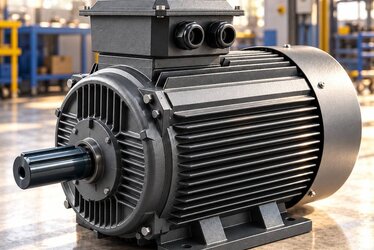
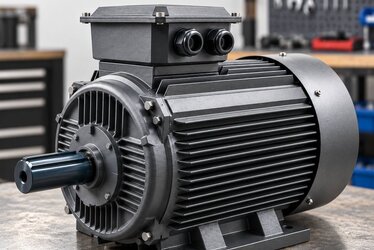
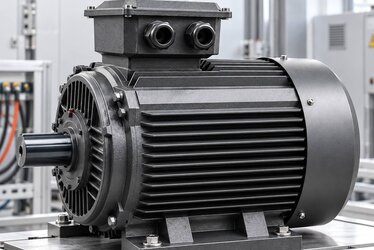
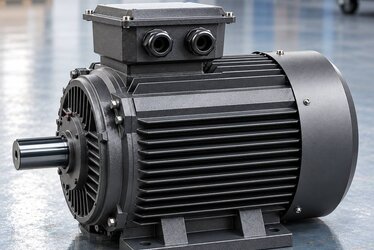
- Squirrel cage: the rotor carries aluminium or copper bars shorted at both ends, with no external connection, brushes or slip rings. It is simple, rugged and inexpensive, and it drives most pumps, fans, compressors, conveyors and crushers.
- Slip-ring (wound rotor): the rotor windings are brought out through slip rings and brushes so resistance can be added at start. Once used for very heavy starts on large drives, it is now rare in new projects as drives and soft starters have spread.
Synchronous motor
The rotor turns in exact step with the field. Permanent magnet (PM) synchronous motors offer high efficiency and usually run on a drive. Synchronous reluctance motors achieve synchronous speed without magnets, through the magnetic shape of the rotor. Both generally cannot be connected straight to the mains without a converter, so motor and drive are chosen together.
An induction motor's speed depends on its pole count: on 50 Hz, roughly 3000, 1500, 1000 and 750 rpm for 2, 4, 6 and 8 poles. The details are in our pole and speed table.
By supply: single-phase and three-phase
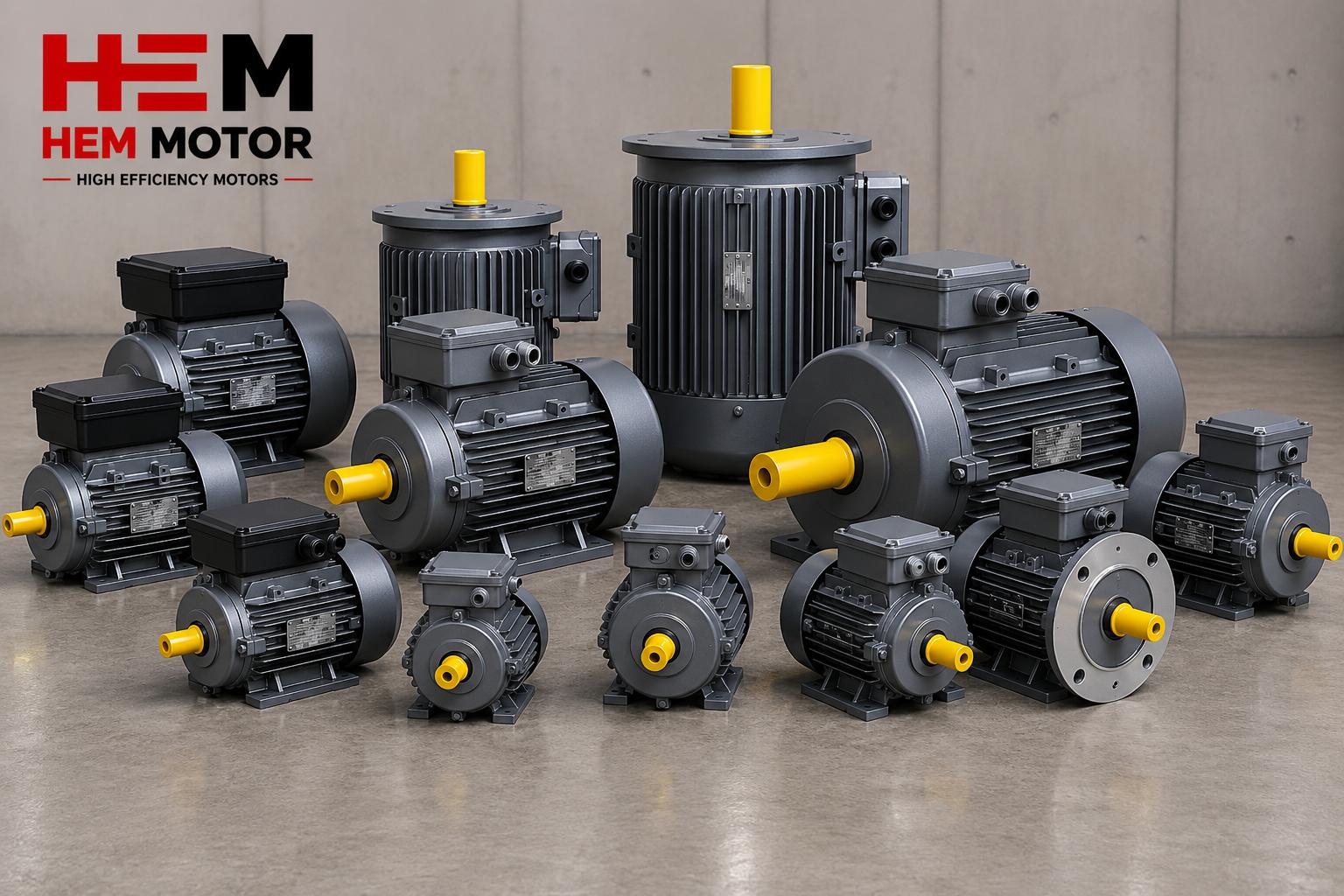
Induction motors also split by how they connect to the network. Single-phase motors run from a 220 V single-phase line. Since they cannot produce starting torque on their own, they use an auxiliary winding and a capacitor. They suit small pumps, compressors and workshop machines where only a domestic supply exists; the HEM Motor single-phase series covers 0.18–5.5 kW. Three-phase motors run on the industrial three-phase supply, reach far higher outputs, produce smoother torque and are smaller for the same power. We compare the two in single-phase or three-phase.
Special motors for positioning and precise motion
Some motors are built not to spin continuously but to move to a given angle and hold it:
- Servo motor: works with a feedback device that reads shaft position (an encoder or resolver) and its own drive. Used for CNC axes, robots and fast, accurate moves in packaging machines.
- Stepper motor: advances a fixed angle with each pulse. Because it can run without feedback, it is common in simple positioning tasks, 3D printers and dosing devices. At high speed and load it can lose steps.
- Brushless DC (BLDC): electronically commutated, compact and efficient. Often found in fans, small pumps and portable equipment.
These motors are sold as systems with their drives and do not replace an industrial induction motor, nor the other way round.