English
 Français
 Türkçe
 Español
 Русский

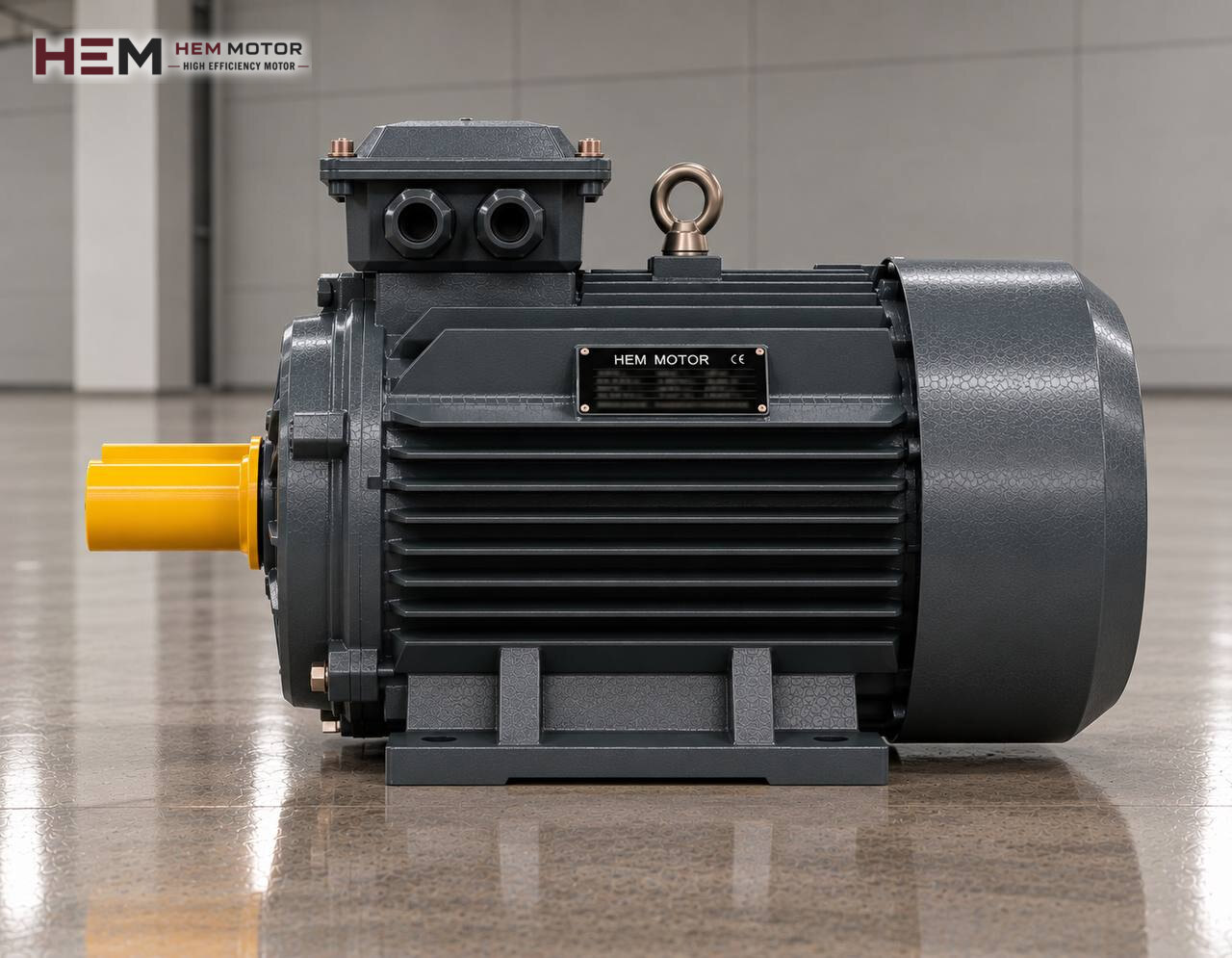
A multi-spindle boring machine is a panel processing machine that drills rows of holes, such as dowel, cam fitting and hinge holes, into furniture panels in a single stroke. The general overview of woodworking machines is on the woodworking machine electric motors page; here we deal with the boring head motor that turns many drill spindles at once and with the machine's auxiliary drives.

How does the boring head work?
The heart of the machine is the boring head, which carries many drill spindles in a row. The spacing between spindles follows the 32 mm system common in the furniture industry. Inside the head is a gear train, and a single motor turns its input. Because the gears turn one another, neighbouring spindles rotate in opposite directions; right-hand and left-hand bits are therefore fitted alternately.
Simple machines have a single horizontal or vertical head. Larger machines have several heads boring from below, above and the side, each with its own motor. During drilling the heads advance towards the workpiece by pneumatic or hydraulic cylinder and retract once the hole depth is reached.
Motor load: short drilling, long idling
The boring head motor has a distinctive duty pattern. The motor usually runs continuously throughout a batch, but the actual cutting load occurs only during the few seconds the bits are entering the panel. In that short time, the number of spindles working at once, the bit diameter and the panel density determine the load. Many spindles plunging together can be heavier for the motor than one thick bit.
Bit speed matters for hole quality. Boring head motors are therefore mostly chosen as 2-pole, in the 3,000 rpm class, and the gearbox often transfers this speed to the spindles at a 1:1 ratio. Keeping the same number of poles on replacement lets work continue without changing bit speed.
Why does direction of rotation matter?
The right and left sequence of bits in the head is arranged for the gearbox input turning in a particular direction. If the motor runs backwards, the bits rub instead of cutting, heat up and burn the panel. The first thing to do after connecting a new motor is to check the direction of rotation at idle; if necessary two phases are swapped.
Mounting: flange connection to the head
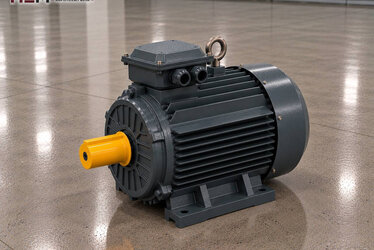
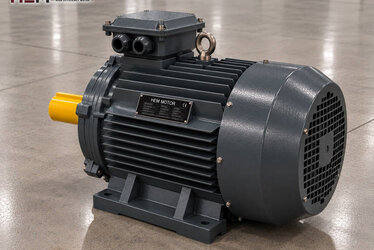
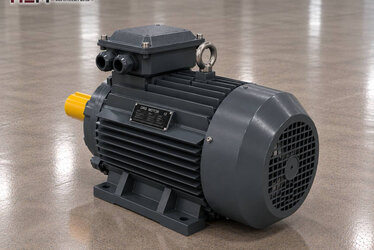
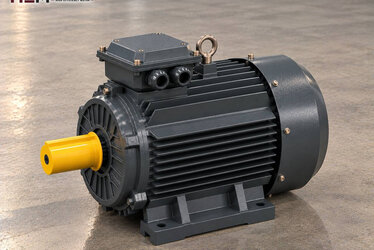
On most machines the boring head motor is flange-mounted directly onto the gearbox housing and moves with the head. On vertical heads the motor shaft may face down or up (as in V1 or V3); on horizontal heads B5 or B14 flange connection is common. The key on the shaft end must sit exactly in the gearbox input coupling, so flange diameter, spigot and shaft size must be compared one-to-one with the old motor. For flange motor options see the flange-mounted electric motors page.
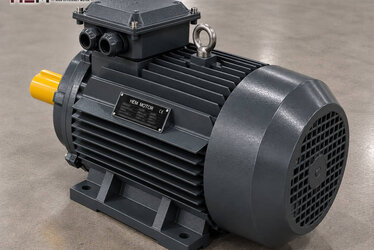
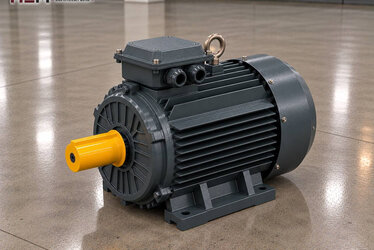
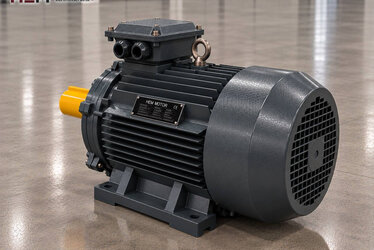
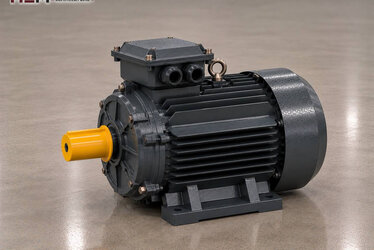
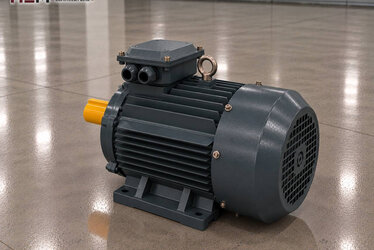
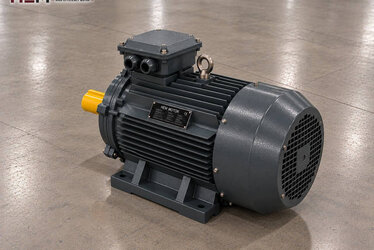
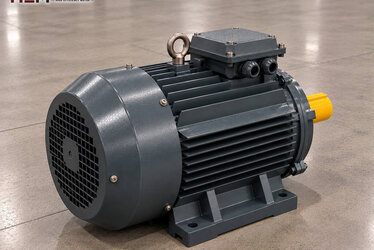
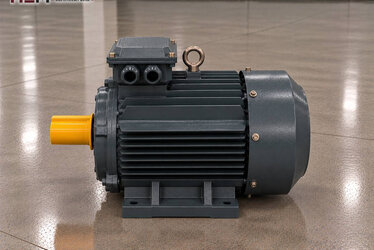
In HEM's three-phase series, depending on frame size, foot-mounted B3, flanged B5 and B14, combined foot-flange B34/B35 and vertical V1, V3, V5, V6 and V15 arrangements are prepared; flange and shaft size are confirmed during ordering. Because the head moves, the motor cable must be laid so that it is flexible and can bend together with the head.
Example motors on a boring machine
| Drive | Load character | What to check | Example HEM model |
|---|---|---|---|
| Single head with few spindles | Short drilling moments, light load | Number of spindles, bit diameter | 90S-2 aluminium — 1.5 kW, 2,895 rpm |
| Main head with many spindles | Many bits plunging at once | Spindles working at once, panel density | 100L-2 aluminium — 3 kW, 2,895 rpm |
| Hydraulic feed unit | Turning the pump under intermittent load | Pump flow, cycle time | 100L2-4 aluminium — 3 kW, 1,450 rpm |
| Table-mounted dust extraction fan | Turning the fan impeller without interruption | Number of connected hoods, pipe run length | 90L-2 aluminium — 2.2 kW, 2,895 rpm |
The examples only give an idea; the final decision is made by examining together the load the machine actually draws, the required spindle speed, how the motor is fitted and the workshop conditions.
CNC boring machines, feed and environment
On point-to-point CNC boring machines, each drill spindle or boring block is driven by a special high-speed spindle motor, and axis movements are made by servo motors. The situation is the same for both motor types: neither is included in HEM Motor's 2026 catalogue. On these machines the standard motor finds its place in auxiliary drives such as the dust extraction fan, the vacuum table pump or the hydraulic unit. If head feed is hydraulic, the motor only turns the pump; details are on the hydraulic pump electric motors page.
Fine MDF and chipboard dust produced while drilling settles on the fan cover of the motor attached to the head. Keeping the extraction inlet near the head working and cleaning the fan cover regularly keeps the motor cool. For those who want to monitor winding temperature, a PTC or PT100 sensor is an order option.
To change bit speed according to the material, the motor can be driven by a frequency converter; if continuous low speed at full load is expected, a separate cooling fan should be considered, a dv/dt or sine filter if the cable from drive to motor is long, and this should be stated in the order. For small machines in single-phase workshops, our single-phase electric motor series covers 0.18 to 5.5 kW.
Information needed for a motor request
Tell us the machine type (single head, multi-head, CNC), which head the motor to be replaced is on, the motor's power (kW) and speed (rpm), the plant voltage, the mounting details (flange type and shaft direction) and how many units are needed. If possible, also add a photo of the gearbox input coupling and the flange.
A photo of the old motor with a readable nameplate is often enough; the method is in the article send the motor nameplate, find the equivalent. Priced models are on the shop page; WhatsApp and phone are on the contact page.
Frequently Asked Questions
I fitted a new motor and the holes come out burnt — why?
The most common cause is the motor running in reverse; the bits rub instead of cutting. Check the direction of rotation at idle and swap two phases if necessary.
Why is the boring head motor flange-mounted?
The motor is usually connected directly to the gearbox and moves with the head. A flange connection keeps the shaft and gear input exactly on axis.
The motor struggles when all spindles are loaded — what should I do?
Check bit sharpness and plunge speed. If the current is still above the nameplate value, a higher-power motor or splitting the drilling into two steps can be considered.
Can I get the spindle motor of my CNC boring machine from HEM?
No; a high-speed CNC spindle motor is not included in HEM Motor's 2026 catalogue. Our standard motors can be used on those machines for auxiliary drives such as the extraction fan, vacuum pump or hydraulic unit.