English
 Français
 Türkçe
 Español
 Русский

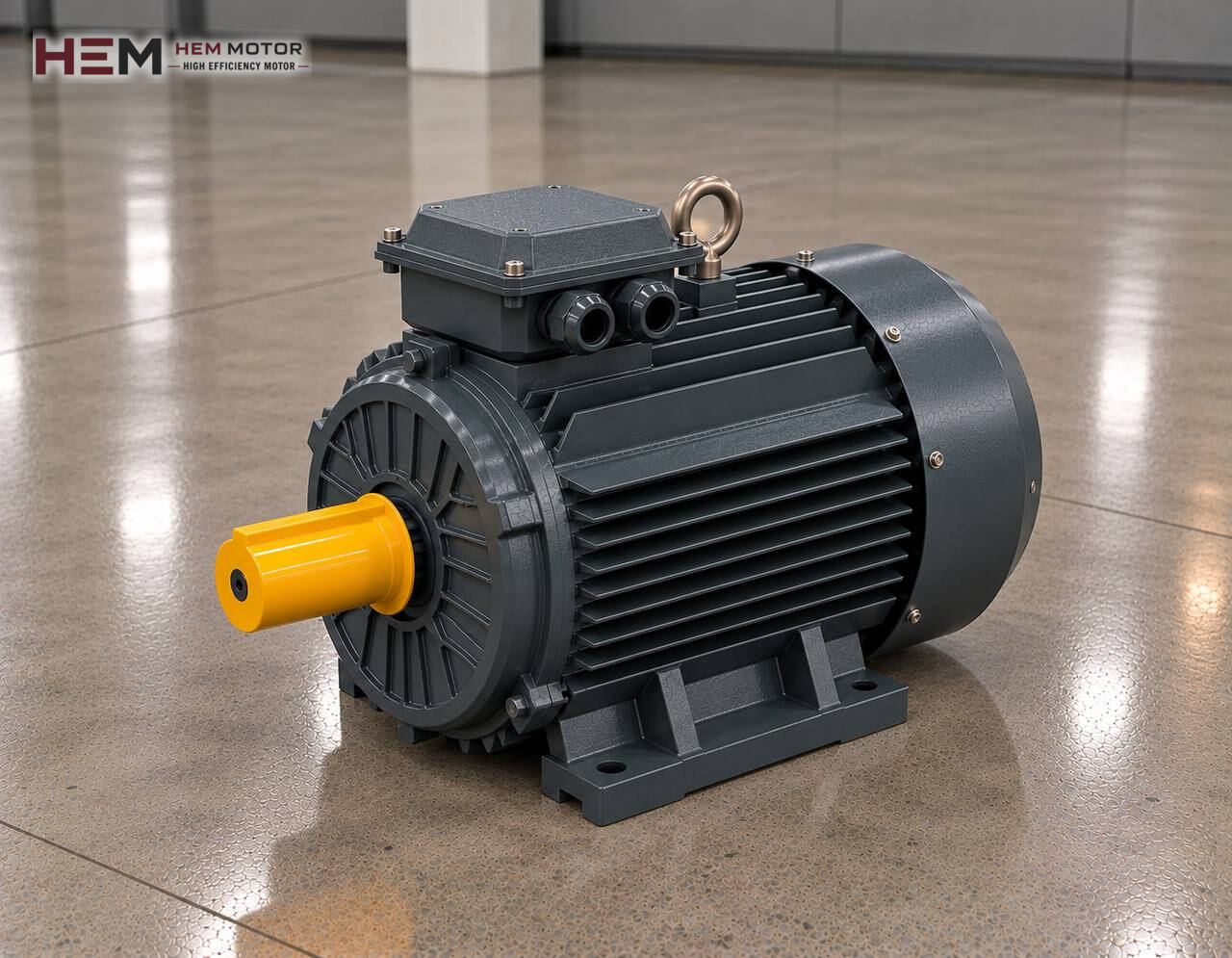
A panel saw is the first station of furniture production: it divides chipboard, MDF, plywood and laminated boards into accurately sized pieces. For an overview of the woodworking section see woodworking machine electric motors. This page covers the three-phase asynchronous motors used on the main saw, the scoring saw and the auxiliary drives of a panel saw.

Two machine types: sliding table and beam saw
The type most often seen in workshops is the sliding table panel saw. The operator pushes the board on the sliding table into the fixed rotating blade. For larger production a horizontal (beam) panel saw is used: a stack of boards lies on the table, a pressure beam clamps the stack and the saw carriage passes underneath to make the cut.
In both types two blades work together. The main saw cuts the board; in front of it a smaller scoring saw scores the underside of the laminate in the opposite direction to the main blade, preventing chipping and tear-out at the edge. Each blade has its own motor.
Main saw motor: peripheral speed and cut section
The load on the main saw motor depends on board thickness, how many boards are cut in a stack, the density of the material and the feed speed. On a sliding table saw cutting a single board the load is moderate; on a beam saw cutting stacks, the motor runs close to rated power throughout the cut.
A clean edge depends on the blade's peripheral speed being within the range recommended by the blade manufacturer. The motor is mostly 2-pole, in the 3,000 rpm class, and connected to the saw arbor by belt; the pulley ratio sets the arbor speed. When replacing, choosing the same number of poles as the old motor keeps the same cutting speed without changing pulleys.
What happens when the blade diameter changes?
On some machines a larger blade can be fitted for a greater cutting height. As diameter grows, the peripheral speed at the same rpm rises and the inertia the motor must accelerate increases. Such changes should stay within the limits allowed by the machine manufacturer.
Scoring saw and auxiliary movements
The scoring saw has a small diameter and needs much less power than the main saw. The scorer must already be turning before the main saw enters the cut; the machine's control circuit ensures this sequence. The scoring motor is usually 2-pole as well and runs on its own belt.
On beam saws the saw carriage moves back and forth, a pusher brings the boards to size and the pressure beam clamps the stack. These movements may use geared motors, servo systems or pneumatic cylinders. Servo is common on the pusher, which needs positioning accuracy; servo motors are not included in HEM Motor's 2026 catalogue. Movements that do not need such accuracy, such as carriage travel, may use a standard geared motor; for details, electric motors for reducers will guide you.
Example motors for saws and auxiliaries
| Drive | Load character | Basis for selection | Example HEM model |
|---|---|---|---|
| Sliding table main saw | Single board, moderate and intermittent load | Blade diameter, pulley ratio, board thickness | 132S1-2 aluminium — 5.5 kW, 2,930 rpm |
| Beam saw main saw | Long, high load when cutting stacks | Stack height, feed speed | 160M2-2 cast iron — 15 kW, 2,945 rpm |
| Scoring saw | Light, continuous load | Blade diameter, control sequence | 80M2-2 aluminium — 1.1 kW, 2,880 rpm |
| Saw carriage travel | Back-and-forth motion through a gearbox | Gearbox connection, starting frequency | 90L-4 aluminium — 1.5 kW, 1,445 rpm |
The models in the table were chosen to give an idea. The final motor is determined by the machine's actual load, required speed, connection method and operating conditions.
Starting, braking and dust
The main saw blade and pulleys are a mass that must be accelerated at start-up; larger machines may use star-delta starting or a soft starter. The brake that stops the blade from coasting for a long time is the machine's safety equipment and is designed by the manufacturer. Some modern machines drive the main saw with a frequency converter; HEM's three-phase series are suitable for speed control with a drive, additional cooling is considered for motors that will stay at full load at low speed for long periods, and a dv/dt or sine filter for long cables.
The fine chipboard and MDF dust produced during sizing sticks to the motor's cooling fins and hinders heat dissipation. The motor usually sits under the table, close to the dust extraction inlet. Horizontal foot-mounted B3 is the most common arrangement on this machine; flange B5/B14, combined B34/B35 and vertical V1, V3, V5, V6, V15 are also available depending on frame. The size of the shaft end carrying the pulley is checked together at ordering. A PTC or PT100 winding sensor is an order option if required.
Information list before ordering
When asking for a quote for your panel saw, it speeds things up if you tell us: is the machine a sliding table or beam saw, is the motor to be replaced on the main saw, scorer or carriage, what is the power in kW, the speed in rpm, the plant voltage, is the mounting foot or flange, and how many units are needed. The pulley shaft diameter and the type of brake arrangement on the machine are also useful.
If an old motor still has its nameplate, a photo is often enough; how to do it is explained in the article on finding an equivalent motor from the nameplate. You can see priced models on our shop page and use the contact page to reach us by WhatsApp or phone.
Frequently Asked Questions
Is edge chipping on laminate caused by the motor?
Usually not. The main causes are scoring saw adjustment, a dull blade or the wrong feed speed. If motor speed is low, for example because the belt slips, that can also spoil cut quality.
Why does the main saw motor slow down during the cut?
The stack may be too high, the feed too fast or the belt loose. Compare the motor's operating current with the nameplate value and check belt tension.
Should the scoring saw motor start before the main motor?
Yes. The scorer must be turning before it enters the cut; otherwise the laminate surface chips. This sequence is ensured by the machine's control circuit.
Can I run the main saw with a 1,500 rpm motor?
Without changing the pulley ratio the blade speed would halve and cut quality would suffer. Choosing the same speed class as the old motor, rather than changing the number of poles, is the safest route.