English
 Français
 Türkçe
 Español
 Русский

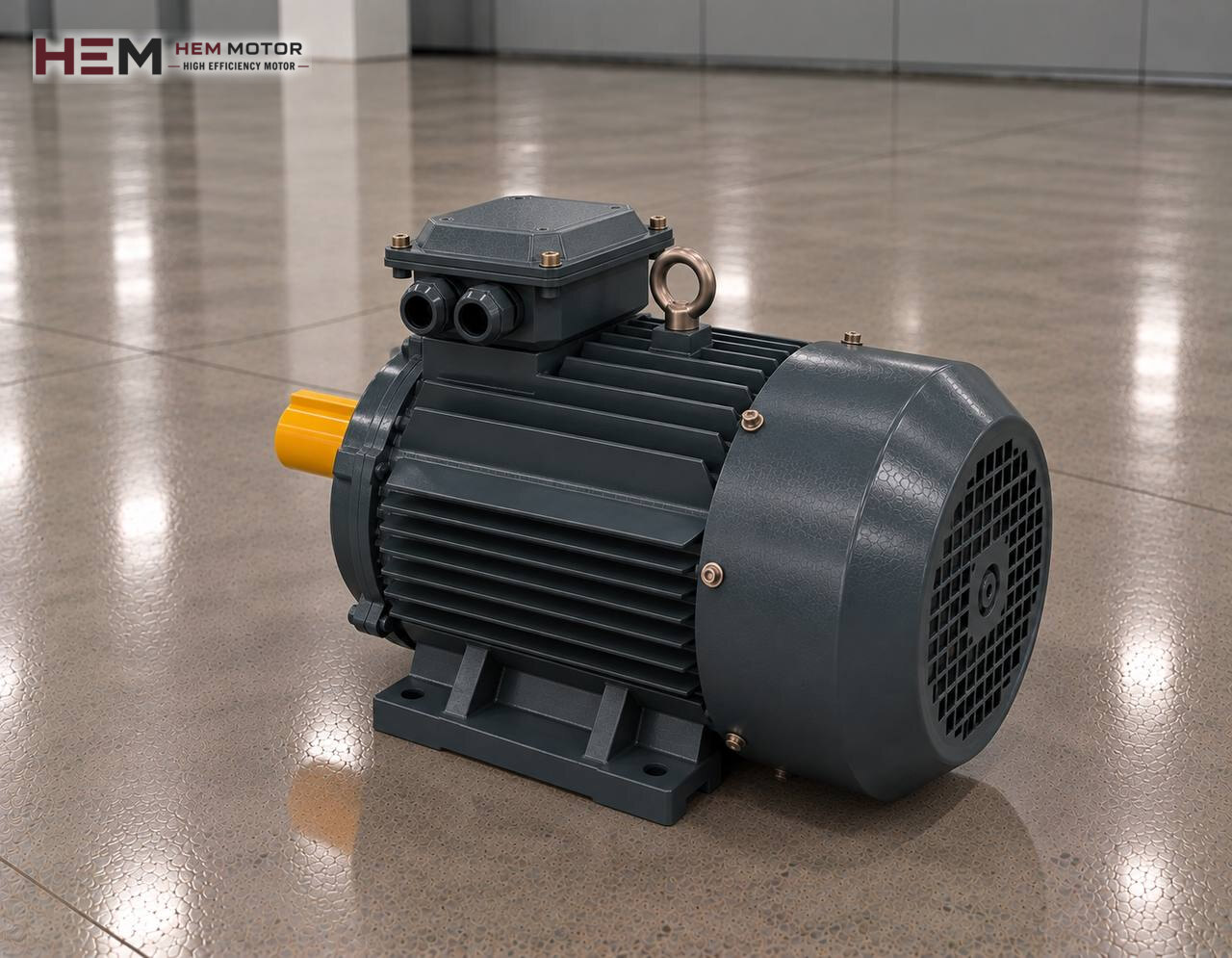
A band saw machine cuts wood with a thin saw band whose ends are welded into an endless loop and which runs tensioned between two wheels. For the other machines in the woodworking sector see the woodworking machine electric motors page. This page describes vertical band saws in joinery workshops, resaw machines and the motor that drives them; the large log band mills of sawmills are a separate subject.

Band movement and where the motor sits
The machine frame holds two wheels, one above the other. The lower wheel is the drive wheel and the motor is connected to it; the upper wheel turns freely, and band tension and tracking are set by adjusting it. The band moves downwards through the table and cuts the workpiece; the cutting force presses the workpiece onto the table.
On small and medium machines the motor sits in the lower compartment of the frame and turns the lower wheel with a V-belt. On some machines the wheel sits directly on the motor shaft. In the second arrangement the shaft end carries the full weight of the wheel and the side force from band tension; shaft and bearing size must therefore match the machine manufacturer's data.
Band speed, wheel diameter and motor speed
On a band saw the cutting speed equals the peripheral speed of the wheel. The larger the wheel, the faster the band travels at the same motor speed. For this reason small-wheel machines often use a 2-pole motor, while large-wheel machines may use a 4-pole motor (around 1,500 rpm). Whichever is chosen, staying in the same speed class as the old motor on replacement keeps the same band speed without touching the wheel and belt arrangement.
Because the band is thin, the cutting load is lower than on a circular saw; but when cutting a tall workpiece or ripping a plank, the band's contact length grows and the motor stays loaded for a long time. In contour (curve) cutting the load is short and variable.
Heavy wheels and starting
Cast wheels are quite heavy. The motor draws a high current for a few seconds while accelerating this mass at start-up; star-delta starting may be seen on large machines. Belt slip at start-up is also common and is corrected by belt tension.
Resaws and horizontal band saws
Resaw machines split a thick board through its thickness into two or more thin boards. On these machines the workpiece is fed to the band at constant speed by a feed roller or a track conveyor. The band motor works under continuous, high load; feeding is done by a separate small geared motor.
On horizontal band saws the band lies parallel to the floor and the workpiece passes beneath it. On these series-production machines the band motor and feed motor are also separate. To change feed speed according to wood species, the geared motor can be driven by a frequency converter; for choosing a geared drive, the electric motors for reducers page will guide you.
Example motors for band saw drives
| Drive | Operating pattern | What to check | Example HEM model |
|---|---|---|---|
| Workshop vertical band saw (contour) | Short, variable load | Wheel diameter, cutting height | 100L1-4 aluminium — 2.2 kW, 1,450 rpm |
| Heavy workshop band saw | Long cuts in tall workpieces | Wheel weight, belt arrangement | 132S-4 aluminium — 5.5 kW, 1,460 rpm |
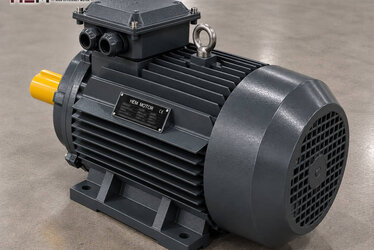
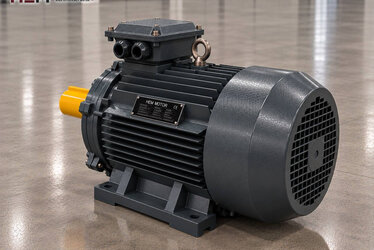
| Resaw / horizontal band saw | Continuous, high load | Section width, feed speed | 160M-4 cast iron — 11 kW, 1,465 rpm |
| Feed roller | Low speed through a gearbox | Gearbox connection, speed adjustment | 80M2-4 aluminium — 0.75 kW, 1,420 rpm |
The models are given only for guidance. The final choice is determined by the machine's actual load, the required speed, the way the motor is connected and the operating conditions.
Band breakage, chips and mounting
When the band breaks, the machine's band-break safety and wheel brake come into play; these arrangements are the machine manufacturer's design. Some machines use a brake motor to stop the wheel quickly; if a brake motor is wanted, state it in your order.
Chips collect in the lower wheel compartment and can reach the motor's fan cover. Opening and cleaning the compartment regularly lets the motor draw cool air. HEM's three-phase motors are offered, depending on frame, in B3, B5, B14, B34, B35 and vertical V1/V3/V5/V6/V15 versions; the shaft end carrying the wheel and the flange size are confirmed together at ordering. A PTC or PT100 sensor can optionally be added to the winding.
A reminder for users who want to drive the band with a frequency converter: our series are suitable for drive operation; if the motor is to deliver full torque at low speed for long periods an independent fan may be needed, and a dv/dt or sine filter if the cable between drive and motor is long. These details should be written in the order.
Small workshops without three-phase supply can look at the single-phase electric motor series between 0.18 and 5.5 kW.
What to send when requesting a quote
Please write the machine type (vertical workshop band saw, resaw, horizontal band saw), the motor's power (kW) and speed (rpm), the supply voltage, the mounting (foot, flange, wheel directly on the shaft), the wheel diameter and how many units you want. If the feed motor is also being replaced, add the gearbox information.
If the old motor's nameplate is readable, a photo is often enough; details are in the article send the nameplate, we find the equivalent. Priced models are on the shop page, and our WhatsApp and phone numbers are on the contact page.
Frequently Asked Questions
The band saw slows down while cutting — is the motor the cause?
Most often a dull band, a band fitted with the teeth the wrong way or a slipping belt causes this symptom. If these are fine, compare the operating current with the nameplate value.
Is a 2-pole or 4-pole motor used on a band saw?
That depends on the wheel diameter and the band speed the machine was designed for. Keeping the old motor's number of poles on replacement is the safest route.
Can the wheel be fitted directly on the motor shaft?
Some machines are built this way. Shaft diameter, shaft length and the bearing's resistance to side load must suit the machine; on replacement the old motor's dimensions should be the reference.
How do I adjust feed speed on a resaw?
The geared motor turning the feed roller can be driven by a frequency converter so that speed is changed according to wood species. If long periods at low speed are expected, state it in the order.