English
 Français
 Türkçe
 Español
 Русский

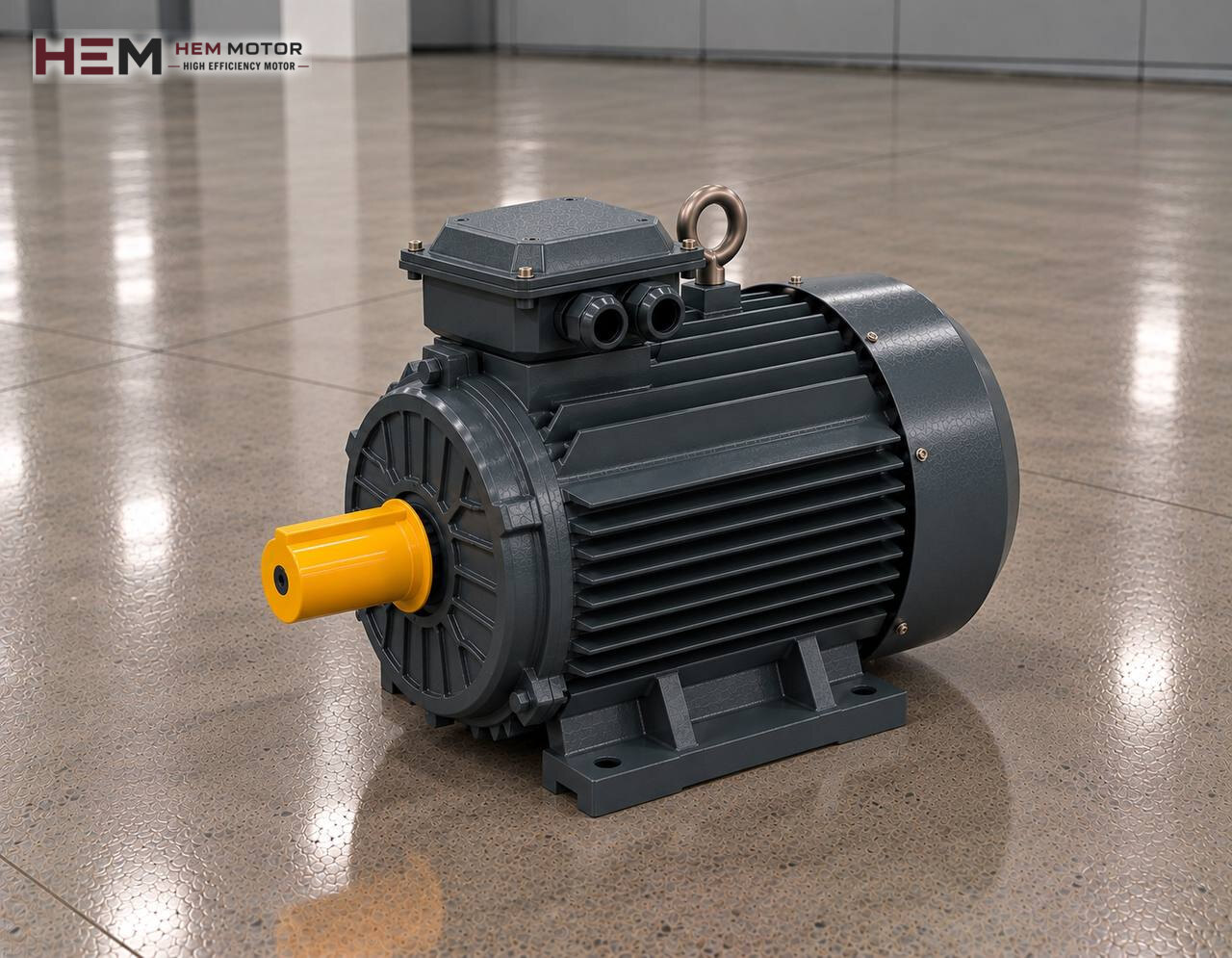
A surface planer (also called a jointer or flat planer in the workshop) is the machine that flattens a twisted or cupped face of a board and squares one edge to that face; in a woodworking shop it usually takes the first cut. This page covers the three-phase asynchronous motor that turns the planer's cutterblock, plus the single-phase option used in small workshops. For an overview of the other machines in the shop, return to our Woodworking Machine Electric Motors page.

What Does the Motor Turn on a Planer, and Where Does the Load Come From?
Two tables sit one behind the other on the cast machine body. The infeed table is lowered by the depth of cut, while the outfeed table is level with the tips of the knives. In the gap between them a cylindrical block spins, carrying two to four straight knives or helically arranged carbide inserts. The operator pushes the board by hand; the motor plays no part in feeding.
The load the motor sees is therefore intermittent and fluctuating. With no board on the table, the block only turns against bearing friction and air resistance, and current falls to its no-load value. As soon as the workpiece enters, depth of cut, board width, wood hardness and knots set the torque. A deep pass on a wide oak plank draws far more current than the same pass on a thin pine strip. The machine maker sizes the motor for this demanding pass.
Cutterblock Speed and Pulley Ratio
For a clean surface the cutterblock turns noticeably faster than a standard motor's mains speed. This speed comes from the ratio between the large pulley on the motor shaft and the small pulley on the block shaft; power is carried by a V-belt or a multi-rib (poly-V) belt. As the ratio grows, the arc over which the belt grips the small pulley shortens and the risk of slip increases.
A two-pole motor, in the 3000 rpm class, keeps this ratio within reasonable limits. Reaching the same block speed with a four-pole motor would roughly double the ratio, which strains the belt and the bearing on the pulley side. That mechanical reason lies behind the preference for 2 poles on these machines; even so, the correct speed is the one stamped on your machine's nameplate. If the pulley diameter is not kept when the motor is replaced, the block speed changes too.
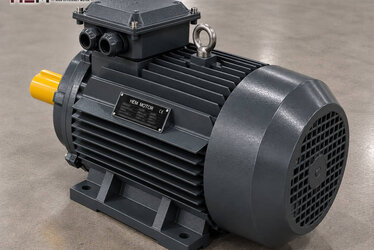
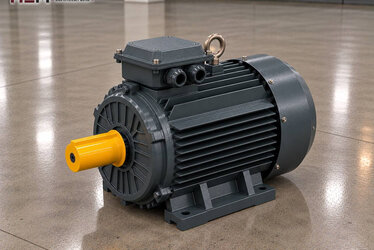
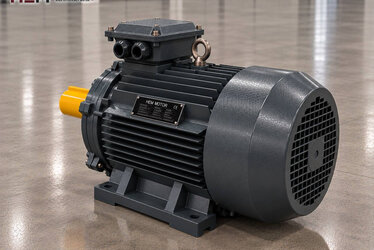
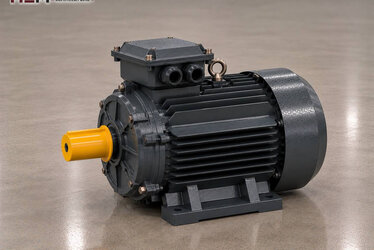
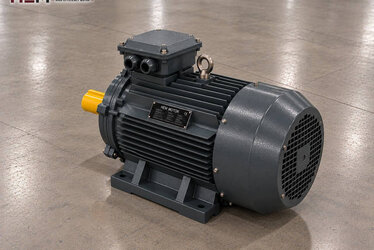
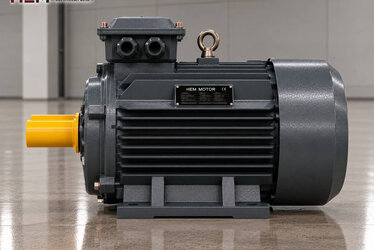
Belt tension is usually set by sliding the hinged or slotted plate the motor sits on. That is why a foot-mounted (B3) frame is the most common arrangement on planers. An over-tightened belt puts a side load on the motor's front bearing and shortens its life; fitting the pulley close to the shaft shoulder reduces this load.
Starting Current and Stopping the Cutterblock
The heavy block and pulleys make acceleration take a few seconds even when the machine starts unloaded. At small ratings, direct-on-line starting causes no trouble. On larger motors star-delta is preferred; this requires a winding rated to be connected in delta on a 400 V supply. In the HEM Motor range, models whose nameplate reads 400/690 V (from 4 kW upwards) suit this method; smaller motors with a 230/400 V nameplate already run in star on a 400 V supply, so the method does not apply to them.
On a planer the real safety issue is stopping, not starting. After the switch is turned off, the block keeps spinning on its inertia for a long time and the exposed knife area is dangerous. Many machines therefore have a mechanical brake or a DC-injection electronic brake controlled from the panel. This arrangement belongs to the machine or panel; brake motors are not part of HEM Motor's 2026 catalogue. If your old machine has a brake, test that it works the same way after switching to the new motor.
Chips, Dust and Motor Position
What a planer throws out is not dust but thick, curled chips. If the extraction line clogs, these chips fill the closed machine body and cover the motor's fan cowl. Because the motor is cooled by air blown by its own fan, chips packed between the fins mean hotter running at the same load. Cleaning the motor compartment regularly, keeping the extraction line open and blowing the fan cowl grille with compressed air are simple but effective measures.
Our motors have IP55 enclosure protection and class F winding insulation. If the chip silo or filter area is classified as an explosive dust zone, a standard motor is not designed for that zone; such a case must be stated separately in the order.
Combination Machines and Single-Phase Workshop Planers
In workshops short on space, surface planing and thicknessing are combined in one body: when the tables are lifted, the same block brings the board passing underneath to size. On these combination machines the motor is usually one step larger than on a plain planer of the same width. The thicknessing side is covered on a separate sub-page of ours, and the four-sided moulder that cuts profiles on its own page.
Small workshops without a three-phase supply run planers with a 230 V single-phase motor. HEM Motor's separate single-phase range covers 0.18–5.5 kW; details are on the single-phase electric motor page. The starting torque of a single-phase motor depends on its capacitor arrangement; for a wide planer with a heavy block, be sure to ask about this value.
Example Selection Table for Planer Motors
| Machine class | Motor's job | Value to check | Example HEM model |
|---|---|---|---|
| Narrow workshop planer | Cutterblock, by belt | Table width, old motor nameplate | 2.2 kW 90L-2 (2,895 rpm) |
| Medium-width planer | Cutterblock, by belt | Pulley diameter, share of hardwood | 3 kW 100L-2 (2,895 rpm) |
| Wide-table planer | Cutterblock, foot-mounted frame | Star-delta start, brake arrangement | 4 kW 112M-2 (2,905 rpm) |
| Planer-thicknesser combination | Block and roller drive | Load in thicknessing mode | 5.5 kW 132S1-2 (2,930 rpm) |
These four models give a starting idea; the right motor is chosen by weighing your planer's table width, pulley layout, mounting and duty together. The kW and rpm values on the old motor's nameplate are the most reliable starting point.
Information for Motor Replacement and Quotation
Before removing the old motor, photograph its nameplate; note the shaft diameter, key size, foot hole spacing and pulley diameter. For a quotation, send us the machine type (surface planer or combination), the required power and speed, the supply voltage (400 V three-phase or 230 V single-phase), the mounting type and the quantity. How to photograph the nameplate is explained in our send your motor nameplate article.
You can find our models with current prices on the buy electric motors page; WhatsApp and phone details are on the contact page.
Frequently Asked Questions
Can I use a 4-pole motor on a planer?
It is possible if the pulley ratio is enlarged accordingly, but belt slip on the small pulley and side load on the bearing increase. If the machine was designed with a two-pole motor, staying in the same speed class is the most trouble-free path.
The motor slows down under load and the overload trips; what could cause this?
The most common causes are blunt knives, too deep a pass and a loose belt. Sharpen the knives, reduce the pass, check the belt; if the problem continues, compare the current you measure with the nameplate value.
Can I convert my single-phase planer to a three-phase motor?
Yes, if the workshop has three-phase power; the new motor is chosen with matching shaft, foot and pulley dimensions, and the switch and protection are renewed for three-phase. Without three-phase power, a suitable model from our single-phase range is considered.
What should be done to make the cutterblock stop faster?
The machine's mechanical brake or an electronic brake module added to the panel is used. This is not a change made to the motor itself; have the brake arrangement installed according to the machine maker's diagram.