English
 Français
 Türkçe
 Español
 Русский

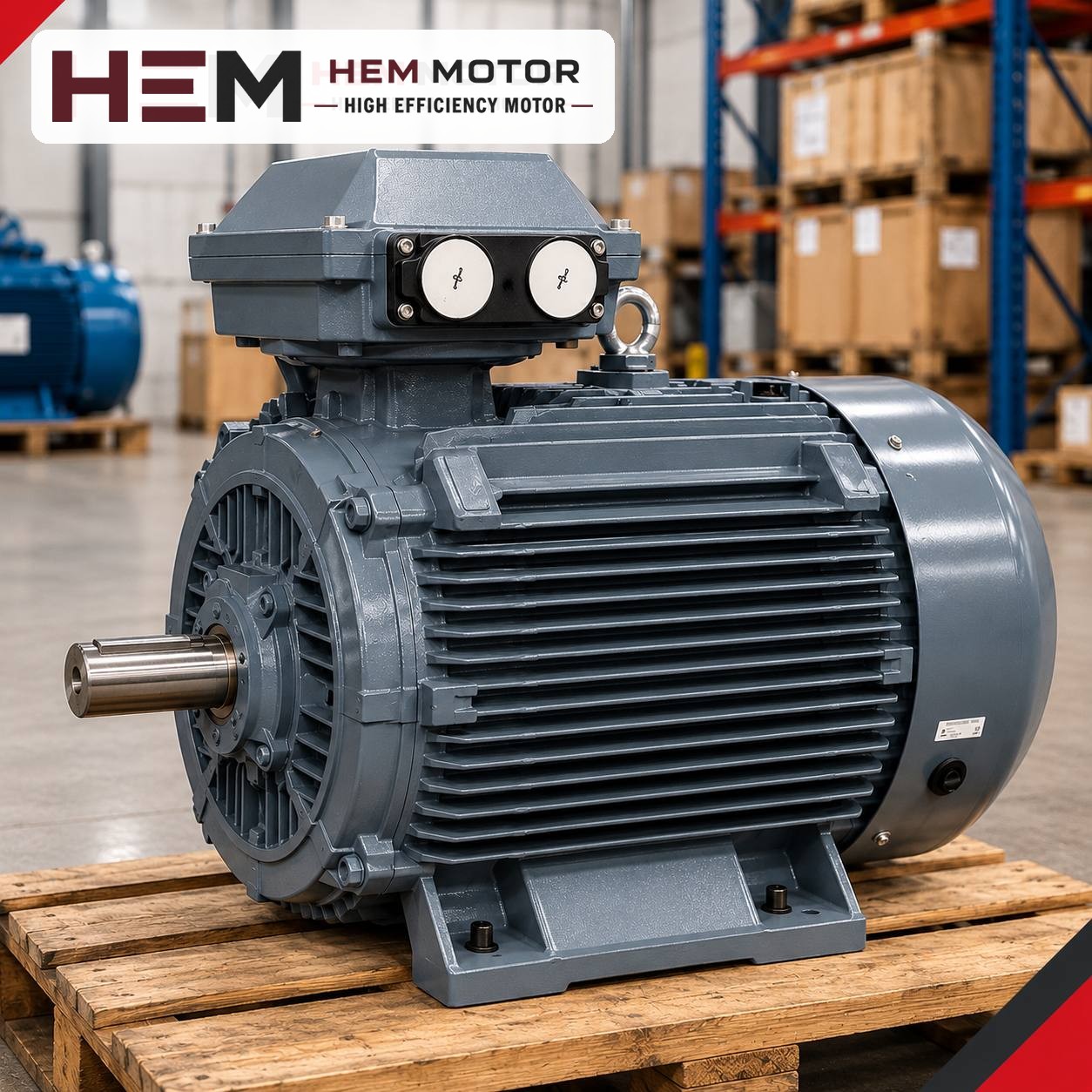

Keeping a separate spare motor for every machine in a plant is both expensive and takes up space in the store. That is why maintenance teams usually ask: "Can a single spare motor do the job for several machines?" The answer is often yes, but not by looking at the power rating alone; only when speed, frame, shaft, mounting arrangement, voltage and starting method are compared together. In this article we explain how to determine a spare motor that will fit more than one machine and in which cases a shared spare will not work. How to store a spare motor is a separate subject, which we covered in our article on keeping a spare motor on the shelf.

Inventory first: which motor is on which machine?
A shared spare plan cannot be made without an accurate list of the motors in the plant. Enter the following information for each machine in a table; most of it is read from the motor nameplate, and some is filled in by looking on site:
- Power (kW) and the rated speed on the nameplate
- IEC frame code (e.g. 132M, 160L)
- Mounting arrangement (B3, B5, B14, B34, B35, vertical)
- Nameplate voltage (230/400 V or 400/690 V) and the connection on site (star or delta)
- Starting method (direct, star-delta, soft starter, drive)
- The equipment it is connected to (coupling, pulley, gearbox, pump) and the part on the shaft end
- Frame material and operating environment (dust, moisture, outdoors)
Identify motors with unreadable nameplates at this stage. Searching for an equivalent of a motor whose nameplate has worn off at the moment of a breakdown takes much longer than planned spare-parts work.
Grouping: machines that can share the same spare
Once the table is ready, divide the machines into groups. For a group to share the same spare motor, all of the following criteria must overlap:
| Criterion | Why it matters | If it does not match |
|---|---|---|
| Number of poles / speed | Machine speed and pulley/gearbox ratio are built around this speed | The machine runs at a different speed; it cannot be a shared spare |
| IEC frame code | Shaft height, foot spacing, shaft and flange family depend on the frame | The base, coupling alignment or flange needs adapting |
| Mounting arrangement | Foot-mounted and flange connections cannot replace each other | The motor cannot be physically connected |
| Voltage and starting | Star-delta starting requires the motor to run in delta at the supply voltage | The motor runs but the starting arrangement does not fit |
| Environment and frame material | Cast iron is more suitable for dusty sites with impacts | The spare has a short life on the toughest machine |
The voltage line is often overlooked. The motor of a machine started star-delta on a 400 V supply must be rated 400/690 V (Δ/Y), because its running connection at 400 V is delta. A motor rated 230/400 V is connected in star at 400 V and is not suitable for a star-delta arrangement. In the HEM Motor series, models of 4 kW and above are rated 400/690 V and smaller powers 230/400 V; this distinction plays a direct role in choosing a shared spare.
Is it worth keeping a spare one power step up?
If there are two different powers in the same frame, you might consider keeping the larger one as the spare and using it on the lower-power machine as well. The HEM Motor range has an example of this: the 4-pole 2.2 kW (100L1-4) and 3 kW (100L2-4) models are both in a 100L frame. In terms of mechanical connection, the 3 kW motor can take the place of a 2.2 kW machine's motor.
However, this approach has its limits:
- The protection setting changes. The motor protection relay or thermal overload must be reset according to the rated current of the motor fitted. Protection left at the old setting either trips needlessly or does not protect the motor. For the roles of the protection devices, see our motor protection article.
- Cable and switchgear are checked. A larger power means a higher rated current; the cable cross-section and contactor must be suitable for it.
- If the frame changes, the advantage is lost. At 4 poles, moving up to 4 kW brings the frame to 112M; in that case it cannot be a shared spare for 100L machines.
- It is not a permanent solution. A motor one power step up serves as a temporary spare; the machine's real requirement is determined by load, duty and starting condition. Upsizing or downsizing a motor based on the machine's name is not correct.