English
 Français
 Türkçe
 Español
 Русский

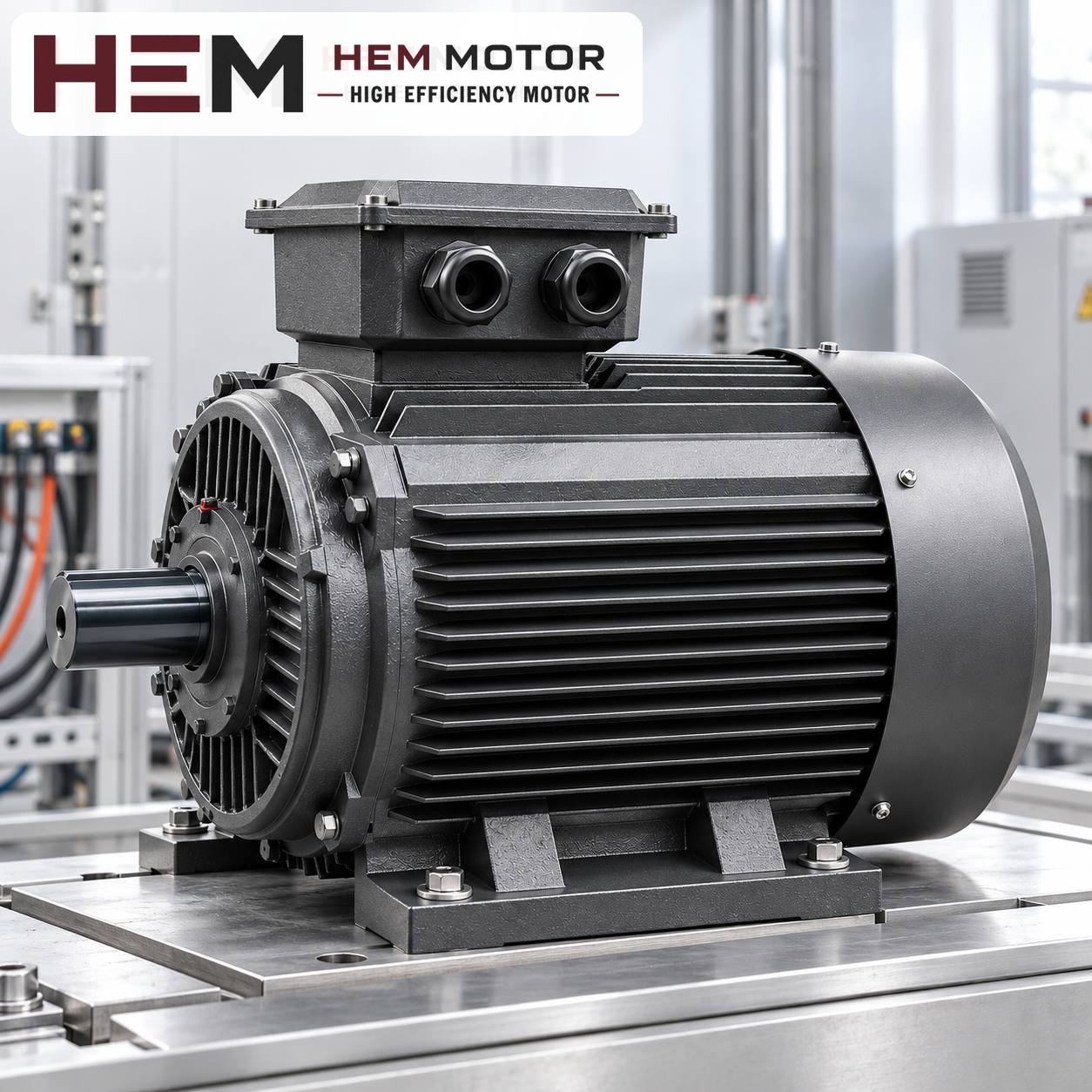

There is no quality difference between an imported electric motor and a domestically produced one that stems solely from the country where it was made. How well a motor performs is determined by the standards it complies with, the values declared on its nameplate and whether those values are backed by documents. In this article we show buyers asking "Should I buy Turkish-made or imported?" step by step which evidence to look at instead of the country of origin.
Why does the origin question look in the wrong place?
The electric motor industry has worked on a global scale for a long time. Most of the world's leading and largest electric motor manufacturers are headquartered outside Türkiye, and their production plants are not in a single country but spread across many countries from Europe to Asia and the Americas. A motor may be designed in one country, its lamination stack or casting produced elsewhere, and its assembly and final test completed in a third country.
In this picture, the label "imported" or "domestic" tells you nothing on its own about the quality of the copper, laminations, bearings and insulation material inside the motor. A very carefully made motor and an ordinary one can come from the same country. What makes a comparison meaningful is measuring both motors with the same ruler, and that ruler is the international standards.
The same ruler in every country: IEC 60034 and related definitions
The international reference for rotating electrical machines is the IEC 60034 family of standards. Whether the motor is made in Türkiye, Europe or Asia, ratings, test methods, degrees of protection and efficiency classes are declared according to the same definitions in this family. As a result, when you put two quotations from different countries side by side, you are comparing the same concepts.
Efficiency class: IEC 60034-30-1
IEC 60034-30-1 defines efficiency classes from IE1 to IE5 for line-fed asynchronous motors; the ones most commonly discussed are IE3, IE4 and IE5. The class name does not change by country: an IE3 declaration relies on the same measurement rules wherever the motor was produced. If the plant where you will install it, or the machine you will export, requires a specific class, you need to see this declaration in writing on the nameplate and in the quotation.
Degree of protection and insulation class
The IP code describes with two digits how well the enclosure is protected against dust and water. In IP55, the first digit expresses protection against dust ingress and the second digit protection against water jets from any direction. The insulation class shows the temperature limit the winding can withstand; class F is the 155 °C thermal class. These letters and digits mean the same thing whatever the origin.
CE conformity
CE marking and a declaration of conformity are required for electric motors placed on the market in Türkiye. CE shows that the manufacturer or importer has declared the product compliant with the relevant technical regulations. As a buyer, you do not have to settle for the mark on the motor; you can ask for the declaration of conformity or the CE certificate.
Evidence that indicates a quality, durable motor
A buyer who checks the items below instead of the origin evaluates domestic and imported quotations fairly. The table also shows where each item is verified:
| Checkpoint | Where is it verified? |
|---|---|
| Power, number of poles, rated speed, rated current | Motor nameplate and quotation text |
| Voltage and connection (Δ/Y), frequency | Nameplate; comparison with your supply network |
| Efficiency class declaration | Nameplate and written quotation |
| IP degree of protection and insulation class | Nameplate and technical documentation |
| CE conformity | Declaration of conformity or CE certificate |
| IEC frame number and mounting arrangement | Model code and dimension drawing |
| Technical contact in Türkiye | Seller's company name, address, contact channel |
A word of caution on durability: no nameplate alone tells you how many years a motor will run. A motor selected at the right power, with protection suited to its environment, correctly connected and protected, has a long life. A wrongly selected motor fails early regardless of its origin.
Replacement with the same IEC frame and access to documentation
The most common concern when buying an imported motor is not being able to find a replacement later. What removes this concern is, again, the standard. The IEC frame number defines the shaft centre height in millimetres; when a standard-frame motor is replaced by another motor of the same frame, the base and coupling alignment are kept in most cases. You can check the frame–power match in the IEC frame – power table.
Being able to see the dimension drawing before ordering also matters. At HEM Motor, dimensions per frame are on the 2D technical drawings page, and the model list and technical data are in the 2026 technical and product catalogue. Mounting arrangements (B3, B5, B14, B34, B35 and vertical V1/V3/V5/V6/V15) are offered depending on the frame; the flange size is confirmed with the order.