How to Choose a Spare Electric Motor for a Rebar Cutting Machine

How to Choose a Spare Electric Motor for a Rebar Cutting Machine

When buying a spare motor for a rebar cutting machine, three pieces of information give a sufficient start: the power and speed on the old motor's nameplate, the way the motor is attached to the machine (foot-mounted slide rail or flange) and the size of the pulley fitted to the shaft end. A motor that matches these three fits into place without changing the machine's flywheel, belt or cutting speed. This article explains spare motor selection for rebar cutting machines and the conditions specific to construction sites.
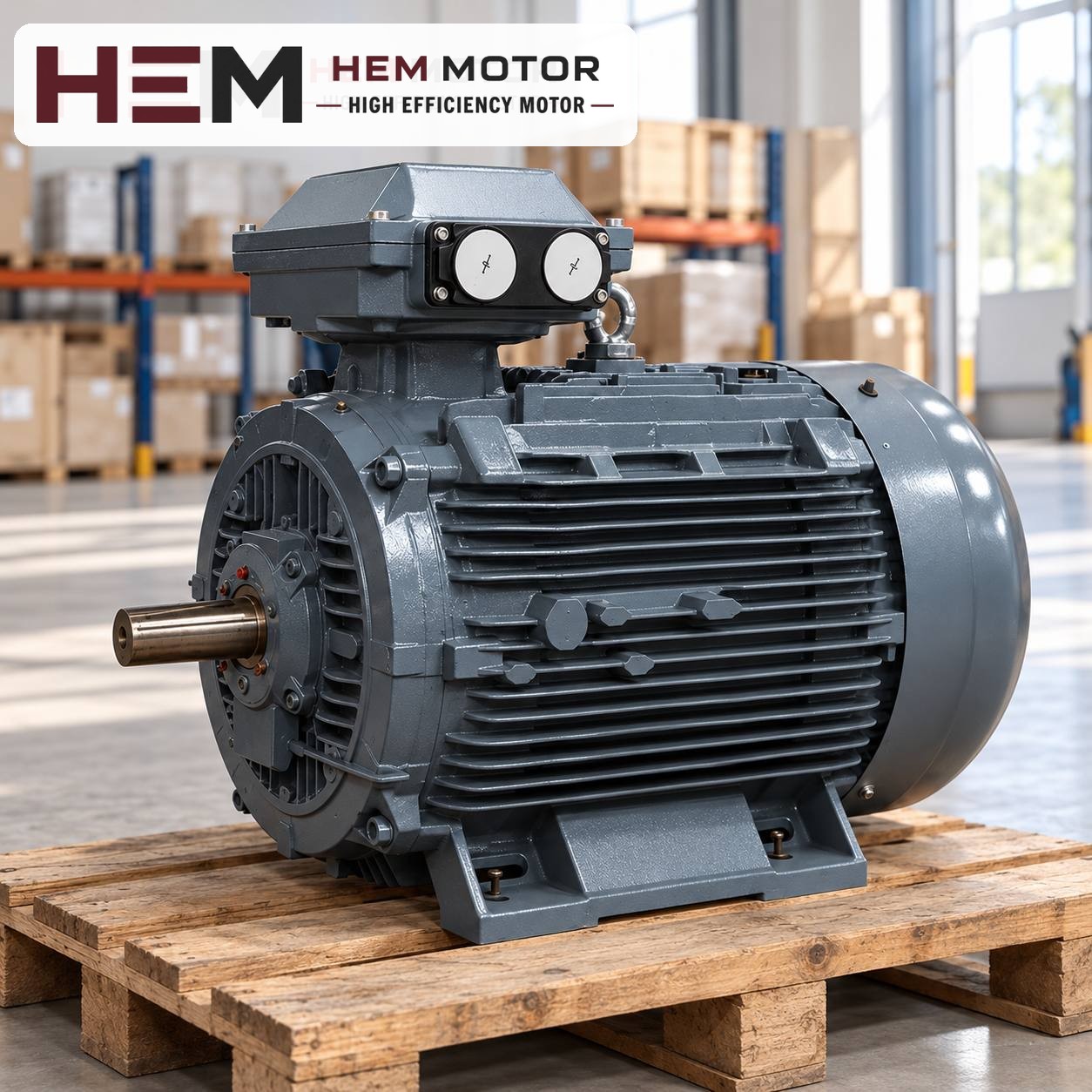
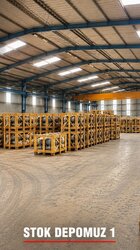
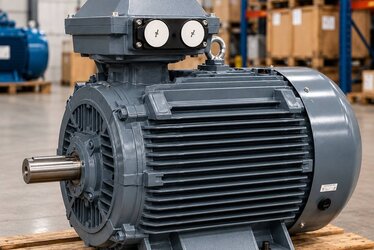
Three-phase electric motor waiting on a pallet in a warehouse
On site, a spare motor ready at the moment of failure shortens the machine's downtime (representative image).

What does the motor do in a rebar cutting machine?

In most rebar cutting machines, the motor turns a large flywheel through a belt and pulley arrangement. The flywheel drives the moving blade back and forth through a gear transmission and crank. The high force at the moment of cutting comes largely from the energy stored in the flywheel; the motor brings the flywheel back up to speed between cuts.

This design affects motor selection in two ways:

  • Moment of cutting: When a thick bar or several bars are cut at once, the flywheel slows down and the motor sees a short-term overload. At that moment the motor must not drop out of speed and stall.
  • Starting: Because the flywheel's inertia is large, the motor draws high current for several seconds at start-up. The starting load is not light even when the machine is unloaded.

Abrasive disc (cut-off) machines used for cutting metal profiles are different. In these, the disc usually turns at high speed and the motor is chosen for the disc's permissible peripheral speed. Changing the motor speed on this type of machine directly affects disc safety; the spare motor must have exactly the same speed.

Order of checks when choosing a spare motor

Do not estimate motor power from the machine name; machines of the same type are fitted with different powers and speeds by different manufacturers. The selection is made using the information read from the existing motor.

  1. Nameplate data: Power (kW), rated speed (e.g. 1,450 rpm), voltage and connection (Δ/Y), number of phases. If the nameplate cannot be read, the machine manufacturer's catalogue information is sought.
  2. Number of poles: The belt ratio and flywheel speed are set for the motor speed. Fitting a two-pole motor in place of a four-pole one turns the flywheel twice as fast and changes the blade stroke rate; this may exceed the machine's design limits.
  3. Frame code and connection: If the IEC frame code is the same, the foot hole spacing and shaft height are the same. If the motor sits on a tensioning slide rail, the holes in the rail must suit the new frame.
  4. Shaft end and pulley: If the existing pulley is to be fitted to the new motor, the shaft diameter and key size must exactly match the pulley hub. Dimensions can be compared in the 2026 technical and product catalogue.
  5. Direction of rotation: The flywheel and gear transmission may be designed to run in one direction. After the new motor is connected, the direction is checked at first start-up; if necessary, two phases are swapped.

For the mounting arrangement, the general information on our site applies: B3, B5, B14, B34, B35 and vertical V1/V3/V5/V6/V15 arrangements are offered according to the frame; the flange size is confirmed with the order. On some compact machines the motor is flange-mounted directly to the gearbox; in that case the flange size, not its name, is compared.

Site conditions: supply, dust and weather

Rebar cutting machines mostly work outdoors, in a rebar yard or supplied from a temporary site distribution board. These conditions concern the supply arrangement as much as the motor.

  • Long extension cable: A thin, long cable run from the site board to the machine lowers the voltage at start-up. A flywheel machine accelerates slowly at low voltage, the motor draws high current for a long time and the thermal protection may trip. Choose the cable cross-section according to the motor's rated current and the distance.
  • Generator supply: If a generator is used on sites without mains, the generator rating must be assessed not only against the motor's rated power but also against its starting current. A small generator may struggle to start a motor with a flywheel.
  • Phase sequence: On temporary boards, the phase sequence can change. When the machine is moved to a new board, check the direction of rotation again.
  • Dust, rain and sun: Our motors are IP55 protected with class F insulation; they are protected against dust and water splashing from any direction. If the machine stays permanently outdoors, consider a protective cover that does not expose the motor directly to rain and standing water; do not block the fan inlet.
  • Single-phase supply: Some small workshops only have a single phase. HEM Motor's product range also includes single-phase motors; however, whether a single-phase motor suits the starting load of a flywheel machine must be assessed separately. In this case, ask us with the machine details.

Prices and technical data are on the product pages; choose a model and order online.

Keeping a spare ready: which motor should wait on the shelf?

A rebar cutting machine is on the critical path on site; if it stops, formwork and concreting wait too. That is why many companies group the motors of the machines on site and keep spares. When comparing motors on different machines, if power, number of poles, frame code and shaft end are all the same, a single spare motor can serve more than one machine.

A motor waiting on the shelf also needs care. Store it in its original packaging in a dry, vibration-free place; turn the shaft by hand from time to time and, after a long storage period, measure the insulation resistance before commissioning. These steps are described in detail in the keeping a spare motor on the shelf article.

Browse suitable HEM Motor models and current prices in the online sales section. For information on industrial general-purpose machine motors, see the general-purpose industrial motors page.

Example models and a hypothetical replacement

Four-pole motors are common on belt- and flywheel-driven rebar cutting machines. Because of the dust and impact conditions on site, cast iron frames are often preferred. The models below are given as examples; the correct power is always read from the machine's own nameplate.

ModelPowerRated speedIEC frameRated current (400 V)Voltage
100L2-43 kW1,450 rpm100L6.02 A230/400 V (Δ/Y)
112M-44 kW1,450 rpm112M7.95 A400/690 V (Δ/Y)
132S-45.5 kW1,460 rpm132S10.7 A400/690 V (Δ/Y)

Do not set up the terminal links by copying the old motor. The small model in the table is rated 230/400 V, so it is connected in star on the site's 400 V line; the other two are rated 400/690 V and are connected in delta. A wrong connection either leaves the motor without enough power or overheats it in the first minutes.

Hypothetical example: suppose the motor of a rebar cutting machine on a construction site has a winding failure. The nameplate reads 4 kW, 1,450 rpm, 112M frame and 400/690 V. The 112M-4 cast iron with the same frame is chosen as the spare. Since the shaft end matches the catalogue dimension, the old pulley is transferred to the new shaft, the motor is placed on the slide rail and the belt is re-tensioned. The motor is connected in delta on the 400 V supply; at first start-up, the flywheel's direction of rotation and the starting time are checked. If the nameplates of two other machines on site show the same values, one additional spare motor is put on the shelf.

Conclusion: what to send with a spare motor request

For a rebar cutting machine, the right spare motor is found with the same power and number of poles, the same frame code and a shaft end that fits the pulley. Assess the site's supply conditions too. Share the following with your request:

  • A photo of the old motor's nameplate (power, speed, voltage, frame code)
  • How the motor is attached to the machine (slide rail, feet or flange) and the pulley hub dimension
  • Supply situation: mains, site board or generator; number of phases
  • The machine's working environment (outdoors, workshop) and daily usage intensity
  • Nameplates of any other machines using the same motor

Send a photo of your current motor's nameplate, its speed and mounting details through the nameplate submission page and request a quote for the right model. You can compare models in the buy electric motors section and use our contact page for any other questions.

Frequently Asked Questions

If I fit a more powerful motor to the rebar cutter, will it cut thicker bar?

Cutting capacity is determined by the blade, crank and frame strength; motor power does not change this limit. A more powerful motor only lets the flywheel recover faster.

Can I use a two-pole motor instead of a four-pole motor?

If the belt ratio stays the same, the flywheel turns twice as fast and the machine's design speed is exceeded. The spare motor should have the same number of poles as the old motor.

Why does the motor trip at start-up on site?

A long, thin cable lowers the voltage, the flywheel machine accelerates slowly and the motor draws high current for a long time. Check the cable cross-section and the board's output voltage.

Can I keep a spare motor on the shelf for years?

If it is stored in a dry, vibration-free place, its shaft is turned from time to time and the insulation resistance is measured before use, it can stay ready for a long time.

HEM Motor Models Related to This Article

The cards show example models related to the topic. A suitable motor is not chosen by power alone: compare speed, voltage, mounting, shaft and connection dimensions on the product page; if unsure, send a photo of the existing motor’s nameplate on WhatsApp.

3 kW 1500 rpm Cast Iron Frame Electric Motor 100L2-4

100L2-4

3 kW · 1500 rpm

  • Cast iron frame · IEC 100L
  • 1450 rpm · IP55
  • Mounting: B3 foot; flange (B5/B14/B35) depending on frame — confirmed with the order

US$202.44 (€180.91)

View product
4 kW 1500 rpm Cast Iron Frame Electric Motor 112M-4

112M-4

4 kW · 1500 rpm

  • Cast iron frame · IEC 112M
  • 1450 rpm · IP55
  • Mounting: B3 foot; flange (B5/B14/B35) depending on frame — confirmed with the order

US$252.63 (€225.77)

View product
5.5 kW 1500 rpm Cast Iron Frame Electric Motor 132S-4

132S-4

5.5 kW · 1500 rpm

  • Cast iron frame · IEC 132S
  • 1460 rpm · IP55
  • Mounting: B3 foot; flange (B5/B14/B35) depending on frame — confirmed with the order

US$339.65 (€303.54)

View product

Similar Articles