In fan and ventilation systems, the energy cost of the electric motor falls mainly in three ways: running the fan only as fast as needed, removing unnecessary resistance from the air path, and choosing the motor at a power and efficiency class that match the fan's real load. The most effective of these is speed control, because the power a fan draws does not change in proportion to speed but with the cube of speed. A fan throttled by a damper keeps the motor running at almost full power even while delivering less air.
Why does the electric motor's power draw fall so much when fan speed drops a little?
The fan affinity laws set three simple rules: airflow changes in the same ratio as speed, the pressure the fan produces with the second power of speed, and the power delivered to the shaft with the third power (general information; confirm with the fan manufacturer). A small speed change brings a large power change. This relationship creates a big opportunity in any system where air demand varies through the day. For example, reducing speed by one tenth cuts the power requirement by roughly a quarter; halving the speed brings power close to one eighth.
Take a hypothetical example. An exhaust fan running 6,000 hours a year and delivering 10 kW to the shaft consumes about 60,000 kWh at fixed speed. If the same fan ran at 80 per cent speed when demand fell, shaft power would drop to about 5.1 kW; even in only half of those hours this makes a difference of more than ten thousand kWh a year. The real figure depends on the fan curve, the duct system and drive losses; the calculation should be done with the project engineer.
Why is throttling with dampers and louvres an expensive habit?
In many older plants the air volume is set with a damper at the fan inlet or outlet. As the damper closes, flow drops. But the fan keeps turning at the same speed and the motor spends part of its energy just building pressure in front of the damper. If the fan is belt-driven, another method is changing the pulley; this is a permanent speed reduction and a cheap solution when demand is constant.
Where air demand varies by shift, season or occupancy, a frequency converter is the better tool. Our three-phase series are suitable for speed control with a frequency converter; for long periods of full-torque operation at low speed an external fan may be needed; if the drive–motor cable is long, a dv/dt or sine filter is considered; these conditions are stated in the order.
Fan torque falls quickly as speed drops. So heating of a slow-running motor is usually not a problem; it is still right to get the fan manufacturer's recommendation when selecting the drive.
Which fan suits which control method?
Fan application
Load profile
Suitable energy method
Point to watch
AHU supply and exhaust fan
Variable with occupancy
Frequency converter with pressure or CO₂ sensor
Minimum fresh air volume
Enclosed car park exhaust fan
Short peaks during the day
Staged operation with CO sensor
Role in the fire scenario
Factory general ventilation fan
Variable by season
Speed control or pulley correction
Heat load in hot periods
Dust collection and extraction fan
Variable with number of machines
Speed control with branch dampers
Minimum air velocity in ducts
Drying and process fan
Constant, long hours
Correct power and high efficiency class
Ambient temperature
The last row of the table matters. On a fan whose load does not change and which runs more than twenty hours a day, the contribution of speed control is limited. For such fans the source of savings is the right motor power and efficiency class.
How does an oversized fan electric motor inflate the bill?
Fan motors are often chosen one or two sizes larger with future capacity growth in mind. This has a price. In an induction motor both efficiency and power factor decline when it runs well below rated load; the motor produces more reactive and active losses relative to the work it does. In plants where fan speed has been reduced over time by belt and pulley changes, this becomes even more pronounced.
A simple measurement gives an idea. With the fan at its usual load, the current of each phase is read with a clamp meter and compared with the rated current on the nameplate. If the current stays far below the rated value, the motor is larger than the fan needs. The replacement decision should be made by looking at the fan curve, duct pressure and future capacity plans together; the motor power is set by the fan's heaviest operating condition.
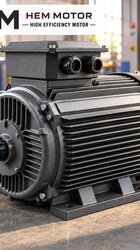
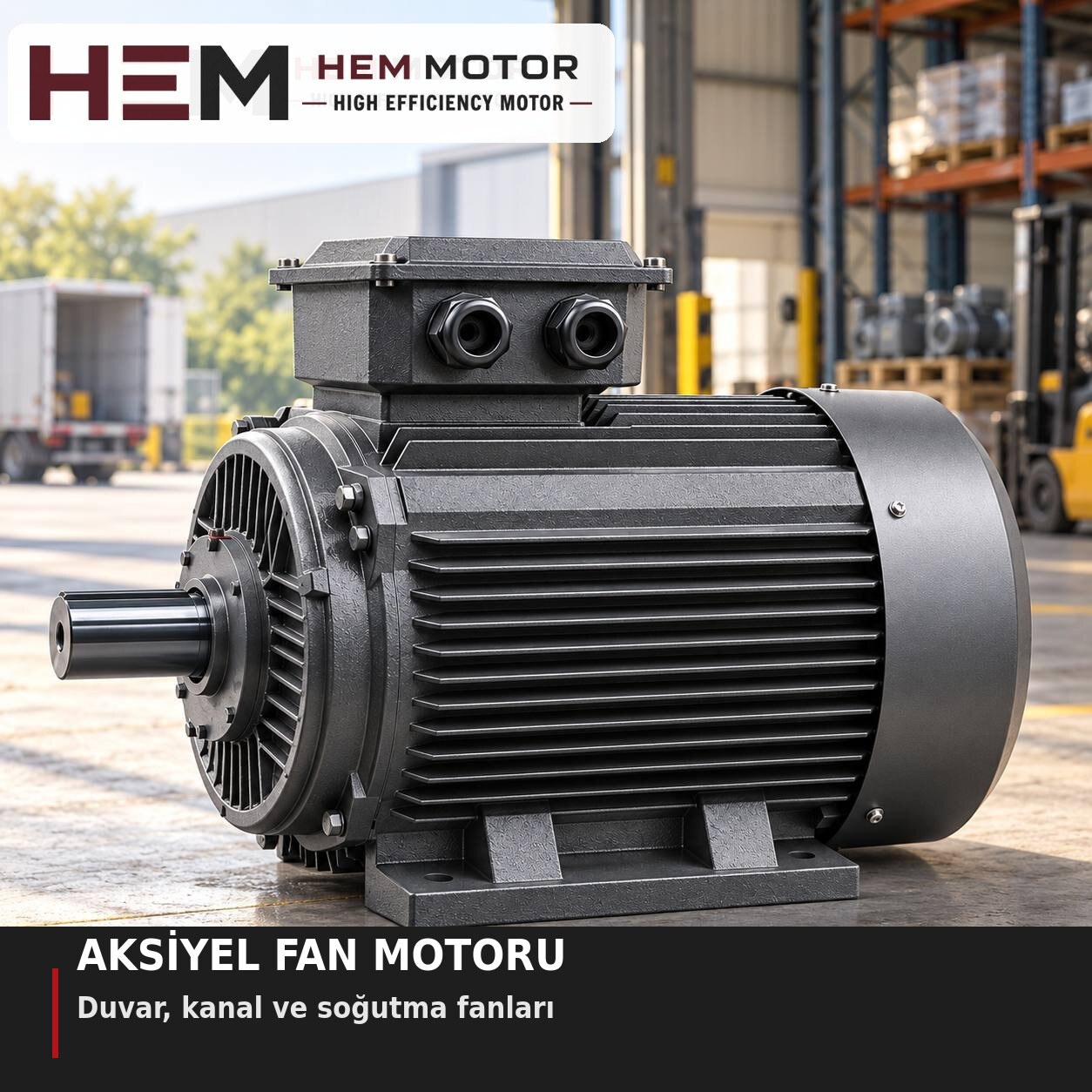
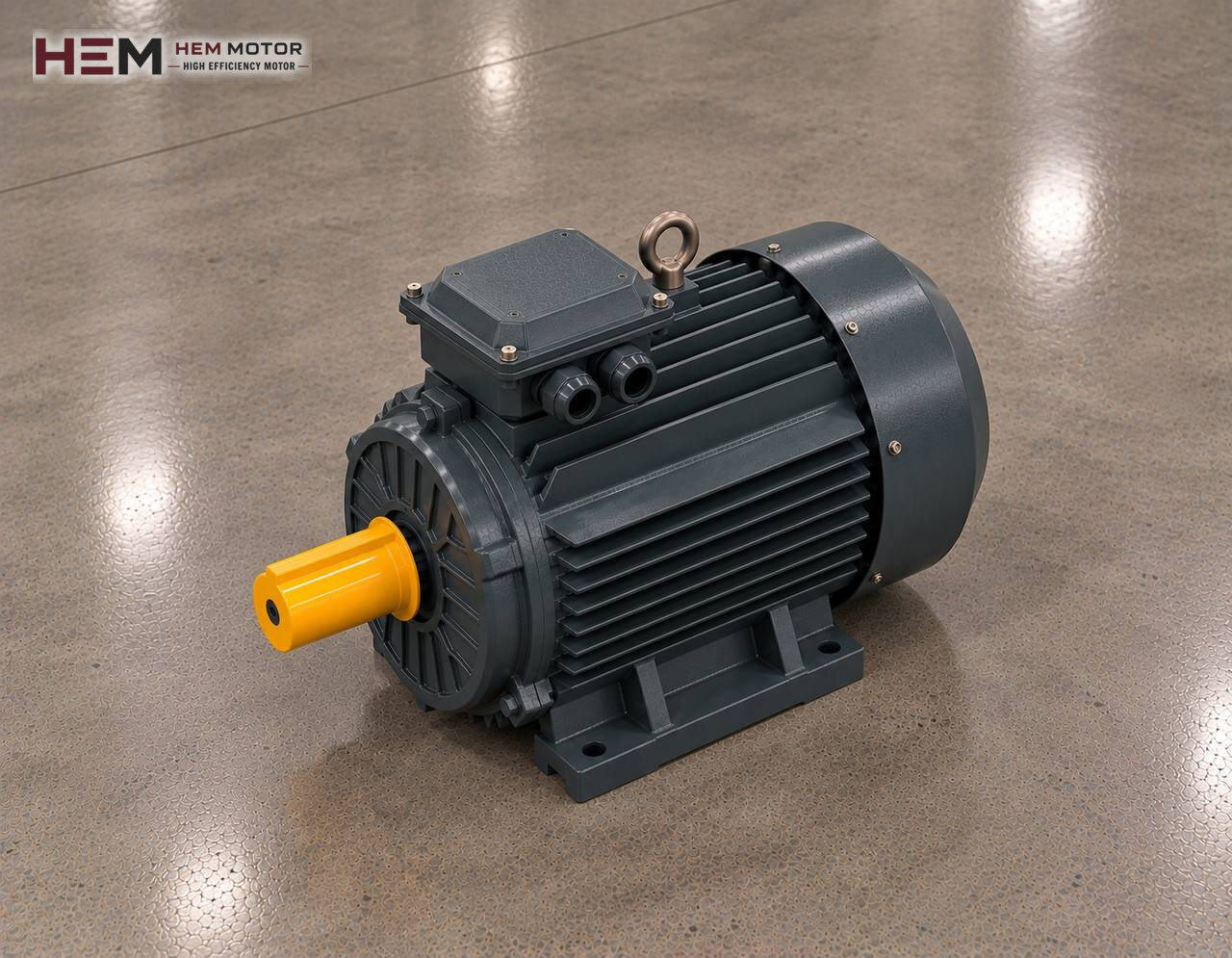
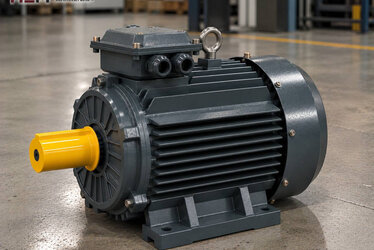
Electric motor driving a duct-type centrifugal fan (representative image).
Prices and technical data are on the product pages; choose a model and order online.
When does the IE3, IE4 or IE5 efficiency class make a difference in a fan motor?
As the efficiency class rises, losses inside the motor fall. How much of this reaches the bill depends on how many hours a year and at what load the motor runs. On a smoke extraction fan that only comes on during a fire, a high efficiency class hardly pays for itself; on an air handling unit or drying fan that runs day and night all year, the difference shows on the meter every month.
HEM Motor offers IE3, IE4 and IE5 efficiency class options. When deciding, calculating with your own plant's operating hours, average load and unit electricity price is sounder than relying on estimated figures. The best moment to rethink the efficiency class, instead of replacing a failed old fan motor with the same class, is the moment of replacement.
Ducts, filters and belts: losses the motor cannot see
Part of the energy a fan motor draws goes into overcoming unnecessary resistance in the system rather than moving air. Clogged filters, dirty heating and cooling coils, sharp elbows and crushed flexible connections raise the fan's pressure. Fitting a gauge to monitor filter differential pressure and changing filters by pressure rather than by calendar stops the motor carrying needless load.
On belt-driven fans a loose belt slips, generates heat and lowers fan speed; the operator then fits a larger pulley and makes the problem worse. Belt tension and pulley alignment need regular checking, and worn pulleys must be renewed in time.
Switching to direct-drive fans where possible eliminates belt losses altogether.
Dirt build-up on the fan impeller also reduces efficiency and upsets balance. Especially on kitchen hood, paint booth and dust extraction fans, impeller cleaning should be part of the maintenance plan; an unbalanced impeller also wears the motor bearings.
Which electric motors can be considered for fan applications?
The system's needs should be clarified first and the motor chosen afterwards. Examples for typical fan powers:
For small air handling units, kitchen exhausts and duct fans, the 3 kW aluminium-frame 100L2-4 runs at a rated speed of 1450 rpm with 230/400 V.
For medium-sized AHU and factory ventilation fans, the 11 kW aluminium-frame 160M-4 can be considered; its rated speed is 1465 rpm and its voltage 400/690 V.
For dust collection and large extraction fans there is the cast-iron-frame 160L-4 in the 15 kW class; it runs at a rated speed of 1465 rpm with 400/690 V.
Other options for fan applications are collected on the fan and extractor motors page, and powers suited to building ventilation on the ventilation electric motors page. You can compare power and frame combinations together with efficiency class options in the electric motor list in our shop. For smoke extraction fans working with high-temperature gas, this duty requires a special motor; it may fall outside the scope of the standard series in HEM Motor's 2026 catalogue, ask us with the nameplate and application details.
Measurement takes the first step in fan energy
Lowering energy costs in fan and ventilation systems starts with knowing which fan runs for how many hours and at what load; speed control, reducing system resistance and choosing the right motor follow. When renewing your long-running fans, you can review efficiency class options among the models suited to fan powers in the shop. If you send us the nameplate of the fan motor you are thinking of replacing and the fan's operating hours through the channels on our contact page, we will assess power and efficiency class with you. HEM Motor prepares and dispatches orders from İzmir/Buca; the WhatsApp and phone buttons on the site are open for this too.
Frequently Asked Questions
Does connecting a frequency converter to every fan lower the bill?
Not always; the gain depends on how long the fan can run at reduced speed during the day. On fans with a constant load that always need full flow, the drive can add consumption equal to its own losses.
If the fan motor is oversized, should I replace it right away?
First measure the current and determine the fan's heaviest operating condition. Moving to the right power when the motor fails or the system is renewed is usually the more economical timing.
Can a belt-driven fan be converted to direct drive?
It is possible if the impeller and speed are suitable; the impeller's fit to the motor shaft and the required speed should be checked with the fan manufacturer. If the speed differs, direct drive may need a frequency converter.
Does changing filters affect the motor's energy consumption?
Yes; a clogged filter raises system pressure and shifts the fan's operating point. Timing filter changes by monitoring differential pressure protects both air quality and energy.
HEM Motor Models Related to This Article
The cards show example models related to the topic. A suitable motor is not chosen by power alone: compare speed, voltage, mounting, shaft and connection dimensions on the product page; if unsure, send a photo of the existing motor’s nameplate on WhatsApp.
For a filter press feed pump, the electric motor is selected for the heaviest moment of the cycle; on a press with a centrifugal pump this moment is usually the start of filling, b... More Details
When choosing an electric motor for a dosing pump, the adjustment range is the flow band produced jointly by the stroke length setting and the motor speed. Mounting dimensions are ... More Details
When choosing an electric motor for a mono pump (progressive cavity pump with a helical rotor), the decisive factor is often not running power but the breakaway torque at the first... More Details
When choosing a motor for a peristaltic pump, the deciding value is not flow or pressure but the torque the rotor needs to squeeze the hose. The rotor turns slowly, so a gearbox al... More Details
When choosing an electric motor for a vegetable washing drum, two things are considered together: how well the motor will withstand splashing and wash water, and at what speed and ... More Details
The gap between an electric motor's fan cover and the wall behind it is the only inlet section through which cooling air reaches the fan; if this gap is smaller than the open area ... More Details
We use necessary and optional cookies to improve your experience, enhance content and analyse traffic. Under the GDPR, optional (analytics/marketing) cookies are only used with your explicit consent. Please choose your preference below.
Cookie Policy
 English
 Français
 Türkçe
 Español
 Русский
 العربية
 Deutsch
 Italiano