Yes. The power drawn by the cooling fan mounted on the motor's own shaft is included in the total losses under "friction and windage loss" when efficiency is measured; the catalogue efficiency is given with this loss already deducted. The power of an independent (separate) fan driven by its own small motor, however, does not appear in the main motor's efficiency and is added to the system calculation separately.
Into which items are the losses of an induction motor divided?
In the indirect method of IEC 60034-2-1, total loss is split into five items: stator winding loss, rotor loss, iron loss, friction and windage loss, and additional load losses (general information; for details see the standard itself). Efficiency is the ratio of shaft power to input power, which is shaft power plus these losses.
Loss item
Where it comes from
Relation to load
Stator winding loss
Resistance of the copper winding
Rises with the square of current
Rotor loss
Rotor bars and slip
Grows with load
Iron loss
Hysteresis and eddy currents in the lamination stack
Depends on voltage and frequency, almost independent of load
Friction and windage
Bearings, fan, air drag on the rotor
Depends on speed, almost independent of load
Additional load losses
Leakage flux, harmonic fields
Grows with load
The fan sits inside the fourth row. It is measured together with bearing friction as a single value and is not listed separately.
How is fan loss separated in the measurement?
In the no-load test the motor runs unloaded and input power is recorded while the voltage is lowered step by step. This power contains iron loss, friction and windage, and a small winding loss. After subtracting the winding loss, the remainder is plotted against the square of voltage; extending the curve to zero voltage, the intercept gives the friction and windage loss (general information).
The logic is simple. Iron loss falls with voltage, while fan and bearings keep their loss as long as the motor keeps turning.
Freshly greased bearings rub a little more in their first hours, so the test is done after the motor has warmed up. A reading taken on a cold motor shows friction loss larger than it is.
This method does not separate fan from bearings. Anyone wanting to see what the fan alone draws would have to remove it and repeat the same test, which can only be done in a workshop.
How do speed and pole count change fan loss?
A fan behaves like a pump: the power it draws rises roughly with the cube of speed. In the same frame, a 2-pole motor turns at roughly twice the speed of a 4-pole one, so fan loss can grow by the cube of that ratio; in practice fan diameter and blade shape soften this difference somewhat (general information; confirm per model with the manufacturer).
That is why manufacturers turn to smaller-diameter or unidirectional fans on large 2-pole motors. Noise drops for the same reason.
Three pole options at the same power make the difference concrete:
160M1-2: cast iron, 11 kW, 2945 rpm, 19.6 A at 400 V, 35.7 Nm.
160M-4: cast iron, 11 kW, 1465 rpm, 20.4 A at 400 V, 71.7 Nm.
160L-6: cast iron, 11 kW, 970 rpm, 22.0 A at 400 V, 108.3 Nm.
All three deliver the same shaft power. In the 2-pole one the fan's share is clearly higher; in the 6-pole one fan loss falls but magnetic losses and current rise. Which is more efficient follows from the overall loss balance, not from the pole count. The prices of the three models can be seen side by side on our shop page.
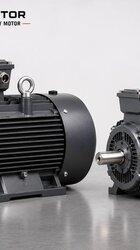
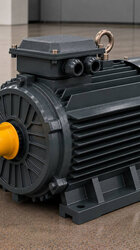
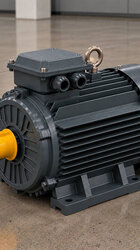
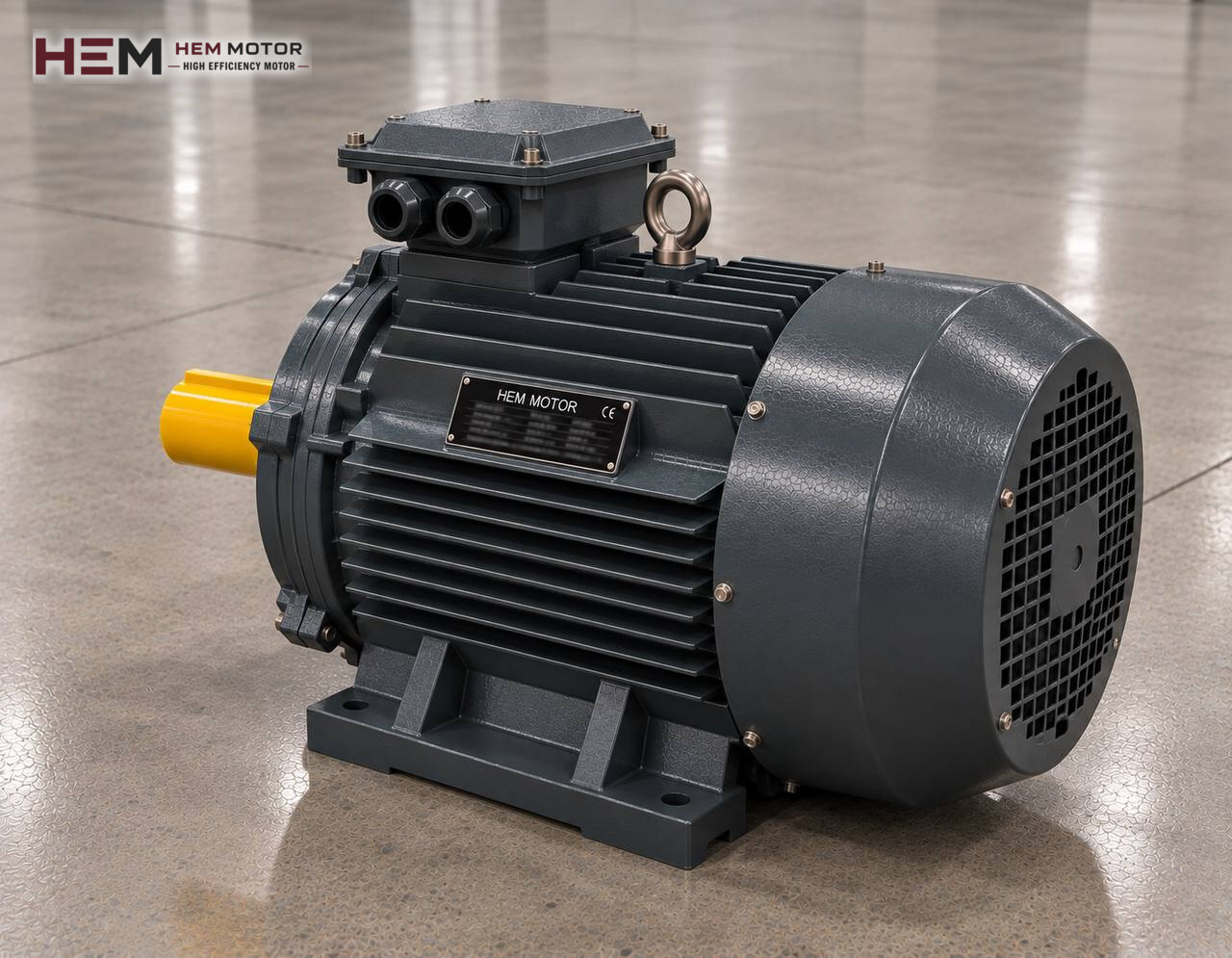
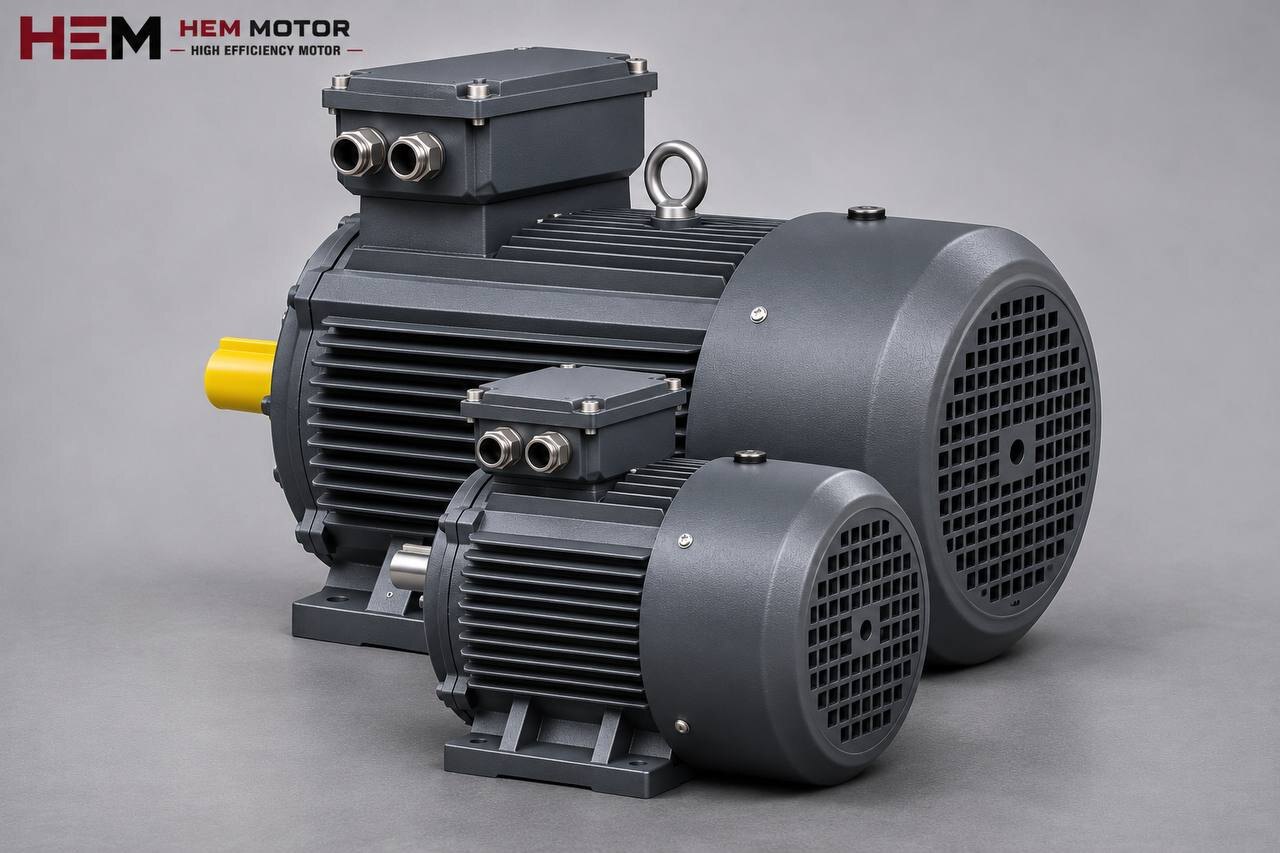
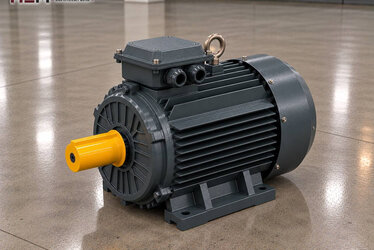
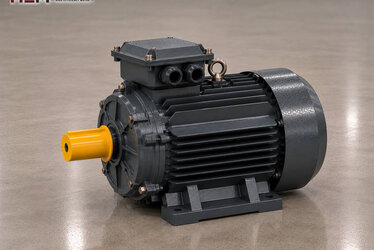
The power used by the shaft-mounted fan enters the motor's efficiency calculation as friction and windage loss (representative image).
Prices and technical data are on the product pages; choose a model and order online.
How is efficiency read on a motor with an independent fan?
In cooling designated IC416, the fan is connected not to the main motor's shaft but to a separate small motor. The main motor's catalogue efficiency then excludes fan loss; the power drawn by the fan motor is a separate consumer. For the difference between cooling methods, see our IC411 and IC416 cooling guide.
Forget this distinction when comparing two motors and the result comes out wrong. A motor with an independent fan can look a point or two more efficient on paper, while total system consumption may be the same or higher once the small fan motor is added.
A hypothetical calculation: a motor delivering 11 kW shaft power with a catalogue efficiency of 0.92 draws about 11.96 kW. Another motor doing the same job with an independent fan draws 11.83 kW at 0.93 efficiency, and if the fan motor uses 0.12 kW, the total is 11.95 kW. The difference almost vanishes. The figures are an example; real values must be taken from catalogues.
What happens to fan loss at low speed with a frequency converter?
As speed falls, the power drawn by the shaft-mounted fan drops quickly, a positive effect in the loss calculation. But the same fan is also the source of cooling: at low speed airflow falls, and if the motor runs at full torque the winding heats up.
For a motor that will turn at full torque around 15 Hz for hours, an independent fan is a serious option. Our three-phase ranges are suitable for speed control with a frequency converter; for long running at low speed with full torque a separate fan may be needed; if the drive-to-motor cable is long, a dv/dt or sine filter is considered; these conditions are stated when ordering.
With loads whose torque also falls with speed, such as pumps and fans, this problem usually does not arise. With constant-torque loads, for example a belt conveyor or a thick-consistency mixer, noting the frame temperature during the first weeks is wise.
Should you ask about fan loss when buying?
Usually not; the catalogue efficiency already carries this loss. The time to ask is when you compare two different cooling methods or a motor with a separate fan; then the fan motor's power should be written separately in the quotation.
If you send the two quotations you have, or the nameplate of the old motor, via our contact page, we will compare them together, taking the difference in cooling method into account. Other models are on the HEM Motor sales page.
Frequently Asked Questions
Does the catalogue efficiency include fan loss?
For a motor cooled by its own shaft-mounted fan, yes. Friction and windage loss is part of the measured total loss.
Does running the motor with the fan removed raise efficiency?
Loss falls slightly, but the motor is left without cooling and overheats quickly. It is not a way to save energy.
Where is the power of a separate fan motor recorded?
Outside the main motor's efficiency, added to the system energy calculation as a separate consumer.
Why are 2-pole motors noisier?
Fan and rotor turn at higher speed. Noise from airflow and fan loss rise quickly with speed.
HEM Motor Models Related to This Article
The cards show example models related to the topic. A suitable motor is not chosen by power alone: compare speed, voltage, mounting, shaft and connection dimensions on the product page; if unsure, send a photo of the existing motor’s nameplate on WhatsApp.
In electric motor modernisation, motor, pump and pipeline are assessed as a single system: first the flow and head the line really needs are determined, then where the pump works o... More Details
In an energy audit for an electric motor, the measuring points should be set as the panel outgoing feeder that supplies the motor, the motor terminal box and, where possible, the s... More Details
A copper rotor has lower electrical resistance than an aluminium rotor, so it reduces rotor losses and can deliver higher efficiency in the same frame; but the efficiency class can... More Details
The test method in an efficiency report should be asked about because the same electric motor can give different efficiency values when measured by different methods, and when two ... More Details
In an electric motor replacement project, the reduction in carbon emissions is calculated by taking the difference in energy that the old and new motors draw from the supply for th... More Details
Excess power margin keeps the electric motor running permanently at part load: the motor does not fail, but at low load its efficiency slips a little, its power factor drops notice... More Details
We use necessary and optional cookies to improve your experience, enhance content and analyse traffic. Under the GDPR, optional (analytics/marketing) cookies are only used with your explicit consent. Please choose your preference below.
Cookie Policy
 English
 Français
 Türkçe
 Español
 Русский
 العربية
 Deutsch
 Italiano