The overall efficiency of an electric motor and gearbox is found by multiplying the two efficiencies: ηtotal = ηmotor × ηgearbox. For example, if a motor with 0.90 efficiency drives a helical gearbox with 0.95 efficiency, the overall efficiency of the chain is about 0.855; in other words, roughly 85.5 units of every 100 units of energy drawn from the supply reach the output shaft.
Why is overall efficiency found by multiplying rather than adding?
Because each element loses part of the power it receives and passes the rest on to the next one; losses stack up along the chain.
While turning the electrical power taken from the supply into shaft power, the motor has copper, iron, friction and fan losses. The gearbox, passing power from its input shaft to its output shaft, produces gear friction, oil churning and bearing losses. The gearbox loss is calculated on power that the motor has already reduced.
That is why adding the two efficiencies or taking their average makes no sense. If a coupling, a belt or a second gearbox stage is added to the chain, its efficiency enters the product by the same logic:
ηtotal = ηmotor × ηgearbox × ηbelt × …
How much does gearbox efficiency vary with gear type?
The most marked difference is seen in worm gearboxes; helical, bevel-helical and parallel-shaft gearboxes run with high efficiency per stage, while a worm gear produces noticeably more loss as the ratio grows.
In helical gearing the contact is mainly rolling and friction loss is small. Between a worm and its wheel, however, the contact is sliding; the worm thread rubs its way along the wheel tooth. As the ratio grows the helix angle shrinks and sliding increases. That is why high-ratio worm gearboxes run with clearly lower efficiency than a multi-stage helical gearbox of the same ratio.
The number of stages also affects the product. In a three-stage helical gearbox the efficiency of each stage is multiplied one by one. Do not write values from guesswork; use the efficiency table given by ratio and input speed in the gearbox manufacturer's catalogue (general information; confirm with the gearbox manufacturer).
Oil temperature tells a lot. Under the same load, the housing of a worm gearbox runs visibly hotter than a helical one; measuring both housings with an infrared thermometer reveals the loss difference even before it is put into numbers.
Hypothetical calculation: a 7.5 kW motor and a worm gearbox
Consider a chain driving a conveyor drum. A cast iron 132M-4 motor (7.5 kW, 1460 rpm, 14.3 A at 400 V) drives a gearbox. Assume a motor efficiency of 0.91 and two gearbox options.
Item (hypothetical)
Helical gearbox
Worm gearbox
Gearbox efficiency
0.95
0.75
Overall efficiency
0.91 × 0.95 ≈ 0.865
0.91 × 0.75 ≈ 0.683
Power required at output shaft
5.0 kW
5.0 kW
Power drawn from supply
5.0 / 0.865 ≈ 5.78 kW
5.0 / 0.683 ≈ 7.32 kW
Power required at motor shaft
5.0 / 0.95 ≈ 5.26 kW
5.0 / 0.75 ≈ 6.67 kW
For the same drum, the power drawn from the supply differs by about 1.54 kW. The power needed at the motor shaft differs too: with the helical gearbox the 7.5 kW motor runs comfortably, with the worm gearbox it approaches 89% of its load. If drum load rises slightly, the worm option pushes the motor to its rated power.
The annual difference can also be calculated: 1.54 kW × annual running hours = kWh difference; multiply this by your own electricity unit price. The numbers are hypothetical; take the gearbox efficiency from your own gearbox's catalogue.
Prices and technical data are on the product pages; choose a model and order online.
How is overall efficiency used when choosing motor power?
The power the machine needs at its output shaft is divided by the efficiency of all elements between motor and machine; the motor's rated power is chosen above this value.
Pmotor ≥ Poutput / (ηgearbox × ηother)
Motor efficiency is not used here, because the kW on the motor nameplate is already output power at the shaft. Motor efficiency comes in only when calculating power drawn from the supply and energy cost. This distinction is often confused on site: a calculation that also divides by motor efficiency leads to a motor larger than needed.
Working with torque is often more practical. If the torque and speed required at the output shaft are known, the torque at the motor shaft is found like this:
Tmotor = Toutput / (i × ηgearbox)
Here i is the reduction ratio. The torque found is compared with the motor's nominal torque; the extra torque required at start and the operating margin the gearbox manufacturer recommends for the load class are accounted for separately. The margin on the gearbox side is defined in the gearbox catalogue and must not be confused with the motor's nameplate values.
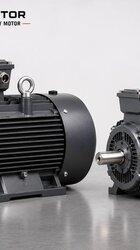
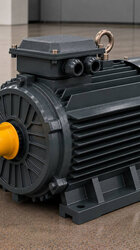
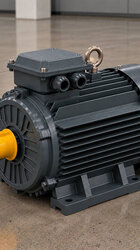
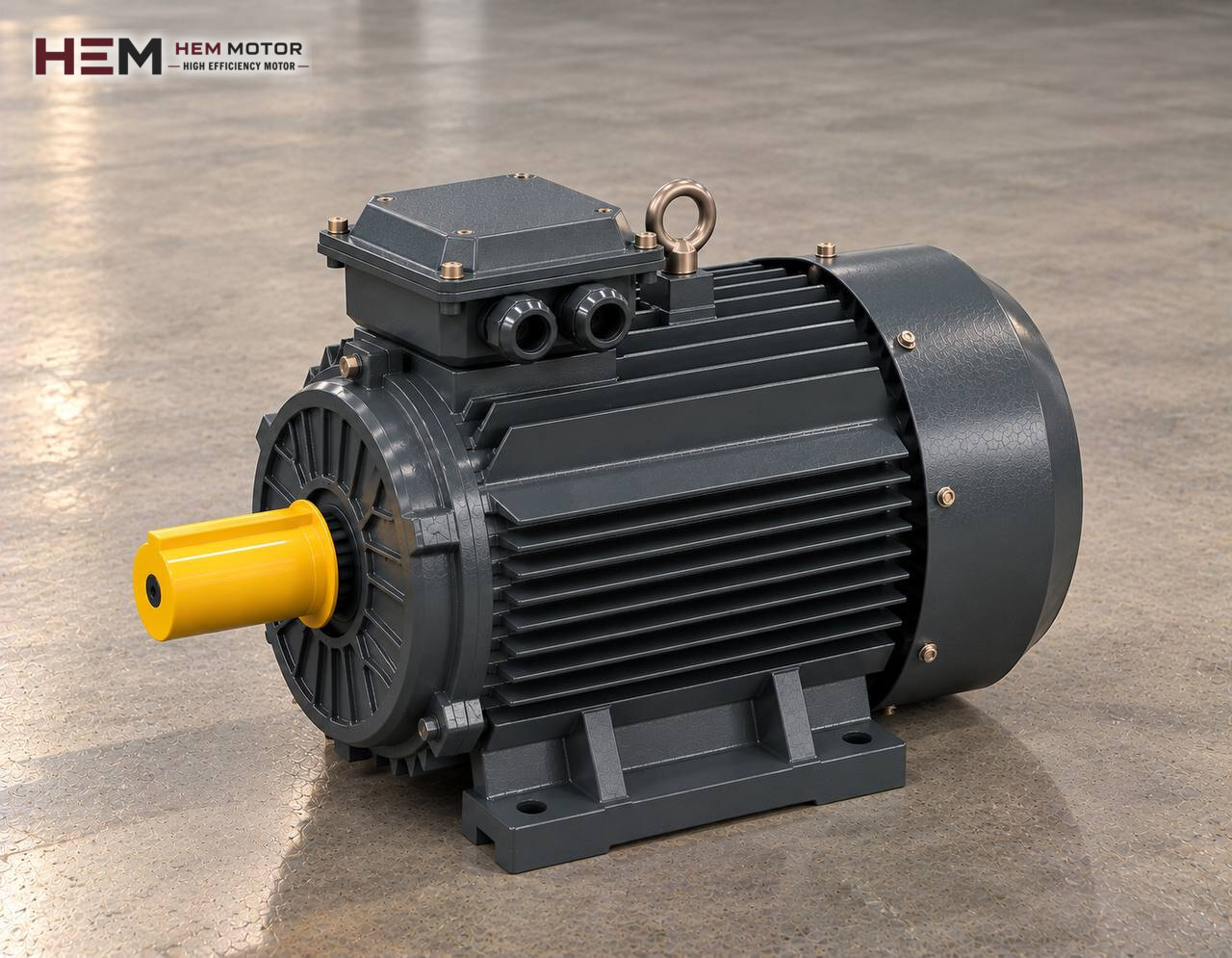
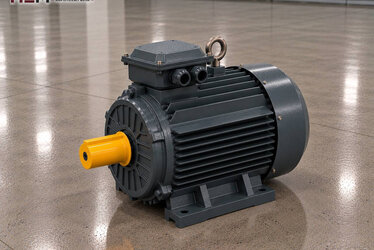
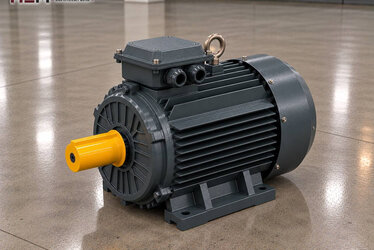
In a helical geared drive, overall efficiency is the product of motor and gearbox efficiency (representative image).
How is overall efficiency measured on site?
Power drawn from the supply is found with a power analyser, and power at the output shaft by measuring torque and speed; the ratio of the two is the overall efficiency. Measuring output torque directly is not possible in every plant, so indirect routes are used in practice.
A workable method goes like this. On the motor side, kW and cos φ are recorded with a three-phase analyser. At the gearbox output, speed is measured with an optical tachometer. Output torque is calculated from a known load of the machine: belt tension and drum diameter on a conveyor, load and drum radius on a hoist. The calculation is rough, but repeated with the same method over the years it shows the change.
A simpler route exists: regularly logging motor current and gearbox oil temperature under the same load condition. If current and temperature rise together, friction in the gearbox has increased; oil level, oil colour and gear backlash are checked. Seeing current drop slightly after an oil change is a familiar picture.
Where do you start to raise overall efficiency?
First find the least efficient element in the chain; in most drives this is the gearbox rather than the motor. If a high-ratio worm gearbox can be replaced with a helical or bevel-helical one, the gain is usually larger than raising the motor's efficiency class.
The motor matters too. HEM Motor offers motors in IE3, IE4 and IE5 efficiency classes; which class is supplied for a particular model is confirmed with the order. General information on high efficiency classes is on the IE4 electric motors page. Frame and flange options that match gearboxes are gathered on the electric motors for gearboxes page. You can compare models by power and speed in the electric motor shop.
Example models: cast iron 112M-4 (4 kW, 1450 rpm, 26.3 Nm), 132M-4 (7.5 kW, 49.1 Nm) and 160M-4 (11 kW, 1465 rpm, 71.7 Nm). All are 4-pole, so they suit the standard gearbox input speed. Mounting type and flange size are confirmed with the order according to the gearbox; see the technical drawings for dimensions.
Send the gearbox nameplate, reduction ratio and motor nameplate of your existing drive through our contact page; we will calculate the overall efficiency of the chain with your values and check together whether the motor power was chosen correctly. 4-pole models suitable for gearboxes are listed with their torque values in the HEM Motor product list.
Frequently Asked Questions
Should I take motor efficiency into account when choosing a motor?
Not for power selection; the kW on the motor nameplate is already shaft power and is divided only by the efficiency of the gearbox and other elements. Motor efficiency is used when calculating energy consumption.
Why is the efficiency of a worm gearbox low?
The contact between worm and wheel is mainly sliding and friction loss is large. Loss increases as the ratio rises; the value is given by ratio in the gearbox catalogue.
Does gearbox efficiency change over time?
Aged oil, the wrong oil level and gear wear reduce efficiency. A rise in motor current and oil temperature under the same load is the first sign.
How is overall efficiency calculated for a two-stage gearbox?
The efficiency of each stage is multiplied separately, and the result is multiplied by motor efficiency to find the efficiency of the whole chain. The gearbox manufacturer's table is used for stage efficiencies.
HEM Motor Models Related to This Article
The cards show example models related to the topic. A suitable motor is not chosen by power alone: compare speed, voltage, mounting, shaft and connection dimensions on the product page; if unsure, send a photo of the existing motor’s nameplate on WhatsApp.
In electric motor modernisation, motor, pump and pipeline are assessed as a single system: first the flow and head the line really needs are determined, then where the pump works o... More Details
In an energy audit for an electric motor, the measuring points should be set as the panel outgoing feeder that supplies the motor, the motor terminal box and, where possible, the s... More Details
Yes. The power drawn by the cooling fan mounted on the motor's own shaft is included in the total losses under "friction and windage loss" when efficiency is measured; the catalogu... More Details
A copper rotor has lower electrical resistance than an aluminium rotor, so it reduces rotor losses and can deliver higher efficiency in the same frame; but the efficiency class can... More Details
The test method in an efficiency report should be asked about because the same electric motor can give different efficiency values when measured by different methods, and when two ... More Details
In an electric motor replacement project, the reduction in carbon emissions is calculated by taking the difference in energy that the old and new motors draw from the supply for th... More Details
We use necessary and optional cookies to improve your experience, enhance content and analyse traffic. Under the GDPR, optional (analytics/marketing) cookies are only used with your explicit consent. Please choose your preference below.
Cookie Policy
 English
 Français
 Türkçe
 Español
 Русский
 العربية
 Deutsch
 Italiano