English
 Français
 Türkçe
 Español
 Русский

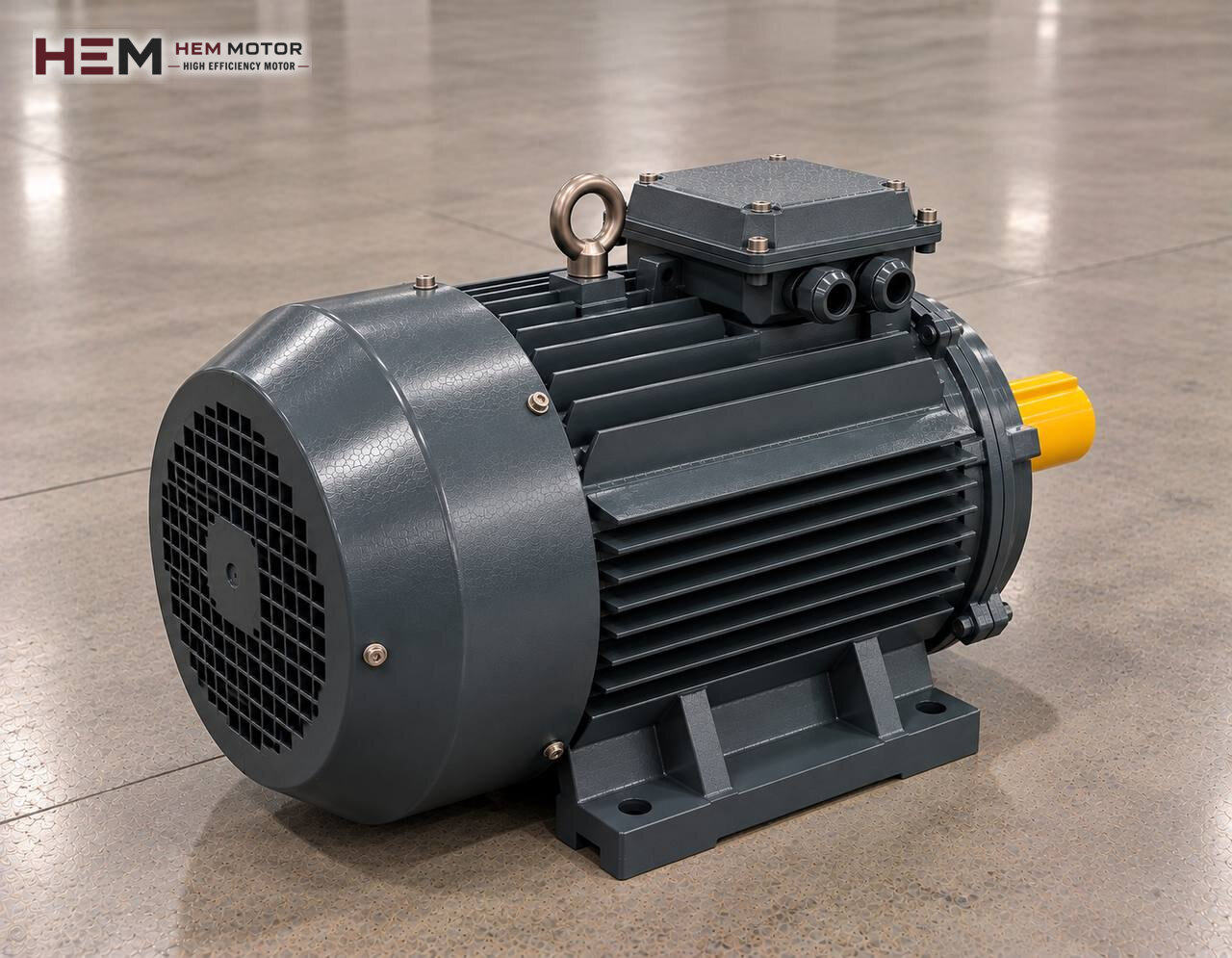
Mixed packaging waste or household waste is tipped into a sorting plant by truck; at the outlet, paper, plastic types, metal and glass have been collected separately. The line that achieves this separation is not one large machine but many small and medium drives, each running on its own motor. Below we cover these drives station by station; for crushers, presses and shredders you can return to the parent page, waste processing and recycling machine electric motors.

From Bunker to Picking Cabin: The Feed Side
At the start of the line, waste is received into a bunker or onto a floor-level infeed conveyor. An apron feeder or chain conveyor is usually used here; the aim is to spread the heaped material onto the line in an even layer.
The feeder motor needs high torque at low speed and almost always works through a gear reducer. Restarting a feeder that has stopped under a full bunker is one of the hardest starts on the line. That is why in most plants the feed rate is set with a frequency inverter; when the downstream machines fill up, the feeder is slowed down.
If there is a bag opener, this machine consists of a slowly turning toothed shaft that tears the bags and releases their contents. Its load is irregular; when a hard object catches in the teeth, the torque rises suddenly.
Trommel and Star Screen: Separation by Size
A trommel screen is a large, perforated, slightly inclined cylinder that rotates slowly. Small pieces fall through the holes, large ones leave at the end of the drum. The drum is turned by a motor and gear reducer or by a chain or drive rollers.
Starting the drum is an inertia start: setting a loaded cylinder in motion needs more torque than keeping it turning. When wet, sticky material builds up inside the drum an imbalance forms and the load fluctuates on every revolution.
On star (disc) screens, rubber or steel stars on shafts arranged side by side rotate; flat material (cardboard, film) travels on top, while small and heavy pieces drop through the gaps. The shaft groups are usually linked by chain and draw power from one or several motors. As film and string wrap around the shafts the load rises gradually; this slow rise in motor current is a good indicator that cleaning is due.
Ballistic Separator, Magnet and Eddy Current
In a ballistic separator, inclined paddles on eccentric shafts move with a rocking motion. Flat, light pieces climb upward, while round, heavy ones roll down. The eccentric shaft creates a continuous oscillating load; the motor and belt must be mounted for this vibrating duty, and anchor bolts should be checked regularly.
An overband magnet lifts ferrous pieces off the conveyor; the magnet itself is stationary, and the motor only turns the stripping belt around it. This is a low-power drive that runs continuously.
An eddy current separator separates non-ferrous metals such as aluminium. The magnetic rotor inside turns at high speed, which is why a 3,000 rpm class motor with a belt or a frequency inverter is usually used. The belt carrying material over the rotor takes power from a separate, slower motor. As rotor speed directly affects separation quality, adjustable speed is common here.
Air Separation: Fans and Compressor
A wind sifter (air classifier) separates light film from heavy pieces with an air stream. This stream is produced by a centrifugal fan; the fan motor runs continuously and the power it draws changes quickly with fan speed. Flow is roughly proportional to fan speed, while the power required rises approximately with the cube of speed; the actual value depends on system resistance. For the fan drive see the industrial fan motors page.
Optical sorters recognise plastic by type and separate it by blowing compressed air at the right moment. From an electric motor point of view, the largest consumer of these machines is the air compressor; for the compressor drive the compressor electric motors page is the right place. Dust extraction fans are also shared auxiliaries of the line.
Conveyors Along the Line and the Control Scheme
A sorting plant has dozens of conveyors between stations: picking cabin belts, transfer belts, outfeed belts and the belt that feeds the baling press. Most use a layout in which a motor of a few kilowatts in the 1,500 rpm class turns the drum through a gear reducer. For details, see the conveyor belt electric motors and electric motors for gear reducers pages.
These lines are started in sequence: the last conveyor starts first and the feeder last; when stopping, the order is reversed. This way, when one machine stops, material does not pile up on it from behind. Motor protection and speed monitoring signals are wired to the control panel so that conveyors do not dump material onto each other. This logic belongs to the plant automation, not to the motor itself.
Our three-phase series are suitable for speed control with a drive. If a feeder or drum will turn at low speed and full load for hours, the motor's own fan may not cool it sufficiently; in that case a separate fan is added. If the run between panel and motor is long, fitting a filter (dv/dt or sine) at the drive output is considered. State both in your order; a short explanation is in the inverter question.
Dust, Moisture and the Maintenance Routine
In sorting plants the air carries paper fibre, dust and film particles. If the fan cover grilles and frame fins of the motors are not cleaned regularly, cooling decreases. Motors located under the screens and next to the bag opener in particular should be checked more often.
Household waste contains a lot of moisture and organic residue; in enclosed but unheated halls, condensation can form overnight. An anti-condensation heater and PTC/PT100 winding sensors are order options. Sections of the line that are washed with a hose or pressurised water are not a design condition for a standard IP55 motor; there, protection by the machine manufacturer or a special motor is needed, so write this in your order.
Because the line has many motors, staying within the same frame family makes keeping spares easier. Foot-mounted, flange-mounted, combined foot-and-flange and vertical versions (B3, B5, B14, B34, B35, V1, V3, V5, V6, V15) are supplied depending on frame; we confirm the flange and shaft that will connect to the reducer with you before the order.
Example Motors by Station
| Station | Motor's job | Point to watch | Example HEM model |
|---|---|---|---|
| Picking and transfer conveyor | Turning the drum at constant speed via a reducer | Reducer flange, start with a loaded belt | 2.2 kW, 1,450 rpm, 100L1-4 |
| Star screen shaft group | Turning chain-linked shafts | Current rising due to wrapping | 4 kW, 1,450 rpm, 112M-4 |
| Trommel screen | Turning a heavy cylinder slowly | Inertia start, unbalanced load | 7.5 kW, 1,460 rpm, 132M-4 |
| Wind sifter fan | Producing a continuous air stream | Fan speed, duct resistance | 11 kW, 1,465 rpm, 160M-4 |
These rows are examples only; the motor for each station is chosen according to its own load, required speed, mounting arrangement and working environment. The powers given are the range commonly seen on lines of this kind; when replacing, check your current motor's nameplate.
Requesting a Quotation for Line Motors
If you need motors for several stations, writing a separate line for each makes our job easier: machine or station name, motor power (kW), speed, plant voltage, mounting arrangement (foot, flange, coupled to a reducer) and quantity. Mark the motors driven by an inverter separately.
Photos of motors with readable nameplates are enough; the find an equivalent motor from the nameplate page explains how to send them. You can browse models and current prices on our shop page, and use the contact page to reach us by WhatsApp or phone.
Frequently Asked Questions
Why does the trommel screen motor struggle on start-up?
Setting a loaded, heavy cylinder in motion needs more torque than keeping it turning. If material stuck inside creates an imbalance, the start becomes even heavier. Emptying and cleaning the drum and reviewing the starting method (for example a drive instead of star-delta) is usually enough.
What speed of motor does an eddy current rotor need?
This depends on the machine manufacturer's rotor design. A common arrangement is a 3,000 rpm class motor with a belt or a frequency inverter. Keep the speed and pulley ratio shown on the current motor's nameplate; changing them affects the separation result.
Does it make sense to buy all the conveyor motors on the line at the same power?
If belt length, incline and carried load differ, the powers should differ too. Still, staying with a few standard powers and the same frame family reduces the spare motor stock; we can plan this together based on your station list.
Why does the motor current on a star screen rise during the day?
As film, string and wire wrap around the shafts, friction increases and the motor draws more current. This usually indicates that cleaning is needed. If the current limit is being approached, clean the shafts first; if the problem continues, check the motor and the chain drive together.
Do you supply motors for optical sorters?
The special components inside an optical sorter belong to the machine manufacturer. Our field is the standard three-phase drives that serve it, such as the conveyor, the air compressor and the extraction fan; we can prepare a quotation for these from the nameplate data.