English
 Français
 Türkçe
 Español
 Русский

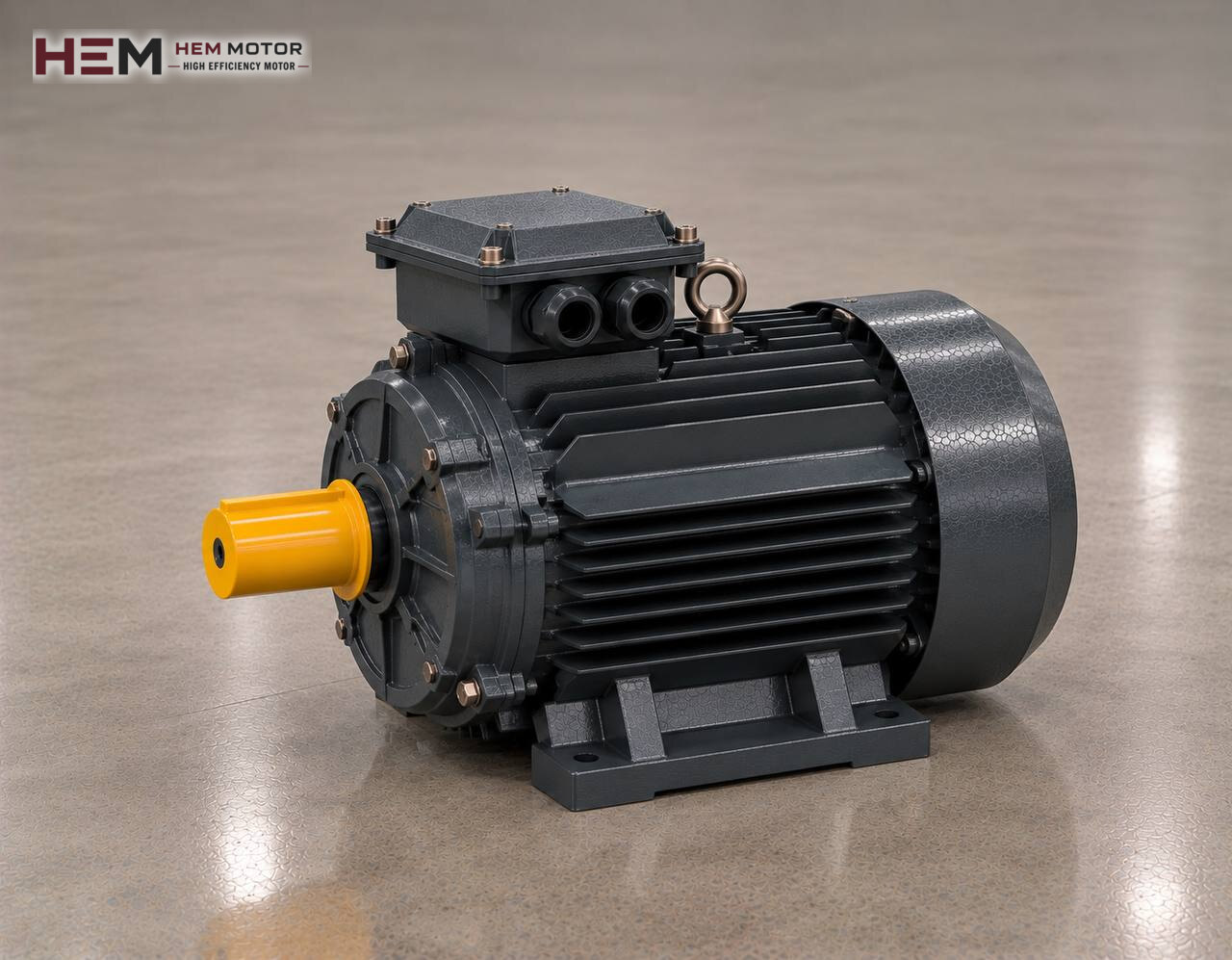
Material arriving at a scrap yard is highly varied: turning chips, profile and sheet offcuts, white-goods casings, aluminium wheels, cable, even a whole car body. The machines that reduce and densify it share one thing: a drive that needs very high force for short periods and draws that force irregularly. On this page we break the shredder types down from the motor's point of view; for the other machines on site, see the waste processing and recycling machine electric motors page.

Four Machine Families, Four Different Loads
Chip crusher: Breaks tangled turnings into short pieces so the oil can be spun out in a centrifuge and the chips melt more easily. It consists of a slow toothed rotor and a fixed counter-knife. Motor power in this family is small; the motor is usually flange-mounted on a gear reducer.
Twin- and four-shaft shredder: Thick cutter discs on two (or four) counter-rotating shafts tear sheet, casings and profiles. Speed is a few tens of revolutions per minute; the high torque comes from a gear reducer. On large models each shaft is driven by its own motor and reducer.
Single-shaft shredder: A ram presses the material against a bladed rotor and pieces are cut until they pass the screen. It is used for lighter scrap such as aluminium profile, thin sheet and cable.
Hammer shredder: Pounds mixed scrap such as car bodies and white goods with hammers hung on a heavy, fast-turning rotor. The rotor behaves like a large flywheel. In the biggest plants the main motor exceeds several hundred kilowatts and is fed at medium voltage; motors of that size are not included in HEM Motor's 2026 catalogue. Small and medium hammer machines, however, fall within the power range of our cast iron series (up to 355 kW).
Jams, Reversing and the Motor's Thermal Load
The most characteristic behaviour of slow-shaft shredders is jamming. When an uncuttable piece (an axle, a cast block) enters between the knives, the shaft stops; the control system briefly turns the shaft back, then drives it forward again. On some machines this cycle repeats several times a minute.
Each reversal means a stop and a restart for the motor. In a direct-on-line arrangement that changes direction with contactors, the starting current heats the winding every time. A frequency inverter softens this transition and limits torque; even so, on a machine that jams often the motor temperature has to be watched. A PTC or PT100 winding sensor can be added on order and wired to the control panel to protect the motor.
What protects the reducer and the knives during a jam is usually a clutch or fluid coupling placed in between, plus a current limit in the panel. These arrangements belong to the machine design; on the motor side, the task is to stay at the rated power and speed on the nameplate and to state the reversing frequency at the ordering stage.
Long Run-Up on a Hammer Rotor
The difficulty on a hammer shredder is different: the rotor is heavy and takes a long time to reach rated speed. During this time the motor draws high current. Star-delta starting may not accelerate the rotor enough before switching to delta; that is why soft starters or frequency inverters are common on large hammer machines. Which method suits depends on rotor inertia and the strength of the supply; take the machine builder's recommendation as the basis.
Once the rotor is up to speed, short but hard load impacts occur when the hammers strike a large piece. The flywheel effect absorbs part of these impacts; fluctuation in the motor current tells you whether feeding is too dense or too sparse. Many plants speed up or stop the infeed conveyor according to the main motor current.
Gear Reducer, Belt and Base Arrangement
On slow-shaft shredders the motor is usually 4-pole (1500 rpm class) and connected to a planetary or helical reducer. A flange design is used to seat the motor directly on the reducer, a foot-mounted design to couple it on a separate base. The reducer ratio and output torque are set by the machine builder; for the reducer side, the electric motors for gear reducers page will guide you.
Hammer rotors use either belt and pulley or a direct coupling. In a belt arrangement the motor sits on a slide base and tension is adjusted with this slide. Foot-mounted (B3), flange (B5, B14), combined foot-and-flange (B34, B35) and vertical (V1, V3, V5, V6, V15) designs are supplied according to frame size; we check flanges and shaft ends together with you before the order.
Some shredders and scrap shears (alligator shears, baling presses) are hydraulic. In these machines the electric motor turns the hydraulic pump and the cylinder produces the cutting force; selection is based on pump flow and pressure. Details are on the hydraulic pump electric motors page.
The Motor in a Scrap Yard Environment
Metal dust, oily chips, sand and rain are normal conditions in a scrap yard. Our motors come with IP55 protection and class F insulation; on a machine working outdoors, a rain cover over the motor and regular cleaning prevent dust collecting on the cooling fins from causing overheating. Where the day–night temperature difference is large, an anti-condensation heater is an order option.
Vibration from the shredder reaches the motor feet and terminal box. Putting anchor bolts, cable glands and coupling alignment on the periodic maintenance list catches most field failures in advance. A change in bearing noise and temperature is also an early warning.
Example HEM Motors by Shredder Type
| Machine | Motor's task | Value to check when selecting | Example HEM model |
|---|---|---|---|
| Chip crusher | Turning the toothed rotor slowly via a reducer | Reducer flange, jam frequency | 5.5 kW, 1,460 rpm, 132S-4 |
| Small twin-shaft shredder | Turning the cutter shafts at high torque | Number of reversals, reducer ratio | 30 kW, 1,475 rpm, 200L-4 |
| Medium twin- or four-shaft shredder | Driving each shaft through its own reducer | Power per shaft, starting method | 90 kW, 1,486 rpm, 280M-4 |
| Medium hammer shredder | Accelerating the heavy rotor via belt or coupling | Rotor inertia, starting time | 110 kW, 1,488 rpm, 315S-4 |
| Infeed and discharge conveyor | Pulling the belt at constant speed | Speed adjustment based on current | 4 kW, 1,450 rpm, 112M-4 |
The models in the table are examples only; the final selection depends on the machine load, required speed, mounting and operating conditions. If you are replacing a motor, the most reliable starting point is the nameplate of the existing one. Our models of 75 kW and above have a service factor of 1.15.
How Should You Prepare Your Shredder Motor Request?
To speed up the quotation, send the following together: machine type (chip crusher, twin-shaft, hammer, etc.), motor power (kW), speed, site voltage, mounting (flanged to a reducer, foot-mounted on a base, belt-driven) and quantity. Also state if the motor reverses or is driven by an inverter.
A photo of the existing motor's nameplate answers most questions on its own; how to send it is explained on the find an equivalent motor from the nameplate page. You can see all models and current prices in our electric motor shop, and use our contact page for WhatsApp or phone.
Frequently Asked Questions
My twin-shaft shredder jams often; is a bigger motor the solution?
Not always. Jams are mostly caused by blunt knives, wrong knife clearance or scrap unsuitable for the machine. A bigger motor puts more torque on the reducer and knives; this decision should be made together with the machine builder.
Why does the motor heat up in reversing operation?
Each change of direction is a stop and a restart; the starting current heats the winding. As the frequency increases, the motor has no time to cool. A frequency inverter and a winding sensor are the most effective measures in this case.
Can I buy a motor for a large plant that shreds car bodies?
If the main motor exceeds 355 kW or requires medium voltage, it is not included in HEM Motor's 2026 catalogue. We can, however, quote for the infeed conveyor, fan, magnetic separator and pump motors in the same plant.
How do I select the motor for a hydraulic metal shear?
The motor is selected not by the tonnage of the shear but by the flow and pressure of the hydraulic pump. If you share the pump nameplate and the existing motor's data, we will determine the right power together.