English
 Français
 Türkçe
 Español
 Русский

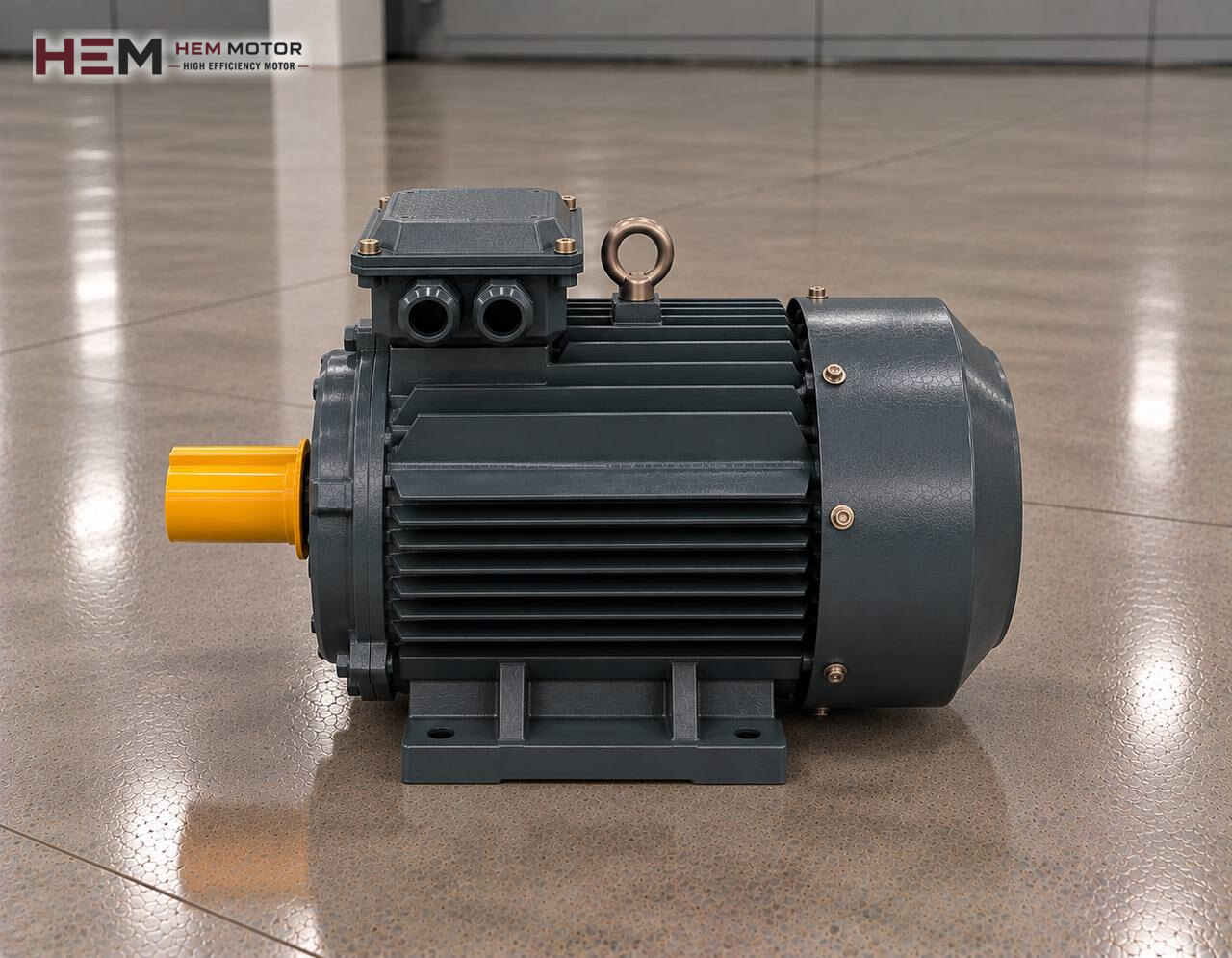
Collected PET bottles arrive at the plant as compressed bales and leave the end of the line as clean, dry PET flake filled into bags. In between, the bottle is stripped of its label, cap, adhesive and any drink left inside. This page follows that journey and explains, step by step, which machine needs which motor. For other recovery machines such as crushers, presses and sorting lines, go to the waste processing and recycling machine electric motors page.

From Bale to Bottle: Opening and Pre-Sorting
The bale opener breaks up a bale whose wires have been cut, using slowly turning toothed drums. The drums are driven by a geared motor; if the bale is tight and wet, the starting moment becomes harder. The loosened bottles travel on a conveyor to a pre-wash drum or a dry trommel, where sand, stones and small caps fall through the perforated surface.
The bottles then pass over a sorting belt. If there is an optical sorter separating coloured and PVC bottles, its air compressor is also one of the line's significant consumers. Belt and drum drives are generally made with 4-pole motors of a few kilowatts.
Label Remover: A Rotor Working by Friction
The first machine specific to a PET line is the label remover. Inside a long housing, a rotor carrying paddles or blades rubs the bottles against each other and against the housing, tearing off shrink labels. The label should be removed without breaking the bottle; rotor speed and paddle angle are therefore set by the machine builder.
The motor load depends on friction and changes directly with the feed rate. If the machine is overfilled the current rises; if it runs empty, it falls. On many lines the label remover motor current is used to adjust the speed of the infeed conveyor in front of it. The rotor is mostly driven by belt and pulley or through a reducer; in the wet type, water is also fed inside.
Wet Granulator: The Machine That Turns Bottles into Flake
The wet granulator cuts the bottles with a bladed rotor while water is sprayed in, and the pieces that pass the screen leave as flake. The rotor turns fast and is heavy; the motor is usually belt-connected. On starting, the rotor takes several seconds to accelerate, and star-delta, a soft starter or a frequency inverter is often used.
The water cools the knives and removes part of the dirt at the first stage, but the area around the machine is constantly wet. It is important to place the motor outside the splash zone, preferably on a raised base, and to keep the belt guard closed. Blunt knives crush rather than cut, which raises the motor current; setting the knife-sharpening interval from the current log is a practical method.
Float Tank and Hot Caustic Washing
PET is heavier than water, whereas the PP and PE used in caps and rings float. The float–sink tank uses this difference: slow paddle shafts skim the cap pieces from the surface and a screw carries the PET that sinks to the bottom out of the tank. These drives are low-powered but run continuously and are almost always geared.
In the hot-wash reactor the flakes are mixed with hot caustic water; adhesive and grease residues are dissolved here. The agitator motor stands on top of the tank, usually vertically, and is exposed to the steam rising from it. For vertical mounting (V1), a rain canopy against drips from above should be specified on the order. An anti-condensation heater and suitable paint protection should be discussed for the steam and caustic environment; direct chemical splashing is not a design condition of a standard IP55 motor, and in that case protection by the machine builder or a special motor is needed.
Behind the hot wash come the friction washers: a high-speed paddle shaft in an inclined housing scrubs the flake with water. This shaft's motor is also belt-connected and is one of the line's more powerful drives.
Drying and Final Separation: Centrifuge and Fans
The washed flake is separated from its water in a vertical or horizontal mechanical centrifugal dryer. A paddle rotor turning at high speed throws the flake against a screen housing and spins the water out. This motor may be 2- or 4-pole; its start is inertia-heavy, and when rotor balance is lost the vibration passes straight into the motor bearings.
Next come the hot-air drying pipe and the zig-zag (air) classifier, both fan-driven. The zig-zag classifier lifts the remaining label fragments and dust because they are light. Fan motor load varies roughly with the cube of fan speed; the real value depends on duct resistance. The industrial fan motors page gives details on fan drives. For the pumps that circulate the line's water, see the pump electric motors page.
Example Motor Matching on a PET Line
| Machine | Motor's job | Value to check when selecting | Example HEM model |
|---|---|---|---|
| Float tank screw | Slowly carrying sunken PET via a reducer | Reducer connection, continuous duty | 3 kW, 1,450 rpm, 100L2-4 |
| Label remover | Turning the rotor under friction load | Current versus feed rate | 18.5 kW, 1,470 rpm, 180M-4 |
| Wet granulator | Turning the heavy bladed rotor by belt | Starting method, knife condition | 37 kW, 1,485 rpm, 225S-4 |
| Centrifugal dryer | Turning the rotor at high speed | Rotor balance, bearing load | 22 kW, 2,955 rpm, 180M-2 |
These pairings are for guidance; the motor of each machine on your line is determined by its own capacity, required speed, mounting and environment. When replacing, the values on the existing motor's nameplate should be the basis.
Information List for PET Line Motors
If you need several motors for the line, write each machine on a separate row: machine name, motor power (kW), speed, supply voltage, mounting (foot, flange, vertical) and quantity. Mark separately the motors driven by an inverter, standing vertically or exposed to steam. Foot, flange and vertical designs are supplied according to frame size; flange and shaft ends are confirmed on the order.
A clear photo of the nameplate is often enough; the send a motor nameplate page explains how. Models and current prices are on our shop page; WhatsApp and phone details are on the contact page.
Frequently Asked Questions
Why does the wet granulator motor draw more current at the end of the day?
As the knives become blunt, they start crushing the bottle instead of cutting it, and the power the motor consumes increases. Clogged screen holes have the same effect. If the current does not return to normal after checking knives and screen, the motor and belt should be inspected together.
What should be considered for the hot-wash reactor's agitator motor?
Because the motor stands vertically on top of the tank, it is exposed to steam and drips. Specify the vertical mounting, the need for a rain canopy and the anti-condensation heater on the order. If caustic splashes reach the motor directly, a shield is needed on the machine side.
Why do motor bearings wear quickly on the centrifugal dryer?
Flake build-up on the rotor or worn paddles cause imbalance, and this vibration passes straight to the bearings. Cleaning the rotor regularly and having its balance checked extends motor life.
Can a single-phase motor be used in a small PET crushing plant?
For low-power drives such as conveyors and small pumps, the single-phase series (0.18–5.5 kW) is an option; details are on the single-phase electric motor page. Large drives such as the granulator and label remover need a three-phase supply.