English
 Français
 Türkçe
 Español
 Русский

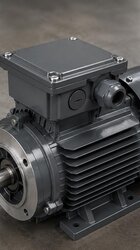


You usually find out that a motor order went wrong the moment the motor is unpacked next to the machine. The flange holes don't line up, the shaft is too thick for the coupling, or the motor runs fine but the star-delta starter in the panel can't be used with it. In almost every one of these cases there is nothing wrong with the motor itself. What went wrong was the information passed on with the order.
Below are the ordering mistakes we run into most often in practice, what causes each one, how it shows up on site, and how to catch it before the order is placed.
"A 7.5 kW motor" is only half a specification
Power alone doesn't describe a motor, because the same power means very different torque at different speeds. Shaft torque is roughly 9550 × kW ÷ rpm. A 5.5 kW motor delivers about 35 Nm at 1500 rpm, but about 52 Nm at 1000 rpm. If the pulley ratio or gearbox was sized around one of those, a motor with the wrong speed will either overspeed the machine or struggle with the load.
Speed follows from the number of poles. On a 50 Hz supply, a 2-pole motor runs at roughly 3000 rpm, 4-pole at 1500, 6-pole at 1000 and 8-pole at 750. The nameplate will show a figure slightly below these round numbers, because an induction motor always runs a little slower than synchronous speed under load. A nameplate reading just under 1500 rpm means a 4-pole motor.
Check the voltage line: 230/400 V and 400/690 V behave differently
The dual voltage on the nameplate tells you the winding voltage in star and in delta. On a 400 V supply, a 230/400 V motor runs in star, while a 400/690 V motor runs in delta.
This matters for star-delta starting, where the motor starts in star and then switches to delta. That only works if the motor is designed to run in delta at 400 V, in other words a 400/690 V motor. Send a 230/400 V motor to a site whose panel is built around a star-delta starter and the motor is perfectly healthy but can't be started properly with the existing panel. As a general pattern, smaller ratings tend to come with 230/400 V windings and larger ones with 400/690 V, but the nameplate is what counts. The wiring side is covered in our star-delta wiring guide.
When the motor doesn't fit the machine
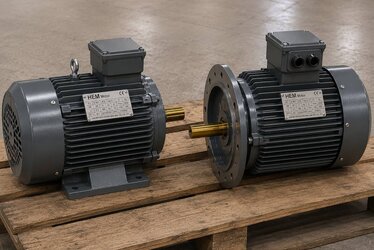
Correct power and speed don't guarantee a motor will bolt on. Foot mounting (B3), large flange (B5), small face flange (B14) and combined foot-and-flange versions (B35, B34) are different mechanical versions of the same electrical motor, and vertical installations bring positions such as V1 and V5 into play.
The pair most often confused is B5 and B14. Both are flanged, but a B5 flange has clearance holes the bolts pass through, while a B14 face has tapped holes and a smaller diameter. On a motor that mounts directly onto a gearbox or pump, that difference means it simply won't go on. We compare the two in detail in B5 vs B14 flange selection.
Shaft diameter and key size follow the IEC frame number, and the frame number itself is the shaft centre height in millimetres: a frame 132 motor has its shaft axis 132 mm above the base. Knowing the frame size of the old motor tells you straight away whether foot holes and shaft will match. All mounting options are listed on the mounting types page.
Leaving out the operating environment
Standard three-phase motors are designed around IP55 protection, class F insulation and an ambient temperature between −15 °C and +40 °C. Above 1000 m altitude, or where the ambient goes beyond 40 °C, the motor can't deliver the same output with the same margin, so either a larger rating is chosen or the order is adjusted accordingly.
The same goes for enclosure protection. A food line cleaned with pressurised water, a crushing plant covered in dust or a pumping station by the sea all call for a separate check on whether IP55 is enough. Options such as IP56 and IP65, and class H insulation, exist for exactly these situations. For hot and dusty sites, see our article on insulation class and frame material.
Running on a drive? Say so up front
Three-phase motors are suitable for speed control with a frequency inverter, but knowing this at the ordering stage changes a few decisions:
- The motor is cooled by its own shaft-mounted fan. If it will run at low speed and full torque for long periods, that fan may not be enough and a separately powered (forced) fan may be needed.
- With a long cable between drive and motor, a dv/dt or sine filter should be considered.
- Larger frames may need an insulated bearing or shaft grounding against bearing currents.
Variable-torque loads such as pumps and fans behave very differently on a drive from constant-torque loads such as conveyors. We explain the difference in constant vs variable torque.