Choosing a Pulley-Driven Electric Motor for a Piston Compressor

Choosing a Pulley-Driven Electric Motor for a Piston Compressor

In reciprocating (piston) compressors the motor is almost always connected to the compressor by belts and pulleys. This arrangement reduces the motor speed to the lower speed at which the compressor must run and makes it possible to drive different compressor heads with the same motor. Even so, a pulley drive raises questions in motor selection that a coupled connection does not: how does the pulley ratio match the motor speed, what load does belt tension put on the shaft end, and how is the motor protected on a compressor that stops and starts frequently on a pressure switch? In this article we address these questions in turn and show examples from the models HEM Motor has on sale that suit compressor drives.
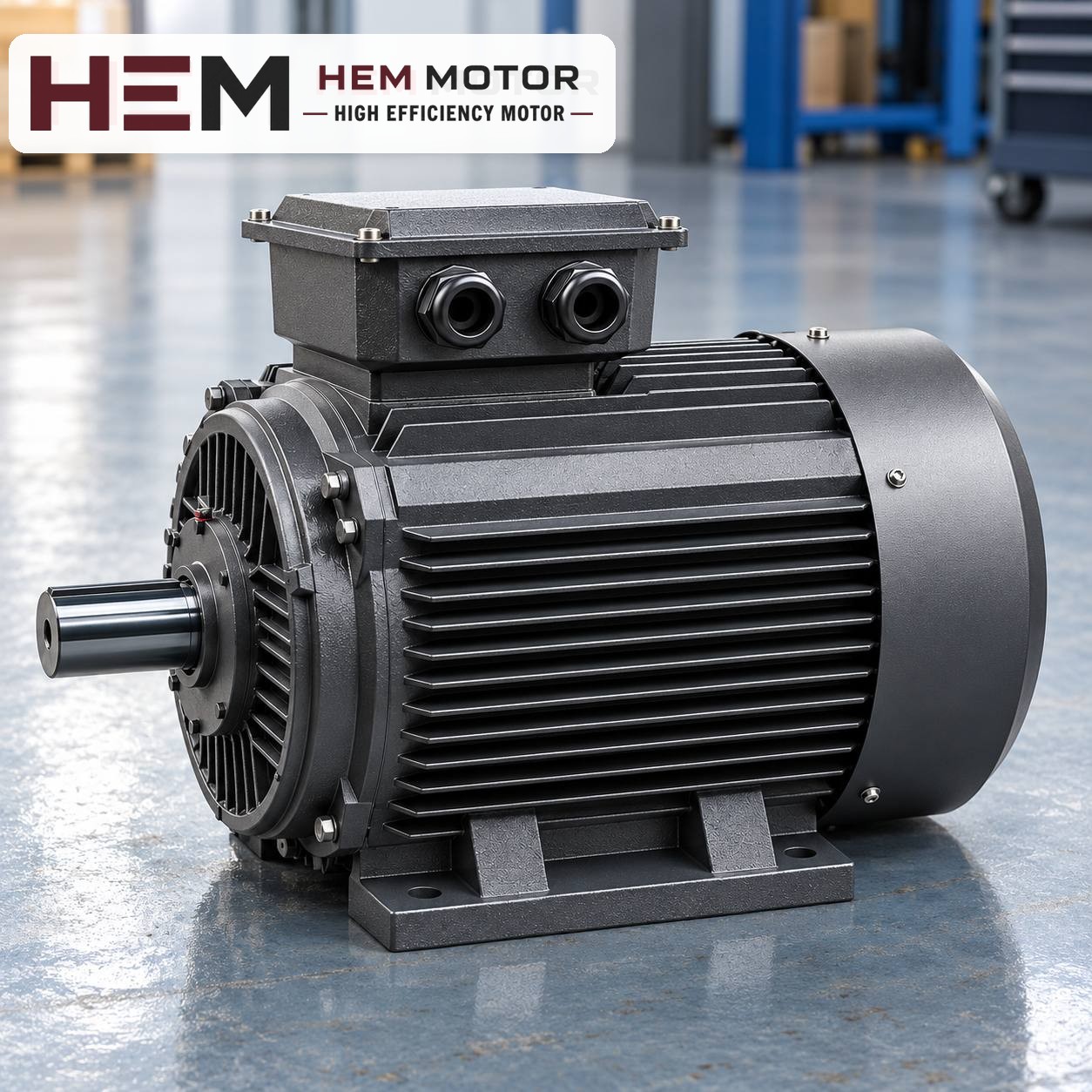
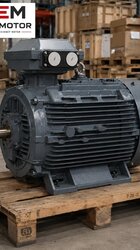
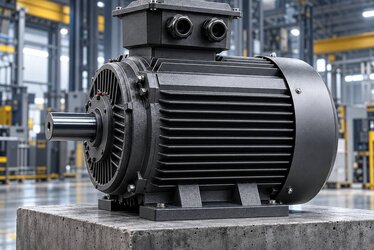
Foot-mounted three-phase electric motor in a workshop
In a pulley drive the motor is usually bolted by its feet to a tensioning rail (representative image).

What does a piston compressor demand from the motor?

Unlike a screw compressor, the load of a piston compressor is not smooth. On each piston stroke the compression resistance rises and during suction it falls; the shaft sees a pulsating torque. For this reason the compressor pulley is often designed as a heavy flywheel that smooths out the fluctuation. On the motor side this has two consequences. First, at start-up the motor must also accelerate the inertia of the flywheel. Second, as tank pressure rises the power drawn by the compressor increases; the motor must not exceed its nameplate rating even at the highest working pressure.

Most workshop compressors run on a pressure switch: when the tank is full the motor stops, and when the pressure drops it starts again. That means many starts per hour. At every start the motor draws several times its rated current and the winding heats up. So when choosing a compressor motor, the question is not only power but also the number of starts per hour and whether the compressor starts unloaded. Compressors with an unloader valve at the cylinder head do not start the motor against tank pressure; a compressor with a faulty valve, however, strains the motor at every start and the problem is passed on to the motor.

Pulley ratio and motor speed

The compressor speed is the motor's rated speed multiplied by the ratio of the pulley diameters. If the compressor pulley is three times the diameter of the motor pulley, a 4-pole motor with a rated speed of 1,460 rpm turns the compressor at about 487 rpm. The compressor manufacturer sets this ratio according to the permitted speed of the head and the required air flow.

That is why the number of poles must be kept the same when replacing the motor. For example, if a 2-pole motor is replaced by a 4-pole model of the same power, the compressor will run at roughly half speed as long as the pulleys stay unchanged, and the air flow drops noticeably. The reverse is riskier: fitting a 2-pole motor in place of a 4-pole arrangement can push the compressor head above its permitted speed. If a change of speed is really wanted, the pulley ratio must be recalculated and the compressor manufacturer's limits checked.

  • Note the rated speed and number of poles on the old motor's nameplate.
  • Record the diameter of both pulleys and the belt type (number of grooves and profile).
  • Find the head speed stated on the compressor nameplate or in its catalogue; confirm the motor and pulley choice against this value.

Shaft end, pulley and belt tension

In a coupled connection the motor shaft carries mainly torque. In a belt drive, however, belt tension applies a constant radial force to the shaft end, and this force is taken by the front bearing. The closer and narrower the pulley sits to the end of the shaft, the lower the load on the bearing. Sliding the pulley outwards along the shaft or over-tensioning the belt are common mistakes that shorten bearing life.

  • Hub fit: The hub of the motor pulley must match the shaft diameter and key size of the new motor. Shaft dimensions depend on the frame; you can find the values in the technical and product catalogue and in the 2D technical drawings.
  • Alignment: The motor and compressor pulleys must lie in the same plane; misalignment wears the belt on its side and causes noise.
  • Tensioning arrangement: The motor is usually mounted in B3 foot-mounted form on a tensioning rail or a slide base. If the new motor's IEC frame size is the same as the old one, the foot holes are in the same place and the existing rail can be reused.
  • Guard: The belt and pulleys must be covered by a guard that does not block the motor's cooling air.

Prices and technical data are on the product pages; choose a model and order online.

Starting method and voltage connection

Direct-on-line starting is common on small compressors; as power increases, star-delta starting is preferred to limit the starting current. Here the motor's nameplate voltage is decisive. HEM Motor's three-phase models from 4 kW upwards are rated 400/690 V (Δ/Y); on a 400 V supply they run in delta connection and are therefore suitable for star-delta starting. Models of 3 kW and below are rated 230/400 V (Δ/Y); on a 400 V supply they are connected in star, so they cannot be started star-delta. If your existing panel uses star-delta, choose the motor according to this distinction.

On a compressor running on a pressure switch, the motor protection circuit breaker or thermal relay must be set to the motor's nameplate current. We explained in detail which fault each protective device responds to in our motor protection article. A compressor room is usually hot and laden with oil vapour; make sure the motor fan can draw clean air. IP55 protection is against dust and water splashes, but it does not solve the motor's heating problem in an unventilated, very hot room.

Example models

The models below were chosen from the power range commonly seen in compressor drives. All are 4-pole (1,500 rpm synchronous), with IP55 protection and class F insulation. Which power your compressor actually needs should be decided by looking at the compressor manufacturer's value and the existing motor's nameplate together.

ModelPowerRated speedIEC frameVoltageRated current (400 V)Rated torque
112M-4 aluminium4 kW (5.5 HP)1,450 rpm112M400/690 V7.95 A26.3 Nm
132S-4 cast iron5.5 kW (7.5 HP)1,460 rpm132S400/690 V10.7 A36 Nm
132M-4 cast iron7.5 kW (10 HP)1,460 rpm132M400/690 V14.3 A49.1 Nm
160M-4 aluminium11 kW (15 HP)1,465 rpm160M400/690 V20.4 A71.7 Nm

An aluminium frame is an option that is easy to carry onto the compressor chassis and fit; on sites with heavy vibration and impact, a cast iron frame is a more rigid alternative. General information for compressor applications can be found on our compressor motors page.

A hypothetical replacement example

The following sequence is not a real customer application but an example for explanation. Suppose the motor of a two-stage piston compressor in a workshop has burned out. The nameplate reads 5.5 kW, around 1,450 rpm, 400/690 V and a 132S frame; the compressor pulley is clearly larger than the motor pulley.

  • Since the power, number of poles and frame stay the same, the candidate model is the 5.5 kW 132S-4; its rated speed is 1,460 rpm, and with the pulley ratio unchanged the compressor speed stays practically the same.
  • If the old motor was frequently tripping its thermal relay, the cause is looked for first: the unloader valve, a leaking check valve, an over-tensioned belt or an unventilated compressor room. Moving to a larger motor without fixing the problem hides the root cause.
  • If the panel has a star-delta starter, the model rated 400/690 V is directly compatible.
  • If the old pulley fits the new shaft diameter and key size, it is reused; if not, a new pulley with the same diameter and groove profile is prepared with a matching hub.

Information to send with your order

To identify the right compressor motor the first time, send the following information together:

  • A photo of the existing motor's nameplate (power, speed, voltage, frame size)
  • Compressor type and working pressure, and whether it runs on a pressure switch or continuously
  • Pulley diameters, belt profile and mounting arrangement (usually B3 foot-mounted)
  • Supply voltage and starting method (direct-on-line, star-delta, drive)
  • Ambient conditions in the compressor room (temperature, dust, oil vapour)

You can review suitable models and current prices on the buy electric motors page. If you have the old motor's nameplate to hand, send a photo of the nameplate and we will identify the model that fits your pulley arrangement together; for other questions you can use our contact page.

HEM Motor Models Related to This Article

The cards show example models related to the topic. A suitable motor is not chosen by power alone: compare speed, voltage, mounting, shaft and connection dimensions on the product page; if unsure, send a photo of the existing motor’s nameplate on WhatsApp.

4 kW 1500 rpm Aluminium Frame Electric Motor 112M-4

112M-4

4 kW · 1500 rpm

  • Aluminium frame · IEC 112M
  • 1450 rpm · IP55
  • Mounting: B3 foot; flange (B5/B14/B35) depending on frame — confirmed with the order

US$241.27 (€215.32)

View product
5.5 kW 1500 rpm Cast Iron Frame Electric Motor 132S-4

132S-4

5.5 kW · 1500 rpm

  • Cast iron frame · IEC 132S
  • 1460 rpm · IP55
  • Mounting: B3 foot; flange (B5/B14/B35) depending on frame — confirmed with the order

US$339.83 (€303.28)

View product
7.5 kW 1500 rpm Cast Iron Frame Electric Motor 132M-4

132M-4

7.5 kW · 1500 rpm

  • Cast iron frame · IEC 132M
  • 1460 rpm · IP55
  • Mounting: B3 foot; flange (B5/B14/B35) depending on frame — confirmed with the order

US$392.38 (€350.17)

View product

Similar Articles