Running Hours Calculation for an IE5 Electric Motor Investment

Running Hours Calculation for an IE5 Electric Motor Investment

When an IE5 electric motor investment pays for itself depends largely on how many hours a year the motor runs and at what load: the annual energy difference is the loss difference between the two motors multiplied by the actual running hours. That is why the calculation starts with on-site hours and load data before the nameplate power.

Below, we explain step by step how to measure running hours on site, how to include the load distribution in the calculation and how to find the break-even hours. The figures in the examples are hypothetical; replace them with measurements from your own plant.

Why does the payback of a high-efficiency electric motor depend so much on running hours?

Because what a more efficient motor brings is an instantaneous power difference, and that difference only accumulates while the motor turns. The loss difference is in kilowatts; the only multiplier that converts it into kilowatt-hours, the value that reaches the bill, is time.

For a fire pump that runs a few hundred hours a year or a seasonal irrigation pump, raising the efficiency class gives a weak economic return. When a motor of the same power runs three shifts, the difference builds up on the bill every month. The first question before deciding should not be "how many kW?" but "how many hours, and at what load?".

Which sources give reliable running hours on site?

The most reliable source is a counter that monitors the motor directly: an hour meter wired to the contactor, the run-time record of the frequency converter or the history of the motor running signal in SCADA. Estimating from the shift schedule is the last resort and usually overstates the hours.

Use the sources in this order of reliability:

  1. On converter-fed motors, read the drive's own run-time and energy counter; many drives also keep a kWh value.
  2. On direct-on-line motors, read the hour meter in the panel. If there is none, adding a simple counter to an auxiliary contact of the contactor is a cheap, permanent solution.
  3. If there is a SCADA or PLC log, export the history of the motor's run bit and take weekly totals.
  4. If none of these exist, connect a portable energy analyser for one or two weeks and scale the result to a year. Deduct maintenance stoppages and holiday weeks separately.

When converting the reading to a year, do not forget seasonality. A chiller pump may run almost continuously in summer and partly in winter; one month's data does not represent the year.

We have collected the general features of motors in this class on our IE5 Ultra Premium Efficiency Electric Motors page; the efficiency class in which a listed model is supplied is confirmed with the order.

How is the load distribution included in the calculation?

You split the hours into load bands, calculate the loss difference separately for each band and then add them up. If the motor does not run at rated load all year, a calculation with a single "full load" value can overstate or understate the difference.

At each load point the loss difference is found with this general expression:

ΔPk = Pshaft,k × (1/ηold,k − 1/ηnew,k)

Here Pshaft,k is the shaft power in that band and the η values are the efficiencies of the two motors at that load. Take the efficiency values from the motor manufacturer's part-load data. Calculating only with the full-load nameplate value gives wrong results at low loads (general information; confirm with the motor manufacturer's data). A power analyser or the drive's power display is used to measure shaft power on site; the current table helps for a rough comparison.
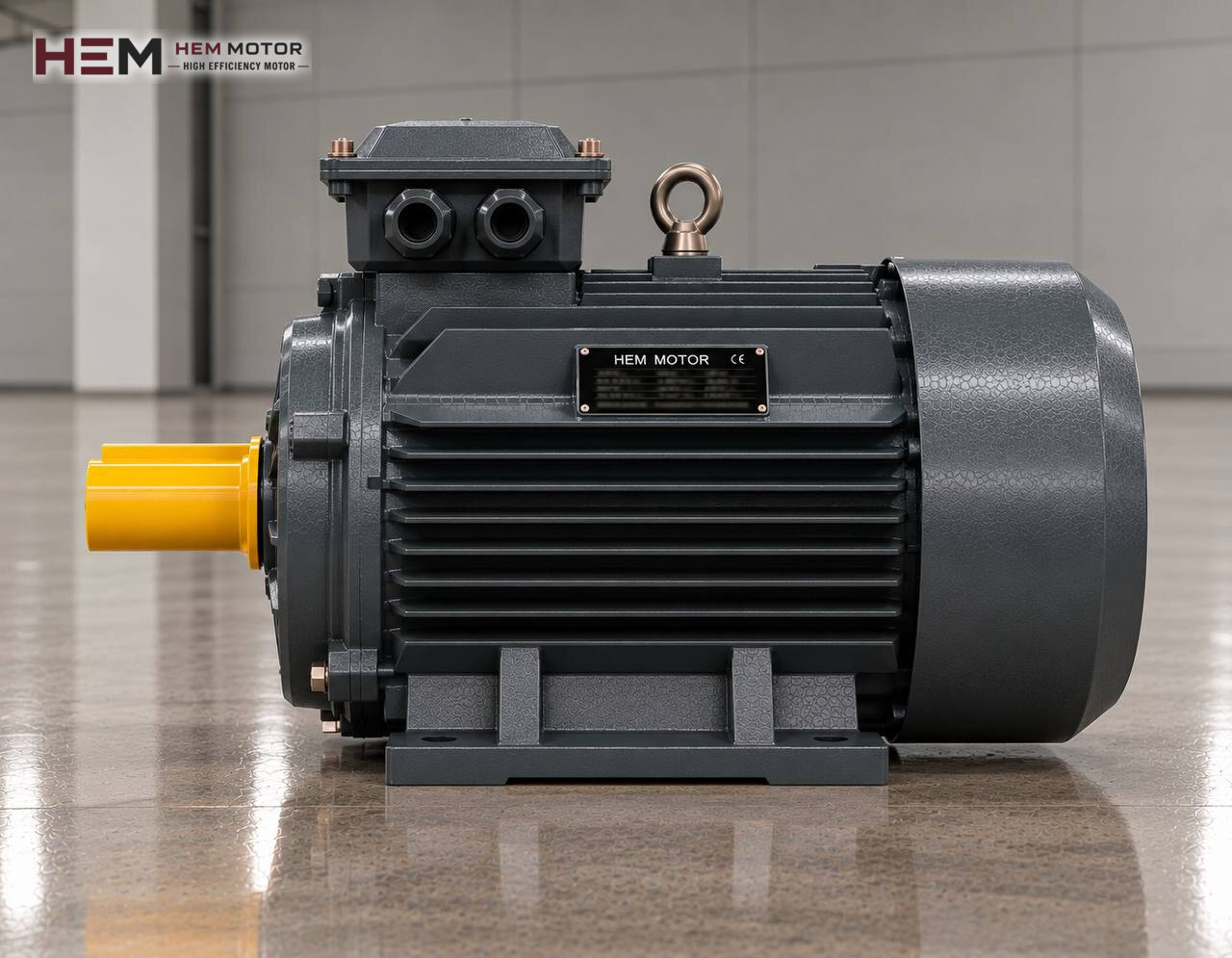
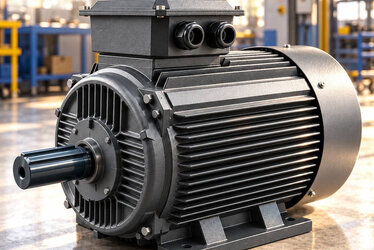
Electric motor driving a chiller water pump
Cooling and circulation pumps turn for most of the year, so they stand out in a running hours calculation (representative image).

Hypothetical example: annual energy difference with three load bands

Consider an 18.5 kW, 4-pole motor driving a process cooling pump. Suppose the drive records show it runs 7200 hours a year, spread across three load bands. The loss differences are hypothetical values calculated from the manufacturer's part-load data.

Load bandAnnual hoursLoss difference ΔP (hypothetical)Energy difference
Near rated load2400 h0.55 kW1320 kWh
Medium load3600 h0.45 kW1620 kWh
Low load1200 h0.35 kW420 kWh
Total7200 h3360 kWh

If the same motor ran only one shift, roughly 2000 hours a year, with a similar distribution, the energy difference would stay around 930 kWh. Motor, loss difference and efficiency class are the same. Only the hours change. This difference often sets the direction of the investment decision.

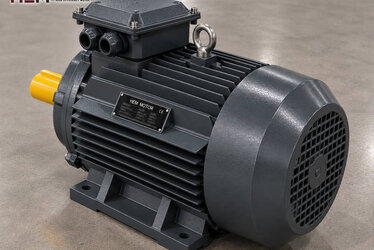
Prices and technical data are on the product pages; choose a model and order online.

How is the break-even running time calculated?

Break-even hours are found by dividing the additional investment by the monetary value of the hourly energy difference. The formula is:

tbreak-even = F / (ΔPavg × c)

F is the total cost difference between the high-efficiency motor and its alternative (motor, drive if needed, installation and commissioning included). ΔPavg is the average loss difference weighted by load distribution, and c is your energy unit cost per kWh. In the example above ΔPavg = 3360 / 7200 ≈ 0.47 kW.

Dividing tbreak-even by the motor's annual running hours gives the payback period in years. Compare the result with the motor's expected service life and the plant's investment policy. Take F and c from your purchasing and energy departments; these values vary greatly from plant to plant.

What are the common mistakes that skew the calculation?

The most common mistake is to assume the motor runs at rated power. An oversized motor turns at part load for most of the year, so the calculation should start with a shaft power measurement.

The second mistake is ignoring the actual condition of the old motor. A motor that has been rewound several times may have lower efficiency than its nameplate value; the comparison then swings in favour of the new motor, but this needs to be shown by measurement, not assumption. The third mistake is not adding the drive's own losses and cost to F if a drive is needed to reach the IE5 level. Finally, watch the speed difference: if the new motor turns slightly faster, the power drawn by a centrifugal pump or fan rises and part of the gain is lost (affinity laws; general information, confirm with the machine manufacturer).

HEM Motor offers IE3, IE4 and IE5 efficiency classes; confirm with the order the part-load efficiency values you will use in the calculation and the class in which the chosen model will be supplied. Our three-phase series are suitable for speed control with a frequency converter; for long periods at low speed with full torque an external fan may be needed; if the drive-to-motor cable is long, a dv/dt or sine filter is considered; these conditions are stated in the order.

Example electric motors for drives with long running hours

Below are examples of 4-pole frames that turn thousands of hours a year in pump, fan and circulation applications. You can compare other powers in the electric motor shop and find notes specific to pump applications on the pump electric motors page.

  • 160M-4 cast iron, 11 kW, 1465 rpm; 20.4 A at 400 V.
  • 180M-4 cast iron, 18.5 kW, 1470 rpm; 33.5 A at 400 V. The power step of the hypothetical example above.
  • 225M-4 cast iron, 45 kW, 1485 rpm; 80.2 A at 400 V, rated torque 289.4 Nm.

Technical data across the series are in the 2026 catalogue, and general information on efficiency classes is on the asynchronous electric motors page.

If you share your hour meter readings, load measurement and the existing motor's nameplate through the contact page, we will assess together, using your own hours data, on which motor raising the efficiency class makes sense. The HEM Motor model list is available for comparing power steps.

Frequently Asked Questions

How can the running hours of an old motor without an hour meter be estimated?

Connect a portable energy analyser for one or two weeks and scale the result to a year. Deduct maintenance stoppages from the total and assess seasonal variation separately.

Where is the load distribution read on a converter-fed motor?

The drive's output power and run-time records are the most practical source. Many drives also keep a power or current histogram; if not, periodic logging can be done via the PLC.

Should the upgrade be made when a motor fails, or by replacing a running motor early?

Upgrading at failure counts only the price difference as investment, so break-even hours are shorter. Replacing a running motor early takes the full cost of the motor into account; reserve that decision for high-hour motors.

Is it right to take the energy unit cost as constant in the calculation?

It is acceptable for a rough calculation, but if tariff bands differ, use a weighted average based on the hours when the motor runs.

HEM Motor Models Related to This Article

The cards show example models related to the topic. A suitable motor is not chosen by power alone: compare speed, voltage, mounting, shaft and connection dimensions on the product page; if unsure, send a photo of the existing motor’s nameplate on WhatsApp.

11 kW 1500 rpm Cast Iron Frame Electric Motor 160M-4

160M-4

11 kW · 1500 rpm

  • Cast iron frame · IEC 160M
  • 1465 rpm · IP55
  • Mounting: B3 foot; flange (B5/B14/B35) depending on frame, confirmed with the order

US$557.82 (€510.52)

View product
18.5 kW 1500 rpm Cast Iron Frame Electric Motor 180M-4

180M-4

18.5 kW · 1500 rpm

  • Cast iron frame · IEC 180M
  • 1470 rpm · IP55
  • Mounting: B3 foot; flange (B5/B14/B35) depending on frame, confirmed with the order

US$856.68 (€784.05)

View product
45 kW 1500 rpm Cast Iron Frame Electric Motor 225M-4

225M-4

45 kW · 1500 rpm

  • Cast iron frame · IEC 225M
  • 1485 rpm · IP55
  • Mounting: B3 foot; flange (B5/B14/B35) depending on frame, confirmed with the order

US$1,656.00 (€1,515.60)

View product

Similar Articles