In an electric motor renewal, production downtime is costed by multiplying the number of hours stopped by that line's hourly downtime cost; the hourly cost in turn is the sum of items such as the contribution margin of lost production, idle labour, scrap during restart and late delivery penalties. This calculation is the soundest way to compare a planned renewal with an unplanned replacement forced by a failure.
Which items make up the cost of downtime?
The first and usually largest item is lost production. What is used here is not the selling price but the contribution margin of each unit of product lost: the amount left after variable costs are deducted from the selling price. As raw material is not consumed, its cost is not added to the downtime loss. The second item is idle labour. If operators cannot be moved to another job during the stop, their hourly cost enters the calculation. Overtime for the maintenance team and the cost of an outside service call also belong to this group.
The third group is process-specific.
A half-finished batch on a food line, reheating time and first-minute scrap in plastic extrusion, cleaning on a paint line. In some customer contracts a late delivery penalty or express freight cost also falls into this group.
How is the hourly downtime cost calculated?
A practical relationship can be set up as follows: Chour = (Q × K) + L + E. Here Q is the line's hourly output, K the contribution margin per unit, L the hourly cost of idle labour and E the other additional costs per hour. Total downtime cost is C = T × Chour + F, where T is downtime and F the one-off items independent of duration.
Hypothetical example, using “units” instead of a currency: the line produces 400 parts per hour and the contribution margin per part is 2 units. Idle labour is 120 units per hour, other hourly additional cost 30 units. Chour = 400 × 2 + 120 + 30 = 950 units. One-off scrap and cleaning at restart amount to 600 units.
Suppose the motor change takes 3 hours in a planned renewal: C = 3 × 950 + 600 = 3,450 units. In an unplanned replacement after a failure, suppose motor supply, removal and commissioning take 14 hours: C = 14 × 950 + 600 = 13,900 units. The difference shows how valuable buying the spare motor in advance is. The figures are hypothetical; put in your own line's data.
How is the downtime itself estimated?
Downtime is not one piece.
In planned and unplanned replacement the steps are the same; their durations differ. The table below shows the typical steps and what affects their duration most.
Step
In a planned renewal
In a replacement after failure
Fault diagnosis
None; the date is known in advance
Finding which part has failed takes time
Motor supply
Motor ready on site
Search for an equivalent, order and freight; time is clarified with the order
Removal and fitting
Team, crane and tools ready
Team and equipment are gathered, may slip outside the shift
Alignment and connection
Base and coupling checked beforehand
Takes longer if a dimensional mismatch appears
Commissioning and process stability
Checklist ready
Done in a hurry, scrap rises in the first hours
Base the estimate on maintenance records. How long each step took in the previous motor change can be taken from the work order or shift log. If there is no record, noting the start and end times of the steps at the next planned stop produces the most valuable data for future calculations.
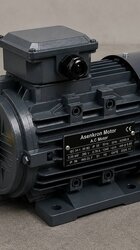
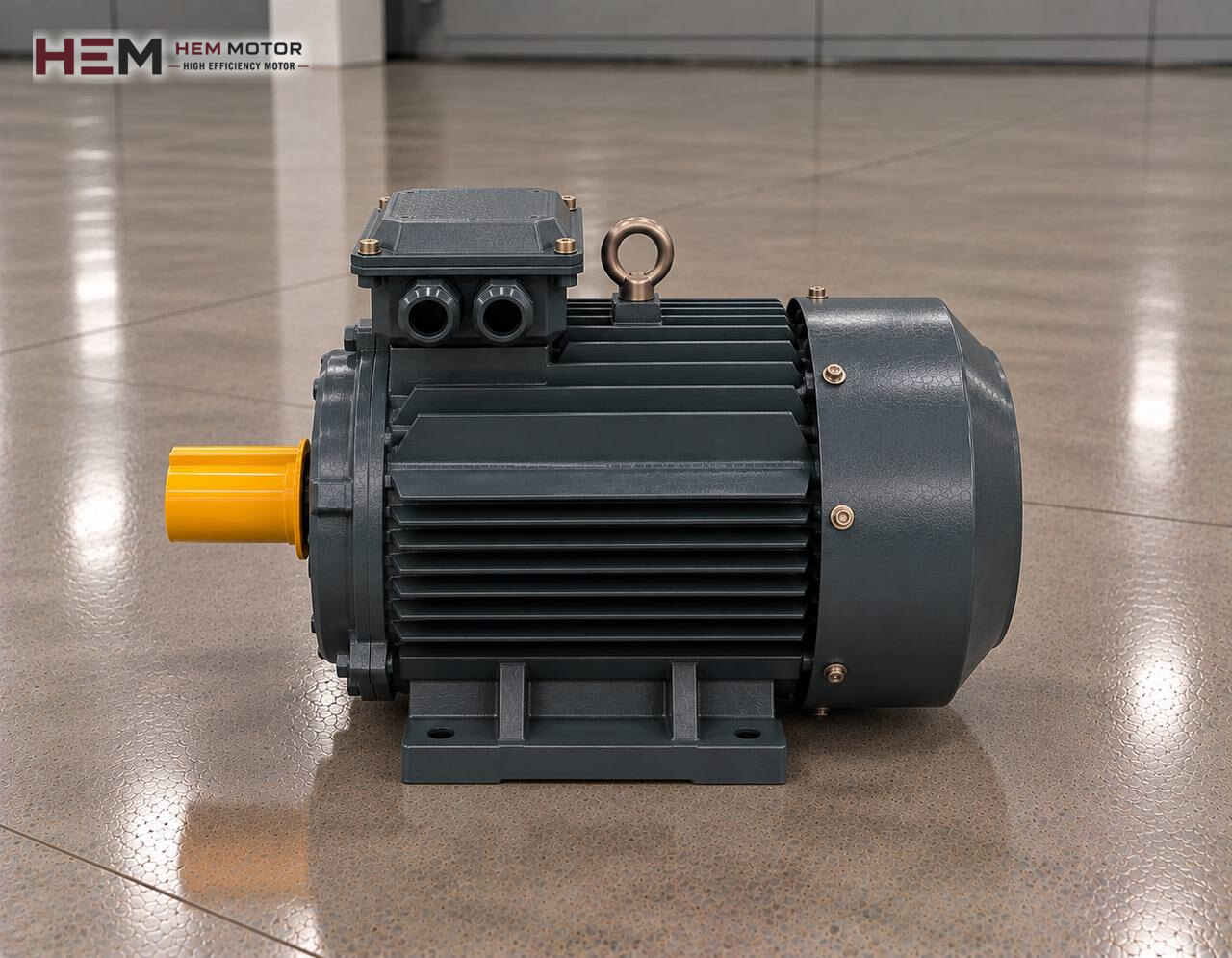
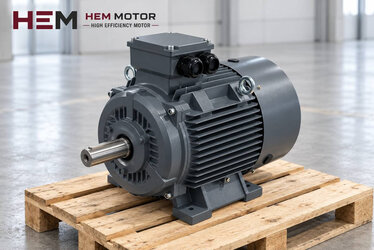
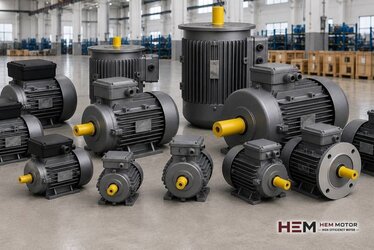
A spare motor ready on site removes the longest step of unplanned downtime (representative image).
Prices and technical data are on the product pages; choose a model and order online.
How does the calculation affect the renewal decision?
Downtime cost becomes an input for two decisions. The first is renewal timing: should an ageing motor whose insulation resistance has started to fall or whose bearing noise has increased be replaced at a planned stop, or run until it fails? The second decision is keeping a spare.
The critical question in this comparison is the probability of failure. Weighting unplanned downtime cost by the estimated probability of failure gives the value called “expected loss”. If the expected loss exceeds the cost of the spare motor and the planned replacement, renewal is brought forward (general information; base the probability estimate on maintenance history).
On site the result of the calculation is often simple. Where the stop of a single motor stops the whole line, that is, on bottleneck machines, downtime cost is high and keeping a spare motor of the same model on the shelf easily justifies itself. For one of two pumps running in parallel, the same result may not follow.
Which mistakes make downtime cost look smaller than it is?
The most common mistake is counting only the time to remove and fit the motor. The time until the process reaches stability, the low efficiency of the first hours and scrap stay outside the calculation. The second mistake is using profit or selling price instead of contribution margin; one shrinks the cost, the other inflates it. The third is counting the stop of a non-bottleneck machine as a stop of the whole line. If there is buffer stock, the line keeps running for a while; this time must be deducted from the calculation. The time needed to find an equivalent motor, on the other hand, is often not estimated at all. If the old motor's nameplate is unreadable or its frame size is non-standard, the supply step takes longer than expected.
Which example motors can be used in this calculation?
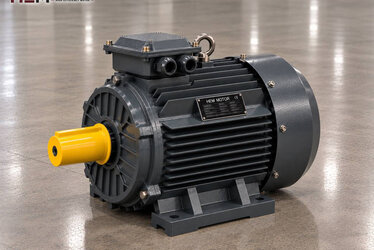
Three cast iron models from power steps often kept as spares for bottleneck machines are listed below. IP55 protection and class F insulation are common to all three. Frame and flange dimensions are in the 2D technical drawings, the whole series in the 2026 catalogue; other powers are listed in the HEM Motor shop.
160M-4: 11 kW, 1465 rpm, 20.4 A at 400 V, rated torque 71.7 Nm. A common spare step on conveyor, mixer and pump lines.
160L-4: 15 kW, 1465 rpm, 27.3 A at 400 V, rated torque 97.8 Nm. Same shaft height as the 160M-4; for considering both powers together in a spares plan.
180M-4: 18.5 kW, 1470 rpm, 33.5 A at 400 V, rated torque 120.2 Nm. On bottleneck machines such as crushers, mills and fans.
When a new motor is fitted, protection values are updated to its nameplate; to include this step in commissioning time, you can look at the article on motor protection settings. All frame options are on the asynchronous electric motors page.
If you send the nameplate list of the critical motors on your line via our contact page, we can work out together which models can be covered by the same spare. Current model information is on our sales page.
Frequently Asked Questions
Should selling price or contribution margin be used in downtime cost?
Contribution margin. Since raw material and other variable costs are not spent during the stop either, the loss is not the selling price but the amount left after variable costs are deducted from it.
How is downtime cost calculated if there is buffer stock?
If buffer stock can feed the line for a certain time, this time is deducted from downtime. Only the time after the stock runs out counts as lost production.
Is keeping a spare motor always right?
No. It is usually right for bottleneck machines and motors with long supply times; for machines running in parallel or with a standby, downtime cost may be low.
Which data should I take from maintenance records for the calculation?
Step-by-step durations of previous replacements, failure frequency, scrap quantity at commissioning and outside service times are the most useful data.
HEM Motor Models Related to This Article
The cards show example models related to the topic. A suitable motor is not chosen by power alone: compare speed, voltage, mounting, shaft and connection dimensions on the product page; if unsure, send a photo of the existing motor’s nameplate on WhatsApp.
A no-load run during electric motor acceptance reveals wrong connection, reverse rotation, current imbalance between phases, bearing noise, vibration and mechanical damage from tra... More Details
Turning the shaft by hand when an electric motor is delivered is the fastest check for damage to the bearings, shaft or rotor during transport: the shaft of a healthy motor should ... More Details
When an electric motor is transported, the shaft end and the flange face are protected separately against impact, scratches, rust and vibration marks. Rust preventive is applied to... More Details
In electric motor procurement, model revisions are tracked by recording in the order, beside the motor's power and speed, its model code, housing material, mounting arrangement, an... More Details
In a framework purchase agreement for electric motors, delivery call-offs are planned once the annual total quantity and price terms are fixed, so that motors are requested in port... More Details
In an electric motor requirements list, annual quantity is defined as the total 12-month consumption for each model, and batch size as the quantity delivered at once in one order, ... More Details
We use necessary and optional cookies to improve your experience, enhance content and analyse traffic. Under the GDPR, optional (analytics/marketing) cookies are only used with your explicit consent. Please choose your preference below.
Cookie Policy
 English
 Français
 Türkçe
 Español
 Русский
 العربية
 Deutsch
 Italiano