English
 Français
 Türkçe
 Español
 Русский

A carton folding and gluing machine (folder-gluer) takes flat carton blanks that have been cut and creased one by one, applies glue to the glue flap, folds the panels along the crease lines and keeps the boxes under pressure until bonding is complete. Flat-folded cartons ready to be erected come out of the machine. This page covers the drives on a carton line where a standard induction motor is used and the steps to follow when replacing a motor; for the whole sector, the packaging and packing motors page is the starting point.

Main motor and auxiliary motors on the folder-gluer line
The machine's sections, in order, are the feeder, the pre-breaker, the gluing unit, the folding section and the compression-delivery section. In the classic design a single main motor turns a line shaft running along the machine by belt or gearbox; each section takes its movement from this shaft through right-angle gear boxes. In this way all carrier belts advance at the same speed and the box passes from one section to the next without slipping.
Besides the main motor, most machines have auxiliary drives. In the feeder there is a vacuum fan or vacuum pump that holds the blanks to the belt; on some models this fan is turned by a standard induction motor. The belt in the compression-delivery section that overlaps and presses the boxes may be linked to the main shaft or driven by a separate motor. On machines using hot-melt glue, the glue tank pump also has its own motor.
The movements the motor does not make need to be separated. Glue discs and gun systems on most machines run from the main shaft or from their own control unit; the opening and closing of glue guns is done by electronic control. On new-generation lines the feeder, folding belts or compression section may be synchronised with separate servo motors. These servo axes are machine-specific; no general compatibility claim can be made with a standard induction motor, and a change can only be assessed together with the machine manufacturer.
Case erectors work the other way round: they open the flat-folded carton, fold the bottom flaps and tape or glue them. On these machines the arm that opens the carton is mostly pneumatic; the standard motor is usually found on the conveyor carrying the carton.
Information needed to identify the main drive motor
The first question is whether the motor is the main drive, the vacuum fan, the compression belt or the glue pump. The main drive is the largest motor on the machine and is usually connected to a frequency inverter in the panel; the inverter's brand and the motor data set in it are useful for the replacement.
Power, speed, voltage and current are read from the nameplate. Note whether the motor is foot- or flange-mounted, whether there is a pulley or a coupling on the shaft and, if there is a pulley, the belt type. The machine's boxes-per-minute capacity and the board thickness range are also useful; on the same machine thin board and corrugated board create different loads.
Relationship between line speed, board type and motor power
The main motor's power is determined by the machine length, the number of carrier belts, the friction in the folding section and the load of the compression section. The calculation that combines these values belongs to the machine manufacturer; for a spare motor the first reference is the power on the existing nameplate. This page does not recommend a kW value for a machine type.
On the speed side, the line shaft speed is the motor speed multiplied by the pulley or gearbox ratio. Since line speed is already set by the inverter, choosing a motor with a different number of poles shifts the inverter's frequency range: to reach the same line speed, the motor has to run at a lower or higher frequency. For this reason keeping the number of poles is the simplest route when replacing. For the vacuum fan, the required suction is determined by the fan impeller diameter and speed; the fan motor is also selected by the speed on the nameplate.
Comparing belt-pulley, coupling and frame dimensions
The main motor is usually foot-mounted (B3) on the machine's lower frame and belt tension is adjusted with a motor slide rail. In this arrangement foot hole spacing, shaft height, shaft diameter, shaft length and key size must be the same as the old motor; otherwise pulley alignment is upset. For motors sitting directly on a gearbox, B5 or B14 flange dimensions and spigot diameter are compared.
The starting point is the IEC frame number (e.g. 100L, 112M). Frame dimensions are in the frame size table and the available mounting arrangements on the mounting types page. The direction of the terminal box and the position of the cable entry also matter in tight frames. Without this comparison it cannot be said that the new motor will sit in place of the old one without problems.
Paper dust, glue vapour and the pressroom environment
Folder-gluers work with paper dust and edge dust breaking off the blanks. This dust collects on the fan cover grille and frame fins and reduces cooling; at end-of-shift cleaning the motor surface should also be blown down with compressed air. On machines using hot-melt glue, take care that motors near the glue tank do not receive direct heat.
Our standard motors are designed for IP55, class F insulation and S1 continuous duty. The ambient limit in the catalogue is −15 to +40 degrees Celsius and the altitude limit 1000 m; a hotter machine room or high altitude is stated in the order. For main motors running at low speed for long periods, a PTC or PT100 sensor can be requested to monitor winding temperature; in humid warehouses an anti-condensation heater is also an order option.
Inverter-driven main drive, setup speed and frequent stopping
On a folder-gluer the main motor turns at constant speed for hours during production; but at a job change (new box size) the operator sets up the machine by inching it in very slow, intermittent steps. During this setup the motor runs at low frequency with frequent starts. Because it is short, this is usually not a problem; but if setup times are long or production runs continuously at low speed, cooling from the motor's own fan decreases and this should be reported in the order.
Our three-phase series are suitable for operation with a frequency inverter; for long running at low speed with full torque a separate fan, and for a long cable between panel and motor an output filter, can be considered. On emergency stop, rapid stopping of the line is achieved on most machines with the inverter's braking resistor or a motor brake; if a brake motor is required, state it in the order. On lines that synchronise sections with servos, changing the main motor can affect synchronisation; this decision should be left to the machine manufacturer.
Information to send for a folder-gluer motor replacement
Sending the motor's nameplate photo and a wide photo showing the motor's place on the machine via WhatsApp is a sufficient start; the find an equivalent from the nameplate page explains the process. Pre-order checklist:
- Nameplate photo: power, speed, voltage, current and connection (delta/star)
- The motor's task: main drive, feeder vacuum fan, compression belt or glue pump
- Mounting type (foot B3, flange B5/B14) and pulley or coupling information
- Shaft diameter and length and key size; terminal box position
- Whether the motor is fed by an inverter or directly from the mains
- Whether there is a brake, encoder or separate fan
- Machine brand, model, year of manufacture and required quantity
It is enough to send the information to the WhatsApp line on the contact page.
Motor groups to examine for a carton folding line
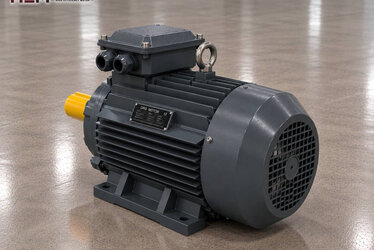
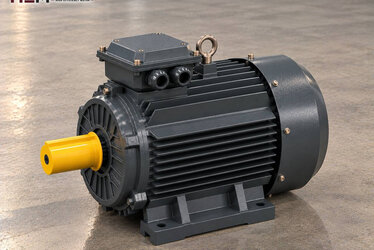
For the main drive and compression belt, robust cast iron frame motors can be examined, and for the vacuum fan and small auxiliary drives aluminium frame motors. All models are listed on the motor shop page. The products below are examples; their suitability for the machine is verified separately: the cast iron 100L2-4 gives 19.8 Nm rated torque at 1,450 rpm, the aluminium 100L1-4 14.5 Nm at 1,450 rpm, and for the vacuum fan 71M1-2 1.28 Nm at 2,750 rpm.
| Folder-gluer section | Motor connection | Point to watch | Example HEM model |
|---|---|---|---|
| Main drive (line shaft) | Foot-mounted motor, belt-pulley, inverter | Low speed during setup, keep the number of poles | 100L2-4 cast iron, 3 kW |
| Compression-delivery belt (if separately driven) | Flange connection to gearbox | Matching line speed, inverter | 100L1-4 aluminium, 2.2 kW |
| Feeder vacuum fan | Fan impeller directly on the motor shaft | Fan speed, dust build-up | 71M1-2, 0.37 kW |
| Servo-synchronised feeder or folding belt | Machine-specific servo motor and drive | Not replaced with a standard motor; consult the manufacturer | No standard model recommended |
The models in the table are selection examples; the final decision is made after machine data, load, speed and mounting dimensions are compared. For cutting, slotting and printing machines, see the paper and board converting machine motor page.
Frequently Asked Questions
The main motor heats up during setup but not in production; why?
During setup the motor runs at low frequency with frequent starts, and its own fan produces little air. If setup times are long, a separate fan option or the inverter settings should be reviewed together with the machine manufacturer.
Can I replace the 4-pole main motor with a 2-pole model?
It is not recommended. With the same pulley and gearbox ratio, line speed and the inverter frequency range change, and torque also falls. Keeping the existing number of poles is the safest route when replacing.
What do I need to know for the feeder vacuum fan motor?
The power and speed on the nameplate, how the fan impeller is attached to the shaft and the motor's mounting type are enough. If the impeller is mounted straight onto the motor shaft, the shaft dimension is especially important.
On a servo-driven folding line, which motors can be standard?
On some lines the vacuum fan, glue pump and delivery conveyor run with standard induction motors. The motors of synchronised axes are machine-specific and are assessed separately.
Where is a motor used on a case erector?
On case erectors the movements that open and fold the carton are mostly pneumatic. The standard motor is usually found on the conveyor carrying the carton and on the belts of the taping section.