English
 Français
 Türkçe
 Español
 Русский

A bag closing sewing machine closes the mouth of a sack filled with flour, feed, sugar, fertiliser or seed with a thread chain stitch. On line-type machines the filled bag travels upright on a conveyor belt; the mouth passes through guides into the sewing head, the thread is cut as soon as stitching ends and the bag moves on to palletising. This page explains which parts the electric motor turns in this arrangement and what to check when looking for a replacement motor. For the whole filling and packing line, the packaging machinery motors page gives the overview.

Sewing head, bag conveyor and column: the parts the motor turns
On column-type (stationary) bag closing units there are two separate movements. The first is the main shaft of the sewing head: the needle bar, looper and feed dog take their motion from this shaft. On some models this shaft is turned by belt and pulley from a small induction motor mounted behind the head or on top of the column. The second is the belt conveyor carrying the bag; this belt is usually driven by a separate geared motor.
On lines where bag length changes, the height of the column carrying the sewing head is adjusted. This adjustment is done by hand on some machines and by a motorised screw mechanism on others. If there is motorised column adjustment, there is a third small motor; it does not run continuously and only turns briefly during adjustment.
The parts that are not the motor's job are also clear. The thread cutting knife is pneumatic or solenoid-operated on most machines; the crepe tape or label feeder that closes the bag mouth runs on its own small mechanism; if heat sealing is used instead of stitching on PE bags, the heated jaw is not a motor. On hand-held portable sack sewing machines, the motor is a machine-specific motor built into the body (usually a single-phase brushed type); a standard induction motor cannot be put in place of these motors. The same limit applies to automatic lines where sewing speed and belt speed are synchronised by servo.
Information to gather for the sewing motor and the belt motor
First separate which motor is to be replaced: sewing head motor, belt conveyor motor or column adjustment motor. Each has a different speed and connection; seeing two motors with different numbers of poles on the same unit is common.
Power, speed, voltage and current are read from the nameplate. For the sewing motor note the pulley diameter and belt type; for the belt motor, the gearbox type and connection flange. It is also asked how many bags the machine closes per hour, whether it runs non-stop through the shift or as bags arrive, and whether the line is supplied from a three-phase panel.
How are sewing speed and belt speed determined together?
The basic measure in bag mouth sewing is the stitch length: how far the bag advances with each needle stroke. This length is set by the ratio of the sewing head shaft speed to the linear speed of the belt. If the belt is fast and sewing slow, the stitches become sparse and the bag mouth may open; in the opposite case the stitches become dense and the thread and head are stressed more than necessary.
For this reason, keeping the speed is decisive when replacing a motor. The pulley ratio for the sewing head motor and the gearbox ratio for the belt motor have been set for the machine; fitting a motor with a different number of poles upsets this balance. On the power side, the sewing head load is small; the belt motor load depends on bag weight and belt length. The correct power and speed come from the machine manufacturer's data and from the nameplate of the removed motor; this page does not recommend a single kW value for the machine.
At small power the limit is clear: our three-phase series has no model below 0.25 kW. If the nameplate shows a value below this, or the unit will run only on a single-phase line, the single-phase electric motor series, ranging from 0.18 kW to 5.5 kW, can be examined as an option.
Checking the pulley, belt alignment and gearbox flange
The motor that turns the sewing head by belt is usually mounted on a plate on the column, foot-mounted (B3) or with a small flange, and belt tension is adjusted by shifting the motor. In this arrangement shaft diameter and length, key size and the foot or flange holes must be the same as the old motor; if the pulley does not sit at the same shaft length, belt alignment is upset and the belt wears quickly.
The belt conveyor motor, on the other hand, is usually fitted to a worm or helical gearbox with a B14 or B5 flange. The comparison starts with the IEC frame size; the flange spigot diameter, pitch circle and bolt type are checked separately. For dimensions see the electric motor frame dimensions page, and for the available connection types the mounting arrangements page. It should not be assumed that the new motor will sit in the same place without problems until the dimensions are verified.
Flour, feed and fertiliser dust: the effect of the filling area on the motor
The bag sewing unit stands just behind the filling scale and works in the fine dust that escapes from the bag during filling. Flour and feed dust form a layer on the fan cover and frame fins and reduce cooling; fertiliser and salt dust can also corrode surfaces when combined with moisture. Regular cleaning of the motor surface and a sound terminal box gasket are important in this environment.
HEM's standard series is built with an IP55 enclosure against dust and water splashes, class F winding insulation and S1 continuous duty; the catalogue defines the motor for ambient temperatures between −15 and +40 degrees Celsius and altitudes up to 1000 m. On units standing in an open dispatch area or an unheated warehouse an anti-condensation heater can be added; a PTC or PT100 sensor that reports winding overheating to the panel can also be requested with the order. In areas with combustible dust that have been classified as explosive atmospheres, a standard IP55 motor is not designed for this condition; a specially certified motor is then required, and such motors are not included in HEM Motor's 2026 catalogue.
Start-stop as bags arrive, speed matching and inverter
On many units the belt runs continuously, while the sewing head runs when the bag mouth sensor sees a bag and stops when stitching ends. In this case the sewing motor makes as many starts per hour as there are bags. On a busy filling line the number of starts will be high, so motor heating should be monitored and, if necessary, solutions such as keeping the sewing motor running continuously and engaging the head with a clutch should be discussed with the machine manufacturer.
To adjust belt and sewing speed together according to bag type, both motors can be driven by a frequency inverter. Our three-phase series can be used as inverter-compatible motors; if there will be long loaded running at very low frequency or mounting far from the drive, add it to the order note. If the belt must stop quickly with the bag, a brake motor may be needed; if a brake motor is required, state it in the order. On lines that match sewing and belt speed with servo drives, this synchronised structure cannot be built the same way with a standard motor and a simple inverter.
Information to send to replace a sewing unit motor
Review is faster when a nameplate photo of the removed motor and a photo showing its place on the column or belt are sent via WhatsApp; the steps are on the send motor nameplate page. Pre-order checklist:
- Values on the plate: kW, rpm, volts, amps and delta/star information
- The motor's task: sewing head, bag conveyor or column height adjustment
- For the sewing motor, pulley diameter and belt type; for the belt motor, the gearbox label
- Mounting type (foot B3, flange B5 or B14), shaft and key dimensions
- The unit's supply and whether an inverter is used
- Product being filled (flour, feed, fertiliser, sugar etc.) and how dusty the area is
- Required quantity and the number of motors to keep as spares
You can send the prepared information to the WhatsApp line on the contact page.
Motor groups in the shop for a bag sewing unit
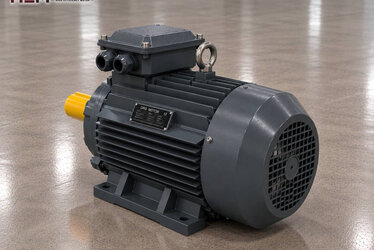
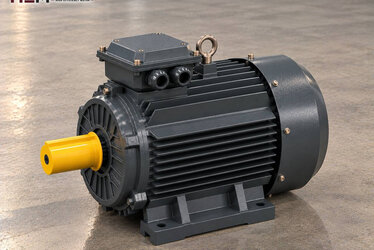
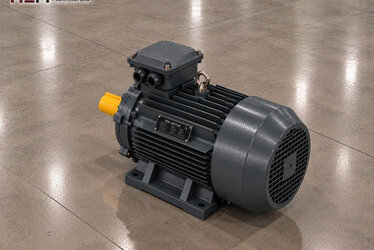
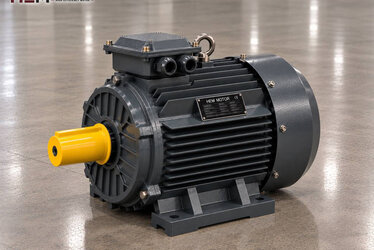
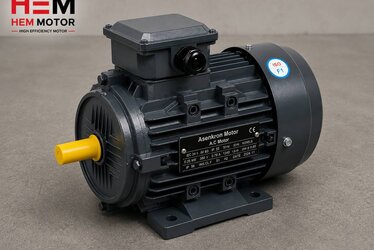
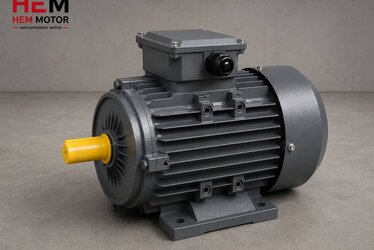
For small, light drives such as the sewing head, aluminium frame three-phase motors can be examined, and for the belt conveyor in a dusty filling area, cast iron frame three-phase motors. All models are on the buy electric motors page. The following are examples; their suitability for the machine is verified separately: 63M2-2 gives 0.87 Nm rated torque at 2,730 rpm, 80M1-2 2.49 Nm at 2,880 rpm and, for the belt, the cast iron 90S-4 7.27 Nm at 1,445 rpm.
| Drive on the bag sewing unit | Transmission | Decisive information for selection | Example HEM model |
|---|---|---|---|
| Sewing head main shaft, light head | Belt and pulley | Pulley ratio, stitch length | 63M2-2, 0.25 kW, 2,730 rpm |
| Sewing head, heavy bags and thick thread | Belt and pulley, start-stop by bag sensor | Starts per hour, heating | 80M1-2, 0.75 kW, 2,880 rpm |
| Bag conveyor belt | Flange connection to gearbox | Matching belt speed with sewing speed, dust | 90S-4 cast iron, 1.1 kW, 1,445 rpm |
| Portable sewing machine or servo-synchronised head | Machine-specific motor and drive | The manufacturer's spare part is used | No standard model recommended |
These models are for guidance; the motor is selected by matching the unit's data, bag load, sewing and belt speed and connection dimensions. If sewn bags are wrapped after palletising, the end-of-line drives are covered under pallet stretch wrapping machine motor.
Frequently Asked Questions
After a motor change the stitches became sparse; what could be the reason?
The most likely reason is that the new motor's speed differs from the old one. When the speed ratio between the sewing head and the belt changes, the stitch length changes too; compare the number of poles and pulley diameter with the old motor.
Can I find a three-phase motor for my hand-held sack sewing machine?
The motor of portable machines is a machine-specific motor built specially into the body. Replacing it with a standard induction motor is not recommended; the machine manufacturer's spare motor should be used.
Is a standard IP55 motor enough for a sewing unit in a flour mill?
In dusty areas not classified as explosive atmospheres, IP55 protection is designed against dust. If the area is classified as an explosive dust atmosphere, a certified special motor is required.
Can I drive the belt and sewing motors with one inverter?
On some machines the two motors are connected to the same inverter and the speed ratio is kept mechanically. Whether this arrangement is suitable depends on the motor powers and the machine manufacturer's diagram.
What should I send for the column height adjustment motor?
A nameplate photo, how it connects to the screw mechanism and whether the motor has a brake are enough. Since this motor runs only briefly, connection dimensions matter more than power.