English
 Français
 Türkçe
 Español
 Русский

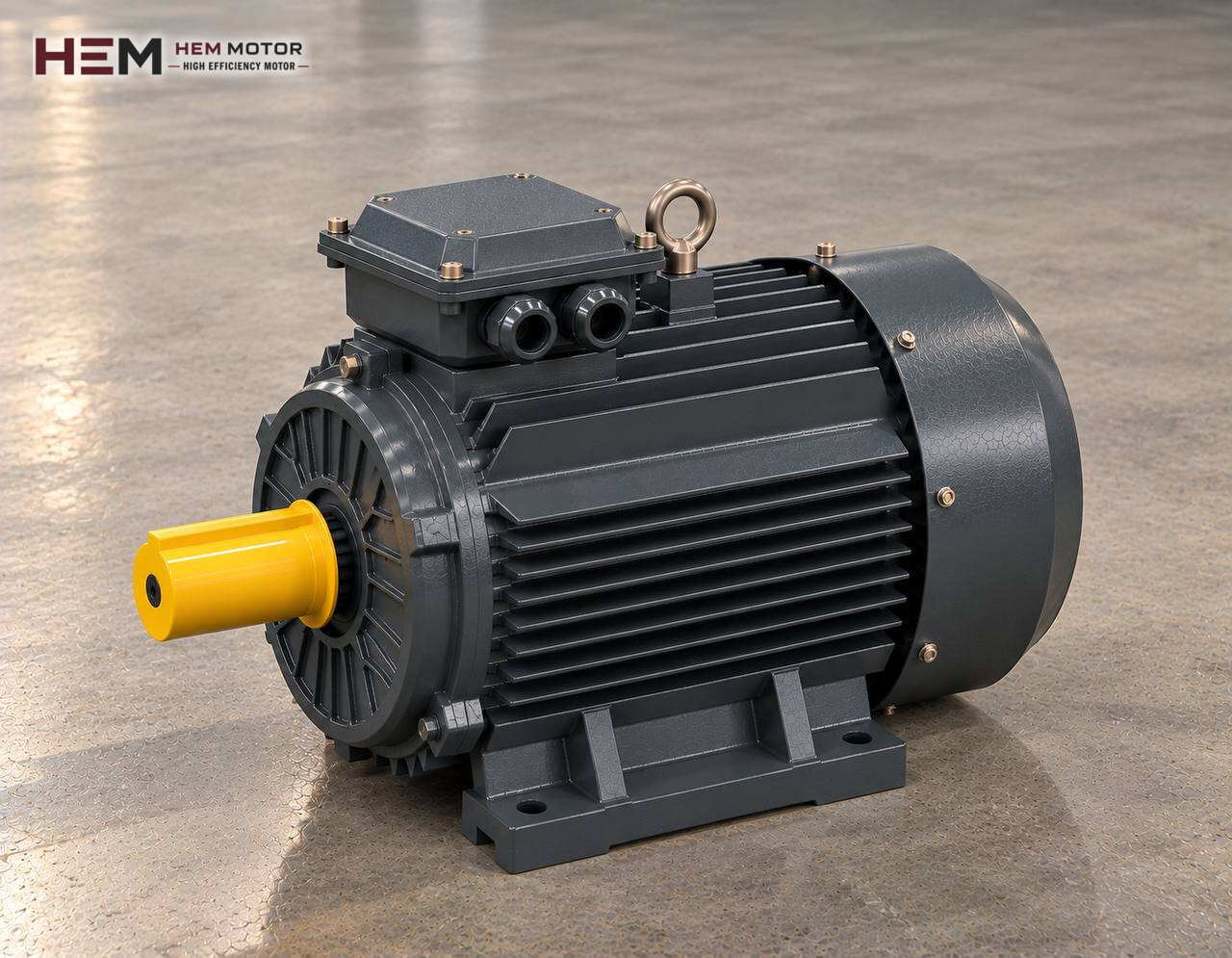
A shrink wrapping machine encloses a product or a group of products in heat-shrinkable film: the film is first placed around the product and sealed, then the pack passes through a hot-air tunnel and the film tightens onto the product. This page is a sub-section of packaging machinery electric motors; it looks one by one at the motors that turn inside a shrink machine: the tunnel circulation fan, the tunnel conveyor, the infeed belt, the film unwinder and the cooling fan at the exit.

Sections of a shrink machine and the moving parts
Shrink machines on the market fall into three main groups. On L-sealers, flat film comes below and above the product; an L-shaped jaw cuts and seals two edges at once. On sleeve wrappers the film wraps the product group from two sides and the ends stay open; this type is common for packs of beverage bottles and cans. On shrink-sleeve labelling lines, a pre-printed tubular film is slipped over the bottle and shrunk in a steam or hot-air tunnel.
In all three types the sealing jaw is usually moved by a pneumatic cylinder or a small geared motor, and the heat comes from heating elements. The electric motors that really run throughout the shift are the tunnel fans and the conveyor carrying the pack through the tunnel. On semi-automatic table-top machines all of these motors may stay at a few hundred watts; on fully automatic beverage lines fan and conveyor ratings become noticeably larger.
Tunnel fan: an impeller in hot air, a motor that stays outside
In the shrink tunnel, air heated by the elements is driven through ducts by one or more radial fans and blown onto the top and sides of the pack. The fan impeller sits inside the hot zone; the motor is fixed outside the tunnel body, often on the top cover or a side wall, and turns the impeller at the end of an extended shaft. In this arrangement the motor is heated in two ways: heat conducted along the shaft into the frame, and the hot air given off by the tunnel sheet metal around it.
That is why it matters to leave a thermal barrier or an air gap between the motor flange and the tunnel wall and to keep the area in front of the motor's fan cover open. The nameplate values of a standard motor apply to a given ambient temperature; if the air above the tunnel exceeds it, this must be stated clearly in the order and, where necessary, the motor should be moved to a cooler spot. A PTC or PT100 sensor in the winding is available as an order option; on a tunnel fan it gives early warning that heat is reaching the motor side.
The fans are usually directly coupled to 4- or 2-pole motors. Letting the fan run on for a while after the machine is switched off keeps the heat left in the tunnel from stressing the shaft and impeller; this is a control setting and is done according to the machine builder's instructions. For the general picture of fan drives see fan and extractor motors.
Tunnel conveyor and how speed affects the film
The surface carrying the pack through the tunnel is a heat-resistant chain with steel rods, a PTFE-coated wire mesh or a roller bed. This belt is usually pulled by a geared motor. Belt speed directly sets how long the pack stays in the tunnel: if it is too high the film does not shrink fully, if it is too low the film can burst or the product heats up more than needed. For this reason the conveyor motor is fed from a frequency inverter on almost every machine, and the operator changes the speed according to film thickness.
When the inverter slows the motor, the motor's own shaft fan slows too. If the tunnel belt runs at low speed for hours, cooling becomes weak; such duty may need separate fan cooling, and an output filter is considered when the cable between drive and motor is long. Both details should be added to the order note. Placing the conveyor motor on the infeed side of the tunnel, away from the hot zone, also lowers its heat load. Flange and shaft matching to the gearbox is explained on the electric motors for reducers page.
If the power fails or the conveyor motor stops, the pack left inside the tunnel burns and the film can stick to the belt. Many machines therefore cut the heating elements when the belt stops; when replacing the motor, take care not to break this interlock circuit.
Infeed belt, film unwinder and cooling fan
On fully automatic sleeve wrappers, products arrive on an infeed belt and are lined up by a pusher or grouper. This belt runs on a motor separate from the tunnel belt, and the speeds of the two belts are set relative to each other. The film reel is usually unwound by a motorised unwinder; a dancer arm measures film tension, and the unwinder motor speeds up or slows down according to the arm's position.
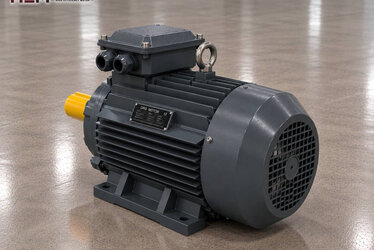
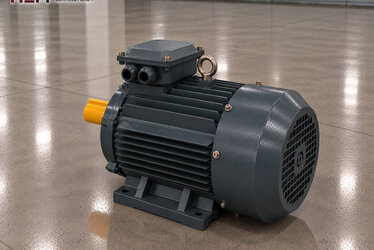
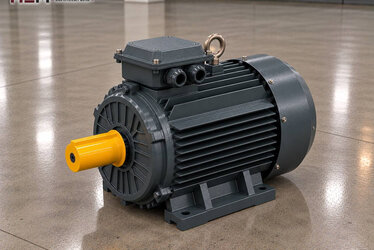
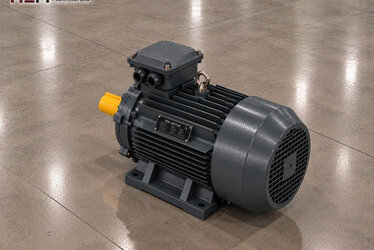
One or two cooling fans at the tunnel exit quickly set the shrunk film and bring the pack down to a temperature that can be handled. These fans are small; our small aluminium-frame models are a good starting point for this job. For table-top machines in workshops with only a single-phase supply, our single-phase electric motor range of 0.18–5.5 kW is also an option.
Mounting and operating environment
Space on shrink machines is tight, so motors are often flange mounted: B5 or B14 on the conveyor gearbox, a foot-and-flange arrangement on the fan bracket. Depending on frame size, B3, B5, B14, B34, B35 and vertical V1, V3, V5, V6 and V15 arrangements are offered; flange size and shaft diameter are confirmed at the order stage. If the fan motor sits on the tunnel's top cover with the shaft pointing down, this vertical position should be stated in the order.
The environment is generally dry and clean; the motor's real load is heat. Small pieces torn from the film and pack dust can collect on the fan guard; keeping the guard clear protects cooling. Our motors come with IP55 protection and class F insulation.
Example motors for a shrink machine
| Drive | Duty | What to check | Example HEM model |
|---|---|---|---|
| Tunnel circulation fan | Continuous, close to the hot zone | Air temperature around the motor, PTC | 1.1 kW 90S-4 (1,445 rpm) |
| Tunnel conveyor | Continuous, speed set by inverter | Cooling at low speed, gearbox flange | 0.55 kW 80M1-4 (1,400 rpm) |
| Infeed belt and film unwinder | Variable speed, frequent speed changes | Speed matching between belts, start frequency | 0.37 kW 71M2-4 (1,340 rpm) |
| Exit cooling fan | Continuous, direct coupled | Fan diameter and required speed | 0.75 kW 80M1-2 (2,880 rpm) |
These models are chosen to give an idea; the power and speed of the motor on your machine, the line speed and the tunnel size determine the final decision. The nameplate of the motor you are replacing is the most reliable starting information.
Information needed for a quotation
In your request, state the shrink machine type (L-sealer, sleeve wrapper, shrink-sleeve tunnel), which drive the motor works on, power (kW), speed (rpm), supply voltage, mounting arrangement and quantity; for a tunnel fan, also add the approximate air temperature where the motor sits. A photo of the old motor's nameplate speeds up selecting an equivalent: send a motor nameplate.
Current prices of the models are listed on the buy electric motors page; our WhatsApp and phone details are on the contact page.
Frequently Asked Questions
The tunnel fan motor fails often; would fitting a larger motor solve it?
Most of the time the problem is temperature, not power. The air around the motor and heat coming along the shaft stress the winding. First check the thermal barrier, the clearance in front of the fan cover and whether the fan runs on long enough when the machine is switched off; if needed, ask for a motor with a PTC sensor.
Is an inverter required to adjust the tunnel belt speed?
If speed adjustment is wanted, it is the most practical way, and our three-phase ranges can be driven by an inverter. Mechanical variators are also seen on older machines; in that case the motor runs at fixed speed and the variator changes the speed.
Can a single-phase motor be used on a small shrink machine?
It can be used on small machines connected to a single-phase supply; our single-phase range covers 0.18–5.5 kW. On fully automatic machines where line speed is finely adjusted, a three-phase motor with a suitable drive is more common.
Can I place the fan motor inside the tunnel?
A standard motor is not designed to run inside the hot air stream. The motor should stay outside the tunnel and the impeller should turn on an extended shaft; if a different arrangement is unavoidable, state it in the order.