English
 Français
 Türkçe
 Español
 Русский

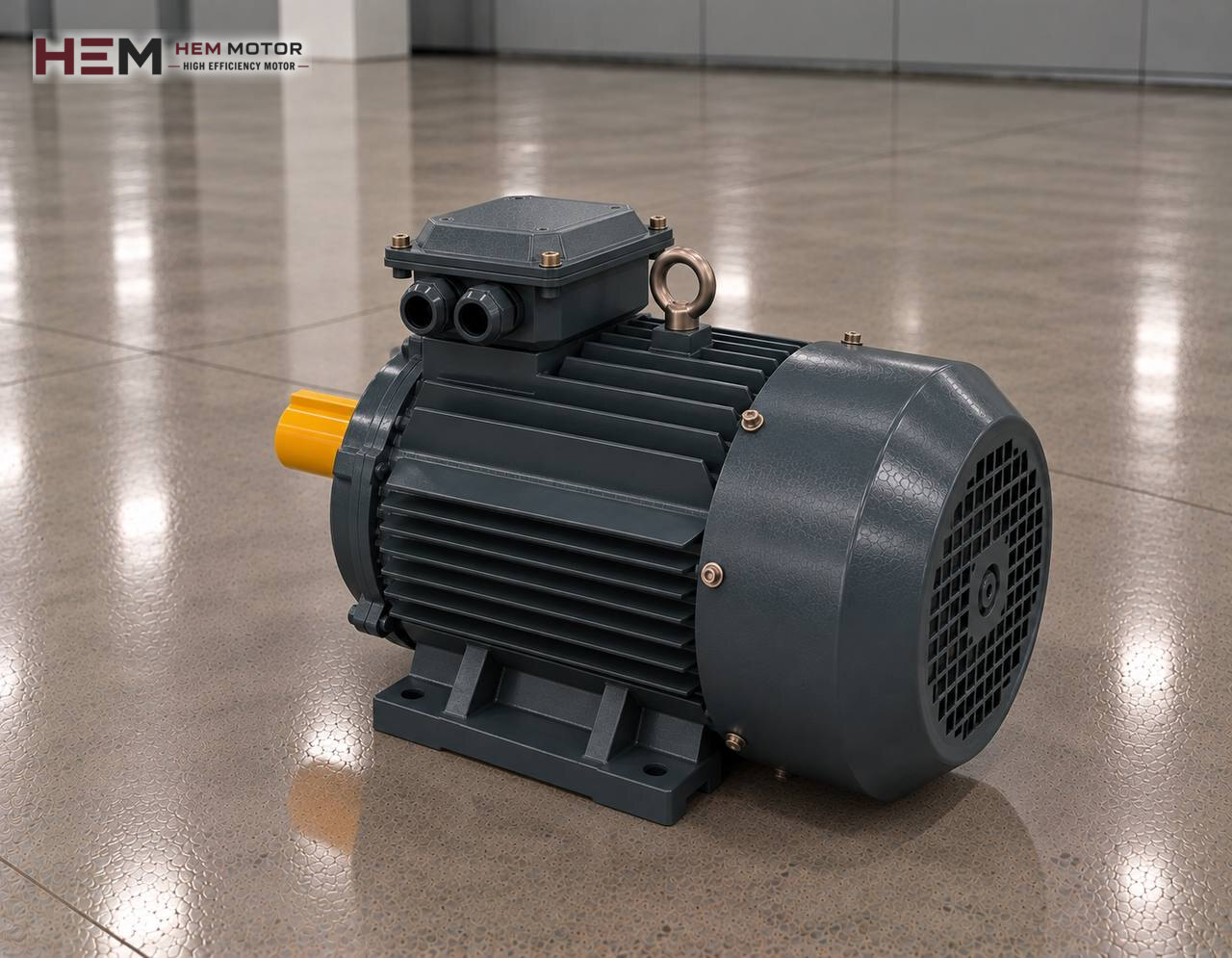
Paper and board converting machines turn paper delivered on reels, or corrugated board sheets, into narrow rolls, sheets, die-cut box blanks and glued boxes. This page is a sub-topic of packaging machinery electric motors; it explains what a standard three-phase motor does on drives such as reel unwinding and rewinding, slitting, sheeting, die-cutting and creasing, folding and gluing, and edge-trim extraction.

From reel to box: which motor on which machine?
In a board packaging plant the material passes through several machines, and the load the motor sees is different on each:
- Slitter-rewinder: unwinds the wide parent reel, splits it into strips with rotary knives and winds them onto narrow rolls.
- Sheeter: cuts paper drawn from the reel into sheets of a set length with a rotating knife cylinder.
- Die-cutting and creasing press: cuts the board sheet with a knife die and presses the fold lines.
- Folder-gluer: carries cut blanks between belts, folds and glues them.
- Auxiliaries: the fan extracting edge trim, vacuum belts holding sheets by suction, dust extraction and glue pumps.
Some of these drives require precise positioning and synchronous motion; modern machines use servo motors in these sections, and servo drives are not included in HEM Motor's 2026 catalogue. The main line drive, cutter cylinders, fans, pumps and flywheel presses, on the other hand, are typical places where a standard three-phase asynchronous motor works.
Unwinding and rewinding: torque changes as diameter changes
On the rewinding unit, paper speed and tension are meant to stay constant. As the roll grows, the shaft must turn more slowly for the same line speed, while for the same tension the torque rises with diameter. As a result, the rewinder motor runs fast with low torque at the start and slow with high torque as the roll fills. On the unwind side the situation is reversed; on many machines a pneumatic or magnetic powder brake is used instead of an unwinder motor, and the brake sets the tension.
A standard asynchronous motor with a vector-controlled inverter and a dancer arm or tension sensor is widely used on such rewinders. When selecting the motor, look not only at rated power but at the torque at the largest roll diameter and at which speed that torque is needed. A rewinder motor that will run for long periods at low speed with high torque may need cooling by an independent fan; state this in the order.
Slitting and sheeting: line speed and the cutter cylinder
On a slitter, the circular rotary knives either turn freely with the paper or are driven by a separate motor. The knife motor is small but runs continuously and is adjusted to line speed. The main line motor turns the pull roll that draws the reel; the stability of line speed directly affects roll quality.
On a sheeter, the knife cylinder enters the paper once per revolution. For the motor this means short load impulses repeated at regular intervals; the inertia of the cylinder and the belt pulley smooths these impulses. Sheet length is set by the ratio of cylinder speed to paper speed; on older machines this ratio is adjusted with a gearbox, on newer ones electronically.
Die-cutting presses: flywheel, clutch and long start-up
Most platen die-cutting and creasing presses are mechanical: the electric motor drives a heavy flywheel by belt, the flywheel turns the eccentric shaft through a clutch-brake unit and the die comes down. The large force at the moment of cutting comes from the energy stored in the flywheel; between two strokes the motor accelerates the flywheel again. So the motor does not stop and restart on each stroke but runs throughout the shift.
The flywheel's inertia lengthens the start when the machine is switched on. During this time the motor draws high current; star-delta or a soft starter eases this phase for the supply. Our models of 4 kW and above are rated 400/690 V, so on a 400 V supply they suit star-delta connection. On presses where a hydraulic cylinder lowers the die, the motor only turns the hydraulic pump; selection is then made using the criteria on the hydraulic pump electric motors page.
Trim extraction fan, vacuum belts and paper dust
In slitting and sheeting, the edge strips that are cut off are carried by duct to a baling press or a collecting cyclone. The fan doing this passes the trim through its impeller; the impeller is therefore an open-bladed material-handling type able to shred the paper strip. The fan usually runs directly coupled to a 2-pole motor and operates continuously through the shift.
The vacuum fans that hold sheets to the belts in folder-gluers and feeders are similarly continuously running drives. Paper dust builds up like a thin felt on the motor's fan guard and cooling fins; regular dry cleaning protects cooling. General information on fan drives is on the fan and extractor motors page.
Mounting and speed control
Main line and rewinder motors are usually foot mounted on the machine frame or flange mounted on a gearbox. Depending on frame size, B3, B5, B14, B34, B35 and vertical V1/V3/V5/V6/V15 arrangements are available; flange and shaft dimensions are confirmed in the order. For every drive whose line speed is varied, our three-phase ranges can run on an inverter; details and the filter question linked to cable length are on the inverter compatible electric motors page. A PTC or PT100 sensor to monitor winding temperature and an anti-condensation heater for machines standing in damp warehouses are order options.
Example motors for paper and board machines
| Drive | Load character | What to check | Example HEM model |
|---|---|---|---|
| Slitter-rewinder main line | Continuous, speed adjusted | Line speed range, torque at low speed | 15 kW 160L-4 (1,465 rpm) |
| Die-cutting press flywheel | Flywheel, impulsive, long start | Flywheel inertia, starting method | 7.5 kW 132M-4 (1,460 rpm) |
| Edge trim extraction fan | Continuous, high speed | Fan speed, dust build-up | 5.5 kW 132S1-2 (2,930 rpm) |
| Rewinder or sheeter cylinder | Torque varying with diameter, repeated impulses | Torque at the largest roll diameter | 4 kW 112M-4 (1,450 rpm) |
The models in the table are examples only; the right motor becomes clear once the machine's web width, speed, starting method and layout are known. The nameplate values of the existing motor are always the first reference.
What to send when asking for a quotation
Write the machine type (slitter, sheeter, die-cutter, folder-gluer), which drive the motor is on, power (kW), speed (rpm), supply voltage, mounting arrangement, whether it runs on an inverter, and quantity. If you can send a nameplate photo, selecting an equivalent becomes easier: send a motor nameplate.
For current prices see the buy electric motors page; for WhatsApp and phone details see the contact page.
Frequently Asked Questions
Is rated power a sufficient criterion when choosing a rewinder motor?
Not on its own. As the roll grows, the required torque rises and the speed falls; you need to look together at the speed at which the motor can deliver the torque needed at the largest diameter and how it will be cooled in that duty.
My die-cutting press motor trips the fuse at start-up; what could be the reason?
Flywheel inertia lengthens the start and the current stays high for a long time. Check the setting of the protective device, the starting method and whether the clutch really is disengaged during start-up.
Why does the trim extraction fan motor heat up quickly?
Paper dust may be covering the fan guard and the frame fins. A blockage in the duct or a damper opened too far also increases the fan's load; check the air path before replacing the motor.
Can I replace the DC motor on an old machine with a standard motor?
Many lines have had their DC drives renewed with an asynchronous motor and inverter, but this is a project task. Speed range, torque at low speed and mounting dimensions must be examined together. DC motors are not included in HEM Motor's 2026 catalogue.