English
 Français
 Türkçe
 Español
 Русский

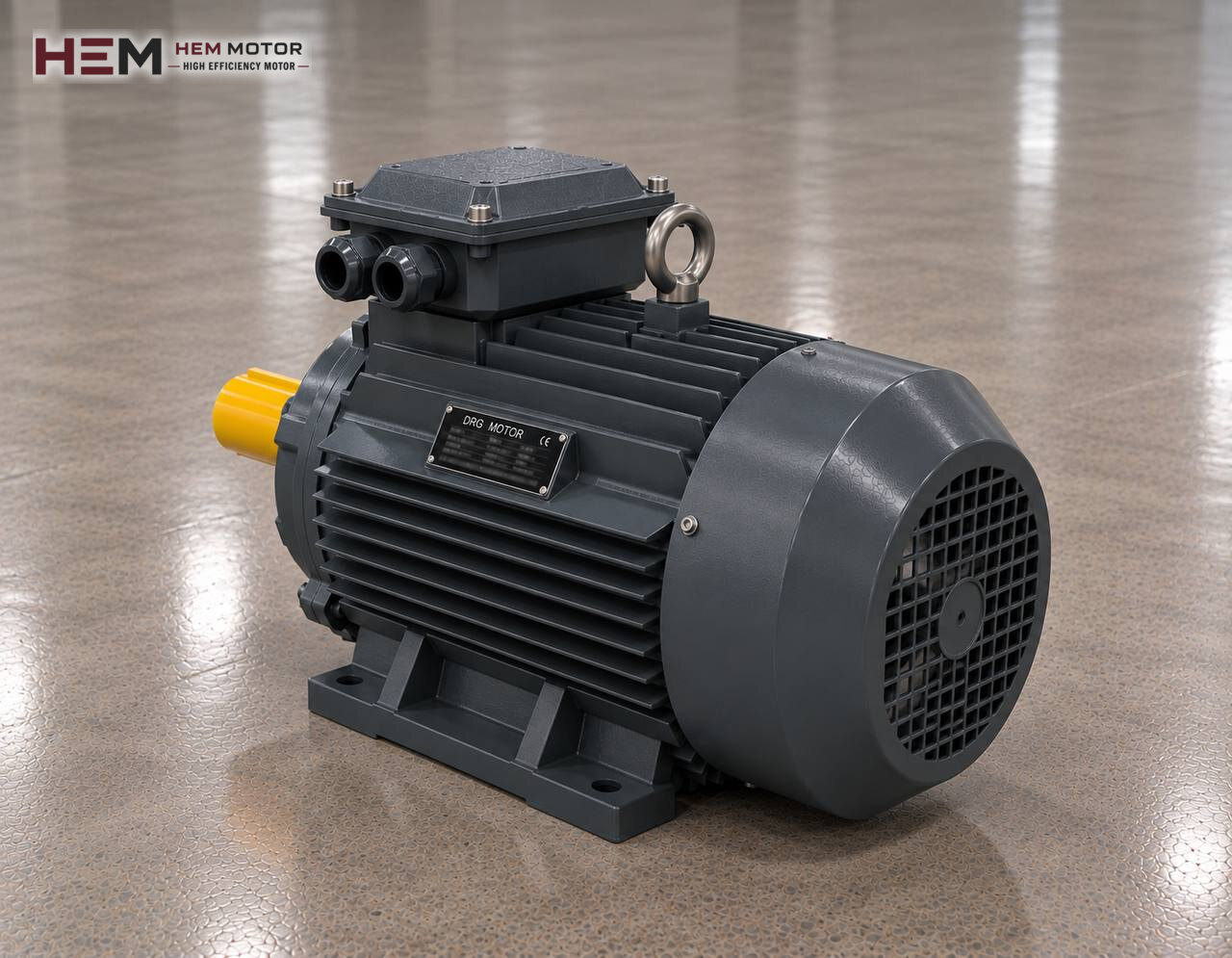
A pallet stretch wrapping machine wraps tensioned film around a pallet being prepared for shipment and turns the load into a single block. The machine is small, but it contains several drives that work independently of each other, each with a different task. For the other machines on the line see the packaging machinery electric motors page; here we only cover the motors of the stretch wrapper.

Machine types and the source of motion
The most common type is the turntable machine. The pallet is placed on a round table, either recessed into the floor or standing on it; while the table turns, the film carriage on a fixed mast travels up and down and wraps the film in a spiral. The turntable drive is the largest motor on the machine.
For light, unstable or very tall loads the rotary arm type is preferred. Here the pallet stays still and the arm carrying the film carriage turns around it. On high-capacity automatic lines the rotary ring type is seen; the film carriage turns on a horizontal ring and the pallet enters and leaves on a conveyor. In these types the rotating mass is the arm or the ring, not the load.
For long profiles, pipes and doors there are horizontal (orbital) wrapping machines; the film ring turns around the product while the product moves forward on rollers. The motor tasks for these products are similar, but the drive arrangement is different.
Turntable drive: load inertia and positioned stop
On a turntable the motor turns a gearbox; the pinion or chain sprocket on the gearbox output drives the gear ring or chain around the table. The table usually turns at between a few and twelve revolutions per minute; this speed is set by the gearbox ratio and, on most machines, by a frequency inverter.
On a heavy, tall pallet the real issue is the moment of starting and stopping. The load must not tip over and the film must not break. For this reason the table accelerates on a soft ramp and, at the end of wrapping, slows down to stop at an angle suited to the forklift entry. A position sensor and the inverter work together. The power of the turntable motor is set by the machine manufacturer according to the maximum pallet weight and rotation speed; for this value, checking the nameplate of the existing motor is best.
On floor-level tables the motor and gearbox sit in a narrow pit under the table. Dust, film scraps and washing or rain water can collect in this pit; it should be considered at the design stage that the motor does not stay at a point where water gathers.
Film carriage and pre-stretch drives
The film carriage is carried along the mast by a chain or a toothed belt. This drive lifts the carriage and lowers it; when the motor stops, the carriage must not slide down under its own weight. On most machines this is provided by the self-locking property of a worm gearbox or by a separate brake. Brake motors are not included in HEM Motor's 2026 catalogue; if your existing carriage motor has a brake, be sure to state this for the replacement.
In a powered pre-stretch unit two rollers turn at different speeds and stretch the film before it is wrapped onto the load. The rollers are driven by one motor through a gear pair or each by its own motor. Film tension is set by the speed of this motor according to the speed of the table or arm; for this reason the pre-stretch motor also mostly works with an inverter.
Low power, single-phase supply and the inverter
The motors of stretch wrappers are low power; this falls at the bottom end of HEM's aluminium frame range. The smallest model in our three-phase range is 0.25 kW; if an even smaller drive is needed, or if the machine will only be connected to a single-phase socket, single-phase electric motors in the 0.18–5.5 kW range can be considered.
On many small machines, however, an inverter fed from the single-phase supply drives a three-phase motor. In this arrangement the inverter output is 230 V three-phase; our motors up to 3 kW carry a 230/400 V rating, so they match this output when connected in delta. Whether extra measures are needed for conditions such as long running at full load at low speed or a long motor cable can be read on the inverter compatible motors page; noting these conditions in the order is enough.
Warehouse environment, mounting and maintenance
Stretch wrappers mostly work in warehouse and dispatch areas, next to forklift traffic. Motors should be protected against mechanical impact by the machine's cover. In cold stores or on open ramps condensation can occur during stops; an anti-condensation heater is an order option. IP55 protection is against dust and water splashes; a motor standing in a puddle is outside the scope of this protection.
On turntable and carriage drives the motor is mostly fitted to the gearbox by a flange. Depending on frame size there are foot-mounted B3, flanged B5 and B14, foot-and-flange B34 and B35, and vertical V1, V3, V5, V6 and V15 positions; on small frames the B14 flange is common. Which flange and shaft diameter match the gearbox is clarified in the order. During maintenance, the turntable chain tension, the gearbox oil and film scraps on the motor fan cover should be checked.
Example models for stretch wrapper drives
On these machines 4-pole aluminium frame motors stand out for geared drives: the 71M1-4 (0.25 kW) gives 1.78 Nm at 1,340 rpm, the 71M2-4 (0.37 kW) 2.64 Nm at 1,340 rpm, the 80M2-4 (0.75 kW) 5.04 Nm at 1,420 rpm and the 90S-4 (1.1 kW) 7.27 Nm rated torque at 1,445 rpm.
| Stretch wrapper drive | What the motor does | Point to watch | Example HEM model |
|---|---|---|---|
| Film carriage lift | Carries the carriage along the mast | Self-locking gearbox or brake | 71M1-4, 0.25 kW |
| Powered pre-stretch | Turns rollers at different speeds | Tension setting via inverter | 71M2-4, 0.37 kW |
| Turntable, standard pallet | Rotates the load on a ramp | Positioned stop, B14 flange | 80M2-4, 0.75 kW |
| Turntable, heavy pallet or rotary arm | Accelerates large inertia | Gearbox ratio, start ramp | 90S-4, 1.1 kW |
The models in the table are examples; the final selection is made according to the machine load, the required speed, mounting and operating conditions.
Ordering a stretch wrapper motor
Send us the machine type and which drive you need a motor for, the motor power (kW), speed (rpm), supply voltage (single-phase or three-phase), mounting type (flange type) and quantity. If you are buying in series for a machine builder, an estimate of the annual quantity is also useful. A nameplate photo of the old motor is the quickest route, as it also contains flange and voltage information. Models and current prices are on the shop page; for WhatsApp and phone you can use the contact page.
Frequently Asked Questions
My turntable motor is single-phase; can I fit a three-phase motor instead?
It can be fitted if the machine has a three-phase supply or an inverter with a single-phase input. If there is only a single-phase socket and no inverter, a single-phase motor or an inverter-based solution is needed.
Why does the film carriage come down by itself?
The worm gearbox holding the carriage may be worn or the brake setting may be off. Before replacing the motor, check which part provides the holding function.
Can I find a motor smaller than 0.25 kW?
Our three-phase range starts at 0.25 kW. If a lower power is needed, we can consider our single-phase range, which starts at 0.18 kW.
Is it mandatory to drive the turntable motor with an inverter?
It is not mandatory; but for soft starting, adjustable rotation speed and positioned stopping an inverter is the most practical way, and it is standard on most new machines.