No-load current is the current a motor draws from the supply while running at rated voltage with no load on the shaft; it consists mostly of magnetising current. Locked rotor current is the current drawn when rated voltage is applied while the rotor is not turning, and it represents the moment of starting. In a quotation the two should be written on separate lines, for the same voltage and with the measuring condition. One describes magnetisation at no load, the other the load the panel will see at starting.
What do the two currents measure and why are they confused?
An induction motor running at no load does almost no mechanical work; most of the current it draws is reactive current that builds the magnetic field in the air gap, and a small part covers iron, friction and fan losses. That is why no-load current is drawn at a low power factor and little energy shows on the meter. The clamp shows a lot, the meter records little.
In the locked rotor condition the picture reverses.
Because the rotor is stationary, no back-EMF forms, and only the impedance of the windings limits the current. The result is a short-lived current several times the rated current.
There are three reasons the two get confused in quotations. The first is simple: both are written in amperes and placed in the table next to nameplate current. Second, some catalogues give locked rotor current only as a ratio and do not give no-load current at all. Third, measurements from site are passed on as "the clamp showed this much at start"; yet the speed at which a clamp meter catches the peak may not show starting current correctly.
Which lines should a quotation table contain?
A comparable quotation table puts the two currents on separate lines together with their conditions, and the skeleton below lets purchasing and engineering speak the same language:
Line
What is written
Why it is kept separate
Rated current (IN)
Amperes at 400 V, at rated load
Basis for selecting cable, overload relay and contactor
No-load current (I0)
Amperes at rated voltage, shaft free
Indicator of magnetisation and of power factor at part load
Locked rotor current (IL)
Amperes at rated voltage or the IL/IN ratio
Starting method, fuse curve and voltage drop calculation
Locked rotor torque (TL/TN)
Ratio to rated torque
Without reading it alongside current, the starting assessment is incomplete
Measuring condition
Voltage, frequency, connection (Y/Δ), cold/hot
Values under different conditions cannot be compared
Rated current is on every nameplate. The others are not always there. No-load current, locked rotor ratio and locked rotor torque are usually found in the catalogue or the test report. For HEM motors these values are read from the technical and product catalogue; if a value not in the catalogue is needed, it is confirmed with the order.
What does it mean if no-load current looks high?
The ratio of no-load current to rated current varies with pole count and power. In small, multi-pole motors this ratio is high; in large 2-pole motors it is low. So saying "no-load current is half the rated current, the motor is bad" can be wrong (general information; confirm with the machine manufacturer).
What matters is comparing two quotations for the same power and pole count under the same condition. If the difference is large, ask.
Measuring no-load current on site is easy. The coupling is removed, the motor is run at rated voltage for a few minutes, and the current of the three phases is read one after another with the same clamp at the same spot and written down. Imbalance between the three phases says more than the average value; marked imbalance points to the supply voltage or the winding. Voltage should also be noted during the measurement, because no-load current is very sensitive to voltage: if the network is slightly high, no-load current rises disproportionately.
Prices and technical data are on the product pages; choose a model and order online.
Where is locked rotor current used on the panel side?
Locked rotor current is the worst case at the moment of starting. It lasts briefly. With direct-on-line starting the motor draws this current for a short time and current falls as it accelerates. If starting takes long, the relationship between the protective device's trip curve and the motor's actual starting time becomes the decisive part of the correct selection.
On the panel side, three calculations need this value. The first is choosing the right trip curve so the protective device does not trip needlessly at starting. The second is the voltage drop on the transformer and cable at starting, and whether other loads on the same line are affected by it. The third is whether direct-on-line starting is enough and, if not, which of Y/Δ, soft starter or drive is chosen.
The owner of these calculations is the plant's electrical engineer, who sets fuse and breaker values under the regulations. The quotation's job is to give the right input, nothing more. You can find the logic of selecting protective devices in the overload relay and fuse selection article.
Hypothetical example: converting the ratio to amperes
Suppose the catalogue gives, for a 15 kW 4-pole motor, a rated current of 27.3 A at 400 V and a locked rotor ratio of 7 as an example. Locked rotor current is about 27.3 × 7 ≈ 191 A. With Y/Δ starting, the value the line sees is about one third of that, around 64 A; in return, starting torque falls by the same ratio.
The ratio was chosen only for the method. The real ratio is written in the catalogue.
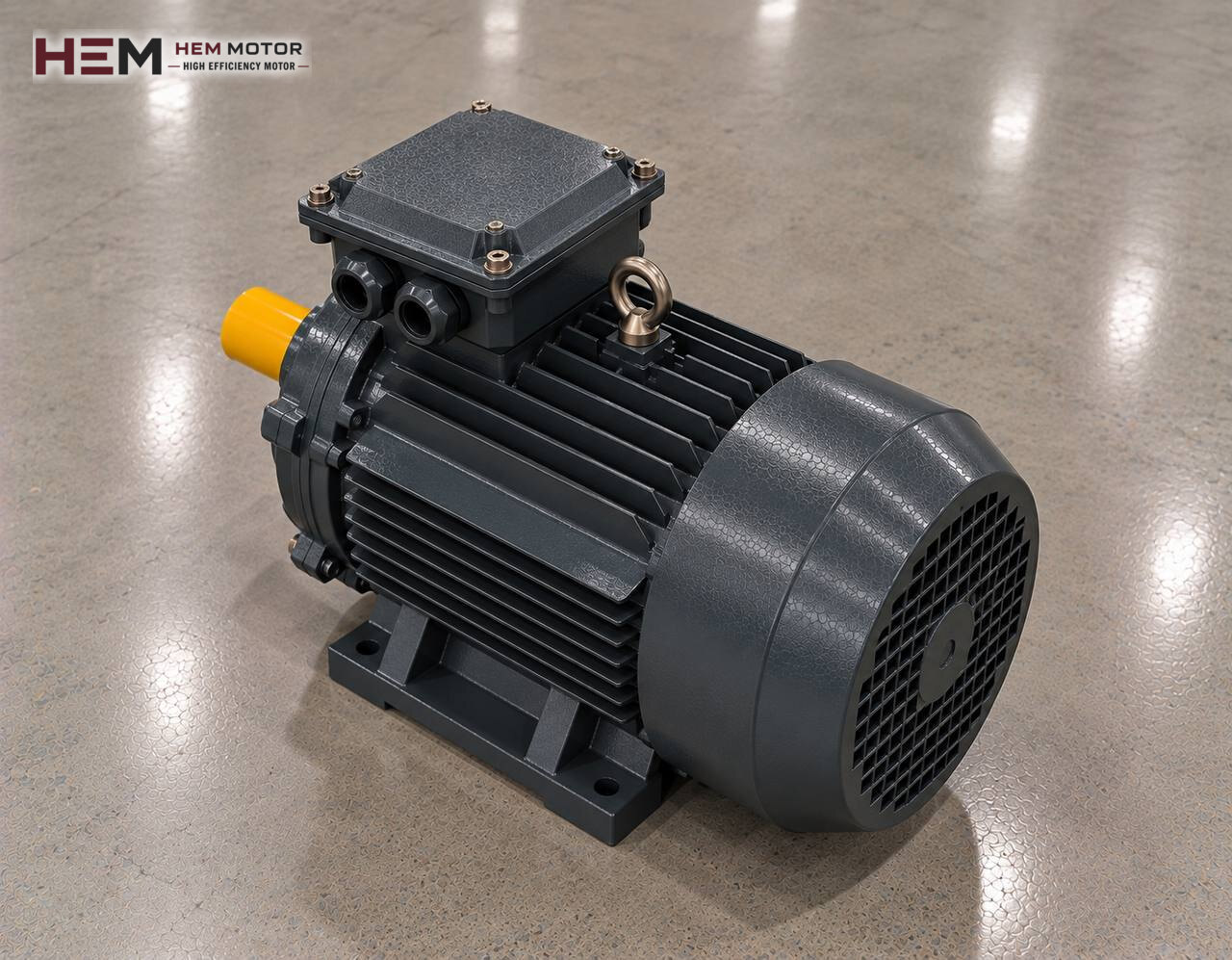
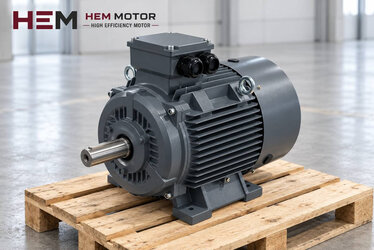
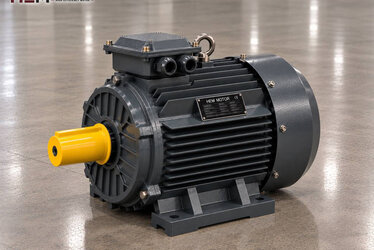
Within the same family, the no-load current ratio changes as power and pole count change; comparison is made at the same step (representative image).
Which mistakes are most common when comparing quotations?
Directly comparing two quotations when locked rotor current is written in amperes in one and as a ratio in the other.
Putting values given at different voltages side by side; 380 V and 400 V data differ even for the same motor.
Confusing no-load current with "no-load power"; high no-load current does not mean high no-load power consumption.
Assessing locked rotor current without torque; a low starting current sometimes comes with a low starting torque.
Comparing a starting value measured on site with a clamp against the catalogue value; the clamp's sampling rate can miss the peak.
The remedy is a single habit: stating the measuring condition and the unit clearly in the request for quotation. Preparing the list of information to request together with the technical drawings and the catalogue speeds up the job. You can compare power steps in the electric motor shop.
Which HEM models can serve as examples for this comparison?
Three 4-pole cast iron models from the same family at different power steps show how rated current appears in a quotation table:
132M-4: 7.5 kW, 1460 rpm, 14.3 A at 400 V, 49.1 Nm; at a small step the no-load current ratio is relatively high.
160L-4: 15 kW, 1465 rpm, 27.3 A at 400 V, 97.8 Nm; the step in the hypothetical example.
200L-4: 30 kW, 1475 rpm, 53.8 A at 400 V, 194.2 Nm; at this size locked rotor current becomes decisive in panel and transformer calculations.
Across the series, protection is IP55, insulation is class F and the motors are CE marked; IE3, IE4 and IE5 options are offered, and which class your chosen model comes in is settled at the order. Family data are on the asynchronous electric motors page. If you send your quotation table or the values of another quotation you have through our contact page, we will work out values comparable under the same condition together. All steps are in the HEM Motor product list.
Frequently Asked Questions
If no-load current is high, does the motor use a lot of energy?
Not directly. Most of no-load current is reactive; to see active power consumption, no-load power must be measured.
If locked rotor current is given as a ratio in the catalogue, how is it converted to amperes?
The ratio is multiplied by the rated current at the same voltage. The rated current at 400 V and the ratio given for 400 V should be used.
How do I verify locked rotor current on site?
A starting record is taken with a clamp or power analyser that can capture peak values. Deliberately locking the rotor for a test is not appropriate on site.
Does a soft starter change locked rotor current?
It does not change the motor's own characteristic; it limits the current drawn from the supply by lowering the voltage applied at starting. Starting torque decreases accordingly.
HEM Motor Models Related to This Article
The cards show example models related to the topic. A suitable motor is not chosen by power alone: compare speed, voltage, mounting, shaft and connection dimensions on the product page; if unsure, send a photo of the existing motor’s nameplate on WhatsApp.
In an electric motor renewal, production downtime is costed by multiplying the number of hours stopped by that line's hourly downtime cost; the hourly cost in turn is the sum of it... More Details
A no-load run during electric motor acceptance reveals wrong connection, reverse rotation, current imbalance between phases, bearing noise, vibration and mechanical damage from tra... More Details
Turning the shaft by hand when an electric motor is delivered is the fastest check for damage to the bearings, shaft or rotor during transport: the shaft of a healthy motor should ... More Details
When an electric motor is transported, the shaft end and the flange face are protected separately against impact, scratches, rust and vibration marks. Rust preventive is applied to... More Details
In electric motor procurement, model revisions are tracked by recording in the order, beside the motor's power and speed, its model code, housing material, mounting arrangement, an... More Details
In a framework purchase agreement for electric motors, delivery call-offs are planned once the annual total quantity and price terms are fixed, so that motors are requested in port... More Details
We use necessary and optional cookies to improve your experience, enhance content and analyse traffic. Under the GDPR, optional (analytics/marketing) cookies are only used with your explicit consent. Please choose your preference below.
Cookie Policy
 English
 Français
 Türkçe
 Español
 Русский
 العربية
 Deutsch
 Italiano