A spare fan and terminal kit is worth adding to the order in plants where motor downtime is expensive, site access is difficult or several motors share the same frame; in a single-motor application that is easy to reach and can tolerate downtime, opening a separate line item is usually unnecessary. The decision is made by comparing the chance of the part failing with the cost of waiting.
Why are the fan and terminals the small parts changed most often?
The fan turns outside the motor, under the fan cover. An object hitting the cover, a cover fitted wrongly during installation or heavy vibration can break the blades. On plastic fans, hot environments and chemical vapour make the material brittle over time. A broken fan cuts cooling; the motor keeps running but overheats.
The terminal kit sits inside the terminal box. A nut left loose heats up, and the terminal board darkens and cracks. A lug of the wrong size, overtightening or moisture entering the box lead to the same result. When the terminal board cracks, the motor cannot be put back into service even if it is sound.
Both parts are cheap, but missing one stops the line.
In which cases does a spare make sense?
If downtime is costly. This is the first criterion. On a continuous process line, in a cold chain or on a critical pump tied to a single motor, even a few hours' wait costs far more than the part itself.
If site access is difficult. Sending a single fan cover to a remote mine site, an island facility, a fan mounted high up or a cross-border construction site can take days.
If many motors share the same frame. In a plant running ten 132-frame motors, one set of spare fan and terminals serves all of them. In this case the spare corresponds to a much smaller share per motor than it first appears.
If the environment stresses the fan or terminals. In areas with dust, moisture, vibration or heat, these parts are changed more often.
In which cases is a spare not needed?
In a single-motor application that is easy to reach, runs in a clean environment and whose downtime can be planned, a spare fan or terminal kit waits on the shelf for years. In that case it makes more sense to request the part when it is needed.
A plastic part ages on the shelf too. Sunlight and a hot store can make a fan brittle before it is ever used. Keep the spare in its own box on a cool shelf, away from sun and damp.
An unnecessary spare is also a cost.
How is a simple calculation set up for the decision?
The value of the spare is compared with expected downtime multiplied by the hourly cost of downtime. The formula is rough but gives a firmer basis than guesswork:
Expected loss ≈ Pfailure × twait × Chour
Here Pfailure is the probability of the part failing within a year, twait the time until the part arrives, and Chour the plant's own hourly downtime cost. If expected loss is greater than the cost of the spare to the plant, buying a spare makes sense.
Hypothetical example: at a pump station, let the probability of a fan breaking be 0.1 per year and the wait for the part 48 hours. If the hourly downtime cost is “B units”, the expected annual loss is 0.1 × 48 × B = 4.8 B units. If the spare fan costs less than this, the spare makes sense. B is set by the plant's own accounts; no figure is given here.
To compare motor prices, see the electric motor sales page; the spare part price is given separately in the quote.
Prices and technical data are on the product pages; choose a model and order online.
The fan and terminal kit are specific to the frame; they may not fit a different frame of the same power or another manufacturer's motor. The following must match on the order:
Part
Information that must match
Where it comes from
Fan
Frame number, pole number, shaft diameter and fan material
Frame, number of terminals (6 leads) and stud size
Terminal box photo
Link and nut set
Same series as the terminal board
Terminal box photo
Box gasket
Box cover size
Cover photo
Pole number matters for the fan. On 2-pole motors the fan turns at high speed; on some frames the blade geometry may differ from 4- and 6-pole versions. So the frame number alone is not enough.
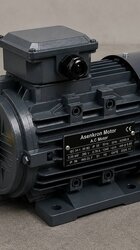
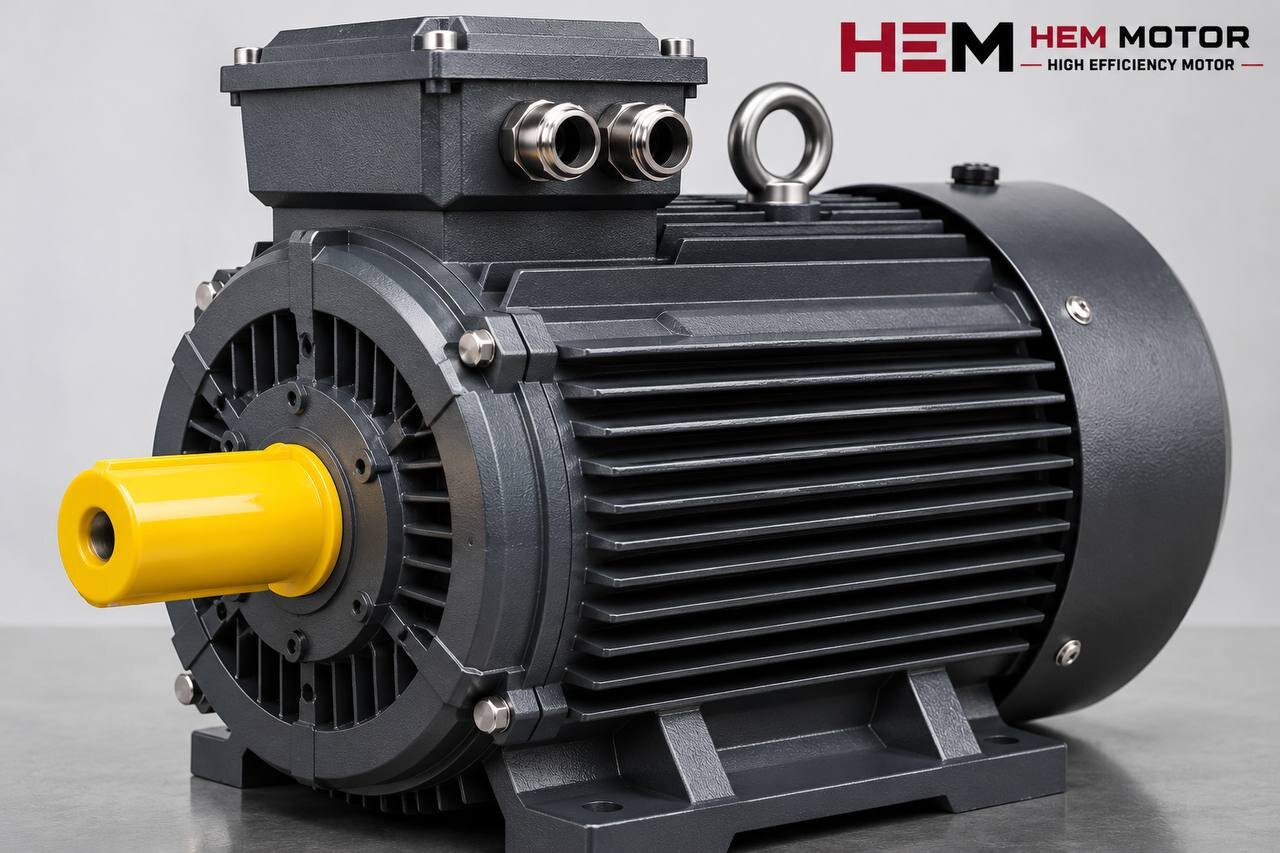
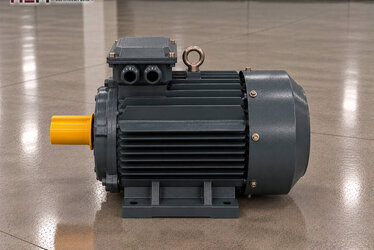
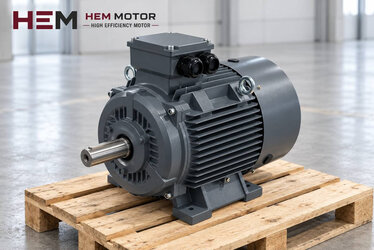
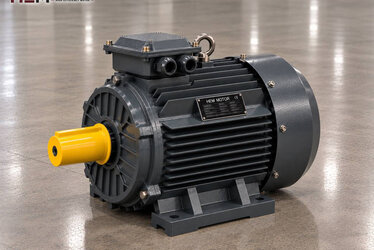
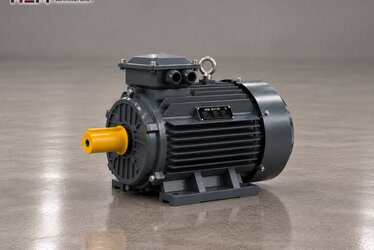
The terminal box and the fan guard are the outer parts of the motor that are handled most (representative image).
Does fitting the spare matter as much as the spare itself?
Yes. If a new terminal board is tightened wrongly, the same fault returns within a few months. Nuts are tightened to the torque value given by the manufacturer; links are fitted in the right position for star or delta connection. The lug size must suit the cable.
When changing a fan, the fan is pushed onto the shaft, not hammered. Hammering can damage the bearing from inside. After the fan cover is fitted, the shaft is turned by hand to check for rubbing.
At the first start after fitting, current and vibration should be checked. These steps are handled together with the protection settings in the motor protection: thermal relay, fuse and MPCB article.
How are a spare fan and terminals requested from HEM Motor?
Whether a spare fan, fan cover and terminal kit can be supplied with the order is confirmed by model and frame. When ordering the motor, state your spare part needs in the same request; the matching code is paired in one go.
As examples, aluminium frame steps that often run in several units at one plant and for which spare part requests are frequent:
112M-4: 4 kW, 1450 rpm, 400/690 V (Δ/Y), 7.95 A at 400 V, 26.3 Nm.
Send plate photos of the motors, a photo of the inside of the terminal box and how many motors of the same frame run in the plant through the find an equivalent from the nameplate page; we will determine the matching spare kit together. Prices can be seen in the HEM Motor sales list.
Frequently Asked Questions
Does a fan from another brand of motor fit a HEM Motor frame?
Even with the same IEC frame number, shaft diameter, number of blades and hub size may differ. It should not be used without checking fit by measurement.
Is a plastic or a metal fan more suitable?
A plastic fan is light and quiet. In hot, chemical or impact-prone environments a metal fan is considered; which option is offered is confirmed with the order.
If the terminal board cracks, does the motor need rewinding?
Usually not. If the winding leads are sound, only the board and links are replaced; insulation resistance is measured after the change.
How long can a spare part be kept on the shelf?
There is no fixed period. A part kept in its own box on a cool shelf away from light and moisture can be used for a long time; plastic parts are checked for cracks before use.
HEM Motor Models Related to This Article
The cards show example models related to the topic. A suitable motor is not chosen by power alone: compare speed, voltage, mounting, shaft and connection dimensions on the product page; if unsure, send a photo of the existing motor’s nameplate on WhatsApp.
In an electric motor renewal, production downtime is costed by multiplying the number of hours stopped by that line's hourly downtime cost; the hourly cost in turn is the sum of it... More Details
A no-load run during electric motor acceptance reveals wrong connection, reverse rotation, current imbalance between phases, bearing noise, vibration and mechanical damage from tra... More Details
Turning the shaft by hand when an electric motor is delivered is the fastest check for damage to the bearings, shaft or rotor during transport: the shaft of a healthy motor should ... More Details
When an electric motor is transported, the shaft end and the flange face are protected separately against impact, scratches, rust and vibration marks. Rust preventive is applied to... More Details
In electric motor procurement, model revisions are tracked by recording in the order, beside the motor's power and speed, its model code, housing material, mounting arrangement, an... More Details
In a framework purchase agreement for electric motors, delivery call-offs are planned once the annual total quantity and price terms are fixed, so that motors are requested in port... More Details
We use necessary and optional cookies to improve your experience, enhance content and analyse traffic. Under the GDPR, optional (analytics/marketing) cookies are only used with your explicit consent. Please choose your preference below.
Cookie Policy
 English
 Français
 Türkçe
 Español
 Русский
 العربية
 Deutsch
 Italiano