The S3 percentage should be stated in the order because an electric motor that delivers the same shaft power in intervals heats up differently from one that runs continuously, and the kW figure on the plate does not express that difference on its own. Without the percentage, the supplier proposes a motor for S1 continuous duty; the outcome is either an unnecessarily large frame or a winding that burns out a few months later.
What exactly does the S3 duty type describe?
S3 is intermittent periodic duty, in which the motor runs at constant load for a while, then stops, and this cycle repeats regularly. Among the duty types in IEC 60034-1, it is the case where starting current is assumed not to affect winding temperature noticeably.
The percentage is the ratio of running time within one cycle to the cycle time. On a machine where a press arm runs for 4 minutes and waits for 6, the value is 40% and it is written on the plate or in the specification as "S3 40%". Unless stated otherwise, the standard cycle time is usually taken as 10 minutes; the preferred percentages are 15, 25, 40 and 60 (general information; confirm with the text of the standard and with the machine manufacturer).
A short cycle is essential. When the motor runs for half an hour and stops for half an hour, the winding reaches thermal equilibrium in every running period and the duty effectively behaves like S1.
What does the supplier have to assume if the percentage is missing?
The assumption is almost always S1. An order form showing only "7.5 kW, 1500 rpm" leads the seller to assume that the motor will turn for hours under the same load, and the proposed size follows from that.
That can backfire in both directions. With a light S3 as the real duty, the proposed motor ends up too large; it runs at part load, power factor drops, and the base frame and coupling grow as well. If the real duty is a heavy cycle with frequent starts, the situation reverses: a motor chosen for S1 heats the winding step by step with the high current it draws at every start, and one day the thermal relay trips in the middle of a shift.
A frequent mistake among machine builders is to copy the power from the old machine's plate straight onto the new one. Suppose the old motor's plate says "S3 25%" and that note never reaches the order: an S1 motor with the same kW figure can mean an entirely different machine.
How do you tell S3, S4 and S6 apart on site?
The easiest way to tell them apart is to time the cycle with a stopwatch and check whether the motor is really de-energised at every stop.
Duty type
What happens in the cycle?
Typical example on site
S3
Running at constant load, then a de-energised stop; the thermal effect of starting is small
A gate that opens and closes a few times an hour, the pressing arm of a fruit juice press
S4
As S3, but in each cycle the starting time noticeably affects heating
A hoisting or loading mechanism that starts dozens of times an hour
S5
As S4, plus electrical braking
A table drive stopped by plugging
S6
The motor does not stop; loaded and idle running alternate
A circular saw idling between cuts
S6 and S3 are often confused. A saw blade that keeps turning between cuts means the motor is not stopping; its fan keeps turning too and cooling never stops. In S3, when the motor stops, its own fan stops as well and the frame cools only by natural convection. This difference explains why two duties with the same percentage end up with different permissible power.
Prices and technical data are on the product pages; choose a model and order online.
How is equivalent power calculated from cycle data?
In a cycle with varying load, winding heating is proportional to the square of current, so reducing the loads to one equivalent power by a root-mean-square average is a common preliminary calculation:
Peq = √( Σ Pi² × ti / Σ ti )
Here ti covers only the periods in which the motor runs. In a hypothetical press cycle, let the motor draw 7 kW for 1 minute and 4 kW for 2 minutes, then stand still for 7 minutes. The weighted sum of squares is 49 × 1 + 16 × 2 = 81; divided by 3 minutes that gives 27, and the square root comes out at about 5.2 kW. The cycle is 10 minutes, running time 3 minutes, so the duty is close to S3 30%.
This result is a first estimate. Since a self-ventilated motor barely cools while stopped, not all of the 7-minute standstill counts as cooling; many engineers account for the stopped time with a reduction factor. The final choice is made by giving the whole cycle and the number of starts to the machine manufacturer or the motor supplier (general information; confirm with the machine manufacturer). The 7 kW peak load must also stay comfortably below the motor's breakdown torque. Equivalent power does not show this.
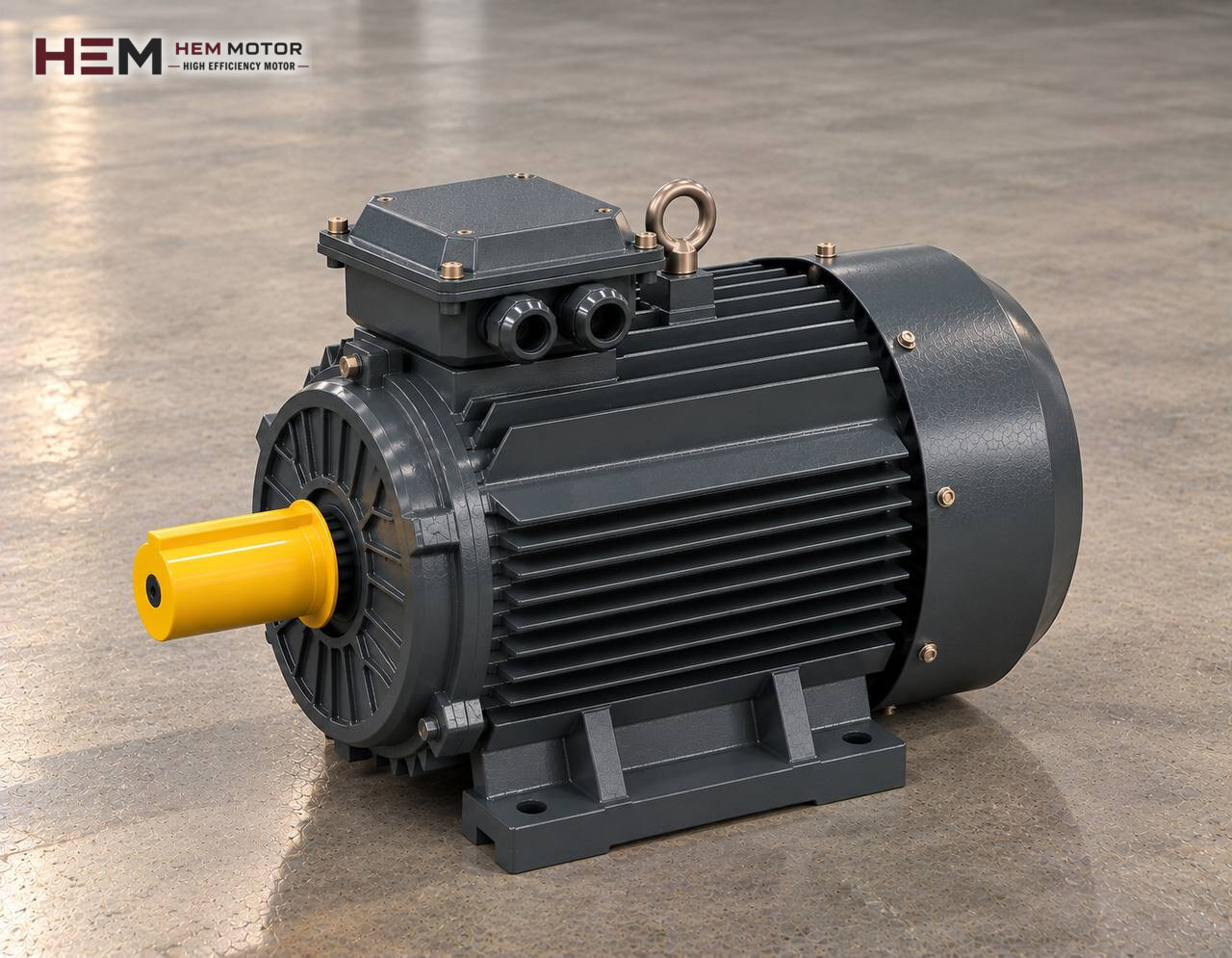
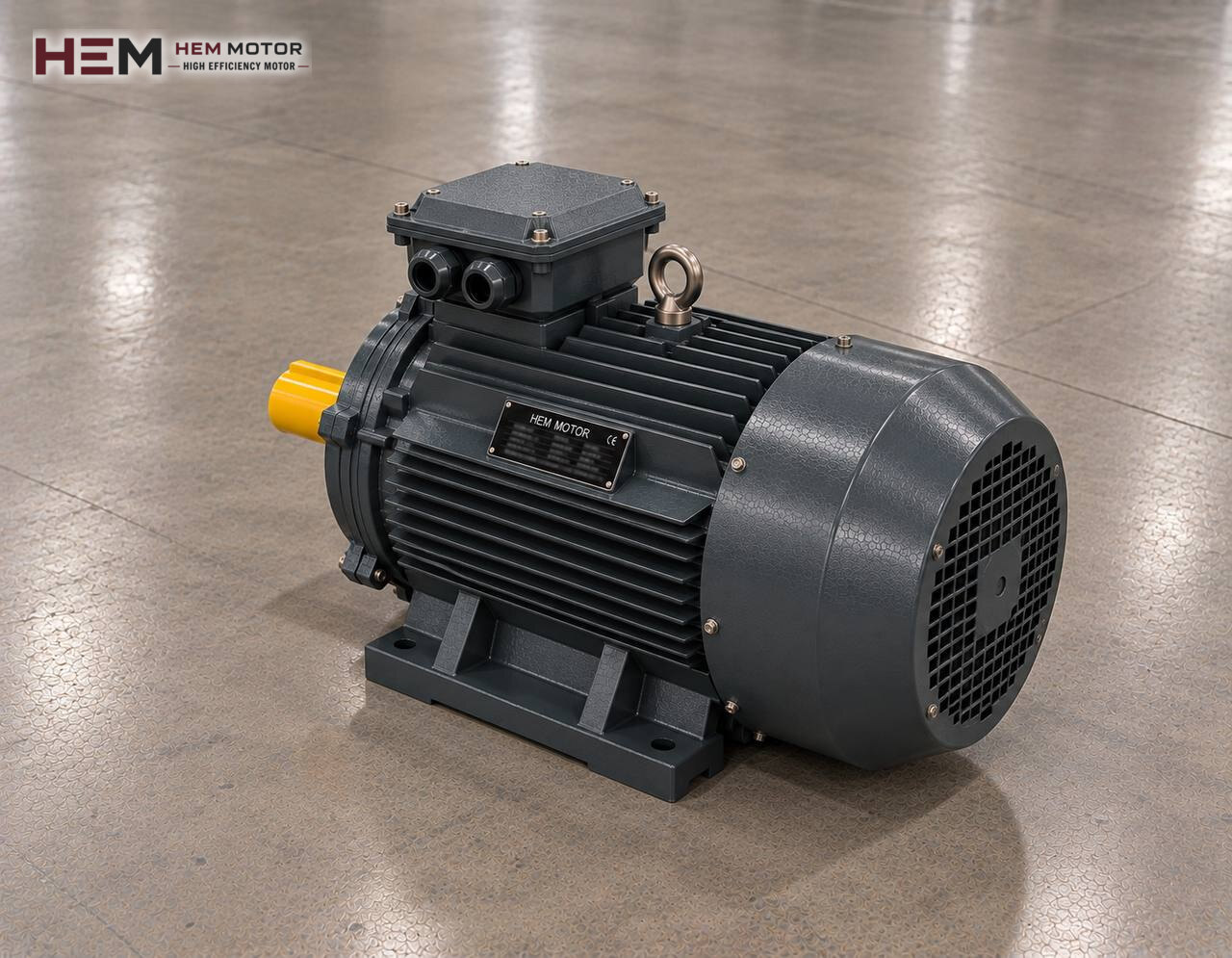
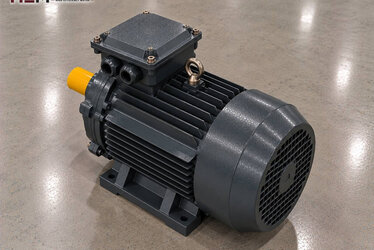
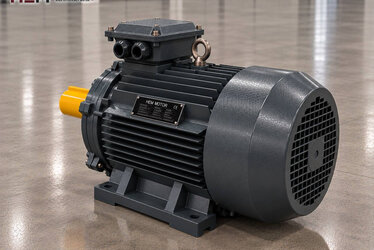
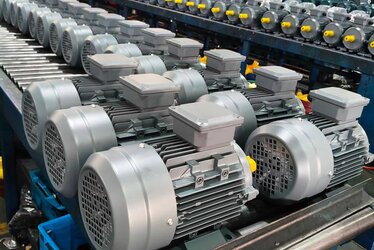
On intermittently operating machines such as presses, the S3 percentage is calculated from the cycle time (representative image).
What order do you follow when measuring the cycle on site?
A calculation on paper is only as accurate as the real cycle record. Take the measurement during the machine's busiest shift.
Attach a logging clamp meter or a power analyser to the motor supply cable; reduce the sampling interval to one second.
Record for at least an hour, ideally a full shift; looking at a single cycle stops you from telling a heavy batch from a light one.
Count every starting-current peak in the log and work out the number of starts per hour. If the number is high, the duty is moving towards S4.
Mark the running and stopped periods and calculate the percentage; also note the average current in each period.
At the end of the shift, check the fan end and the top of the frame with a non-contact thermometer; keep the reading to compare with the next record.
A brake, hold or reversing movement at the end of the cycle changes the record. Plugging the motor to a stop puts a second peak on the current graph; this detail must always be written separately in the order.
What should be added next to the S3 information in the order?
Even "S3 40%" on its own is not enough; the supplier also needs to know how long the cycle is and how many starts each cycle contains.
When preparing the form, write the percentage, cycle time, starts per hour, peak load and braking method side by side. Add it too when a frequency converter will drive the motor: our three-phase series are suitable for speed control with a frequency converter; for long periods of full torque at low speed an external fan may be needed; if the drive-to-motor cable is long, a dv/dt or sine filter is considered; these conditions are stated with the order. On machines with frequent stops and starts, a PTC sensor embedded in the winding can be requested as an order option and catches heating that a thermal relay cannot see.
In HEM Motor's standard series, the duty type printed on the plate and the permissible power for S3 are confirmed per model with the order. Our article on preparing a quote request lists point by point what other information a request should contain.
For the hypothetical 5.2 kW equivalent power, three 4-pole aluminium-frame sizes worth considering are listed in our shop:
112M-4, 4 kW, 1450 rpm, 7.95 A: falls below the equivalent power; discussed if the cycle is lighter and the peak load is low.
132S-4, 5.5 kW, 1460 rpm, 10.7 A: the size closest to the equivalent power in the example.
132M-4, 7.5 kW, 1460 rpm, 14.3 A: the safe side if the number of starts is high or the 7 kW peak lasts long.
Share your current log and the machine's cycle time through the channels on our contact page, and we will check the equivalent power together and mark the right size. Cast iron equivalents sit in the same power order on our sales list.
Frequently Asked Questions
Can a motor with an S1 plate be used in S3 duty?
Yes; an S1 motor usually runs cooler in intermittent duty. The question is whether a smaller motor would do, and that is answered with cycle data.
What happens if a motor rated S3 25% is run continuously?
Run continuously at plate power, the winding exceeds its design temperature. Unless the load is clearly below that power, insulation life shortens quickly.
Is the S3 percentage still meaningful if the cycle is longer than 10 minutes?
As the cycle gets longer, the winding approaches equilibrium in each running period and the margin offered by the S3 percentage shrinks. For long cycles, write the running time itself instead of a percentage.
At what point does the number of starts call for S4?
There is no fixed limit; starting time and load inertia decide. Writing the starts per hour in the order lets the supplier make this decision correctly.
HEM Motor Models Related to This Article
The cards show example models related to the topic. A suitable motor is not chosen by power alone: compare speed, voltage, mounting, shaft and connection dimensions on the product page; if unsure, send a photo of the existing motor’s nameplate on WhatsApp.
In compact electric motor selection, power density shows how small a frame the same kilowatts are taken from; cooling area is the outer surface through which that frame can shed he... More Details
An aluminium frame is a sound choice for drives with low vibration, coupling alignment or moderate pulley load, no shocks and a flat base. Where small pulleys put a large radial lo... More Details
IEC and NEMA nameplates are not compared directly but field by field after translation: power from HP to kW, protection from enclosure type to IP code, while efficiency class and s... More Details
IP55 protection is enough in most cases for an electric motor working outdoors, provided the motor does not take rain directly, condensation water can drain from the frame, and the... More Details
Class F insulation means the winding materials are chosen to withstand up to 155 °C; Class B temperature rise means that at rated load the motor's winding rises no more than 80 K a... More Details
No, they are not the same thing. The insulation class defines the thermal ceiling of the insulating material around the winding; the permitted ambient temperature shows how warm th... More Details
We use necessary and optional cookies to improve your experience, enhance content and analyse traffic. Under the GDPR, optional (analytics/marketing) cookies are only used with your explicit consent. Please choose your preference below.
Cookie Policy
 English
 Français
 Türkçe
 Español
 Русский
 العربية
 Deutsch
 Italiano