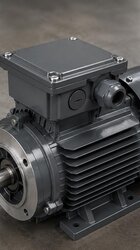
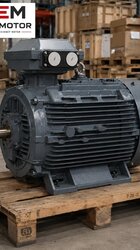
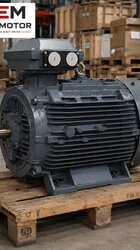
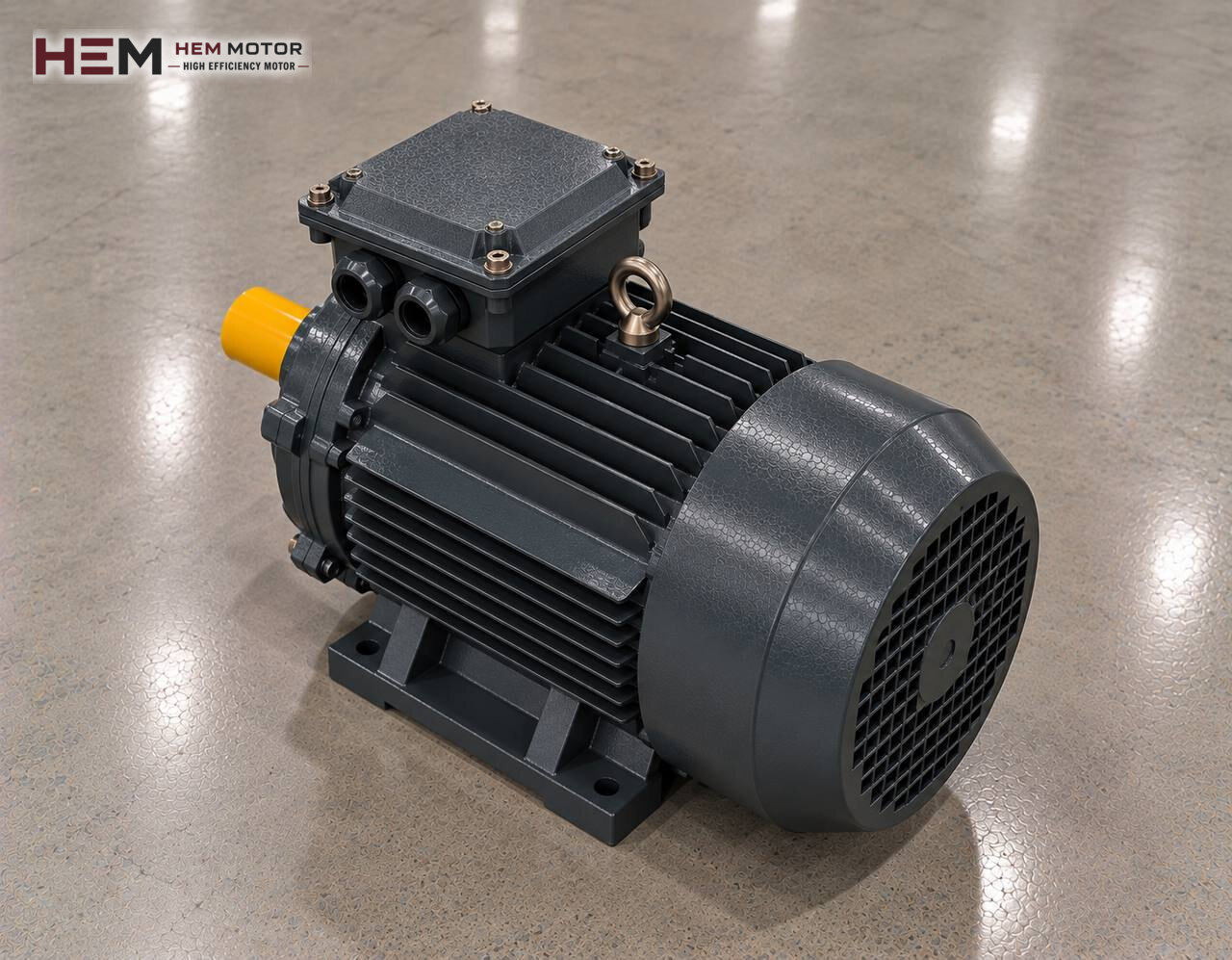
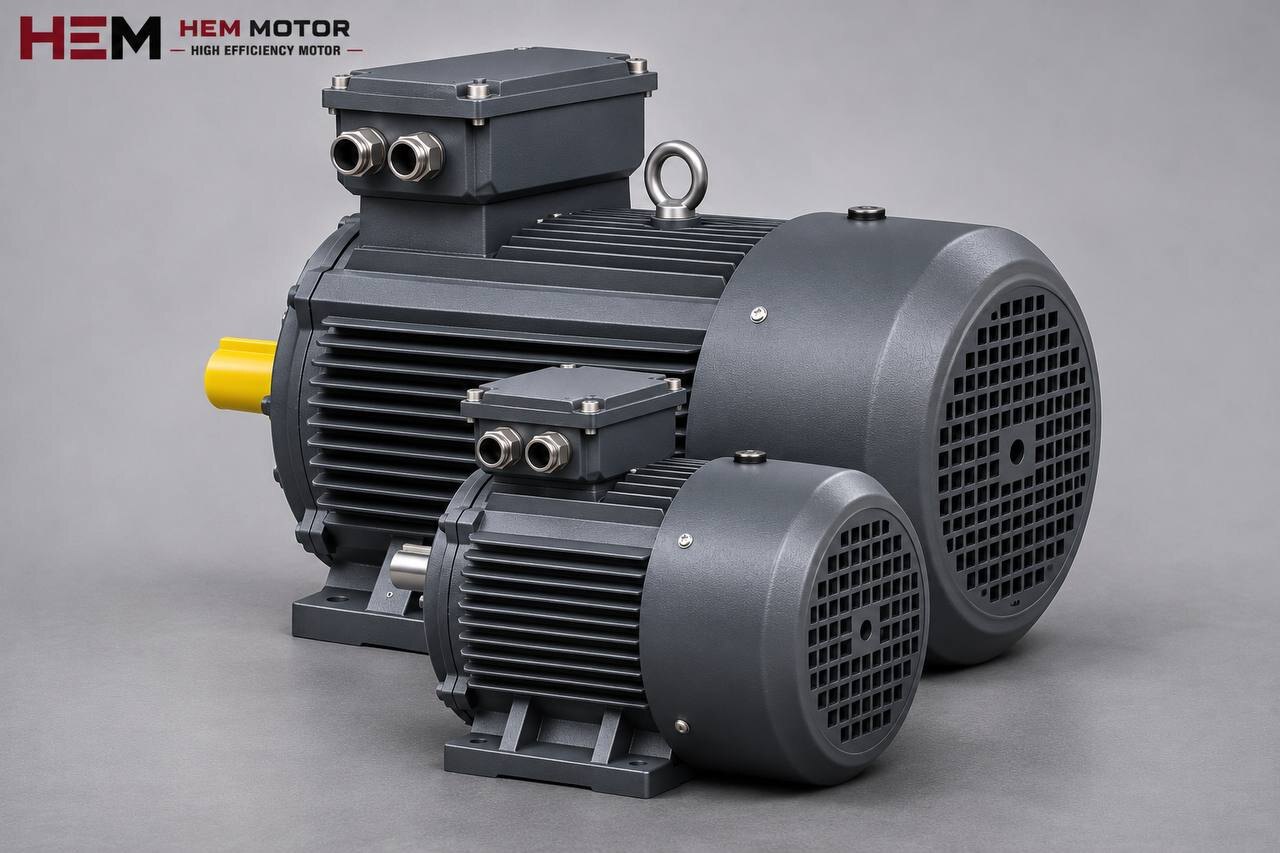
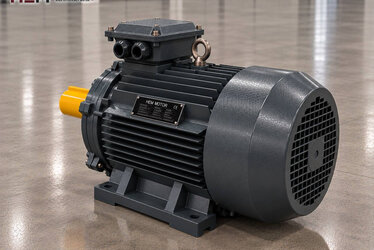
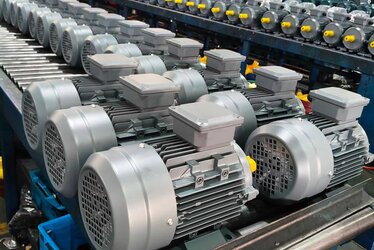
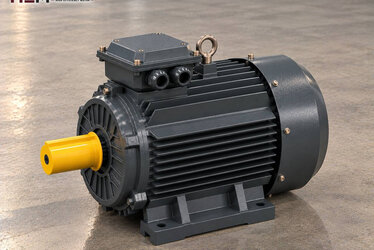
IP55 protection is enough in most cases for an electric motor working outdoors, provided the motor does not take rain directly, condensation water can drain from the frame, and the effects of sun, salty air or dust are considered separately. IP55 says the motor is protected against water jets from any direction and against harmful dust deposits; it does not say the motor will survive being under water or pressure washing.
What do the two digits in IP55 mean on site?
The first digit 5 says the motor is protected against harmful amounts of dust getting in; the second digit 5 says water jets from any direction will not harm it. The definitions come from the protection codes in the IEC 60529 standard (general information; for detailed test conditions see the standard itself).
"Dust-tight" and "dust-protected" are not the same thing. With IP55 some dust can get in; the condition is that it is not enough to disturb the motor's operation. The water side is similar. The test is defined by spraying from a given distance at a given flow rate, and standing under continuous rain for months is outside the scope of that test.
Outdoors the real question is a different one. Where does the water reach the motor?
Where does water get into a motor running in the rain?
Water usually gets in not through the frame itself but through the shaft seal, the terminal box gasket and the cable gland. If one of these three points has loosened, hardened or been fitted wrongly, IP55 stays on paper.
The cable gland is where mistakes happen most. When the diameter of the cable it is tightened on does not match the gland's range, the seal does not grip the cable and rainwater seeps along the cable into the box. A cable entering the box from above has the same result, and faster. Entering from below and leaving a "drip loop" that first hangs downwards stops water walking along the cable into the box.
The terminal box cover also needs attention after every service.
If the cover screws are not tightened in a cross pattern, the gasket is crushed in one corner and left open in the opposite one, and after the first downpour a teaspoon of water collects at the bottom of the box. A gasket with a permanent crush mark, a crack or hardening is replaced with a new one. The shaft-side seal wears over the years; damaging the seal lip while removing and refitting a belt pulley or coupling is a common occurrence.
How does condensation wet an IP55 motor from the inside?
Condensation is the moist air inside the frame turning into water on the winding and inner surfaces when the motor warms up by day and cools down at night; IP55 sealing does not expel this water and may even keep it inside. It is seen especially on pumps that stop and start several times a day and on spare motors that stand for long periods. The problem grows quietly.
The signs are familiar. When the terminal box is opened you see greenish oxide on the terminals, water droplets on the inside of the cover, or insulation resistance readings that fall from season to season. Insulation resistance is measured with a megger between winding and frame; recording the value and following it over time tells far more than a single measurement.
There are three ways to prevent it. The first condition is that the condensation drain holes at the lowest point of the frame are open and facing down for the mounting position; if the motor is mounted in a position other than on its feet, the holes may end up on top. An anti-condensation heater that keeps the winding warm during long stops can be requested as an order option. For a motor that cools down often, a simple circuit on the control side switches the heater on during stops.
Prices and technical data are on the product pages; choose a model and order online.
What else should be checked outdoors besides IP55?
Sun, salty air, temperature swings and wind-blown dust are factors that the IP code does not define but that determine the motor's life. Writing only "IP55" in a specification is not enough to describe outdoor use. The protection and insulation data of the standard range are shown on every product card in our shop.
Factor
What is seen on site
Measure to take
Direct rain
Water in the box, oxide on terminals
Light canopy or top cover, check gland diameter
Day-night temperature swing
Falling insulation resistance, droplets inside
Direction of drain holes, anti-condensation heater option
Sun
Higher frame temperature, faded paint
Shade; take care not to block the fan inlet
Salty, humid air
Blistering paint, rust on bolts
Paint and fasteners discussed when ordering
Wind-blown dust, leaves
Deposits on fins, clogged fan cover
Periodic cleaning, blowing out with air
A common mistake when building a canopy is making a box that encloses the motor completely. The fan draws air through the rear cover and blows it over the frame fins; in a box closed at the back, the motor draws in its own hot air again. A cover closed on top and open at the sides and back is usually enough.
The gap in front of the fan cover is the place most often blocked by protective boxes built outdoors (representative image).
When should more than IP55 be requested?
Where the motor is pressure-washed, where waves or splash water hit it continuously, or where it sits in a pit close to the level of standing water, IP55 may not be enough. In such conditions IP56 is discussed when ordering as an optional extra.
Applications immersed in water or permanently under water belong to another class. A submersible pump or a submerged mixer needs a special motor; it may fall outside the standard range in HEM Motor's 2026 catalogue, so ask us with the nameplate and application details.
One more case. On a roof extractor with a vertical shaft, rainwater can run down along the shaft. With vertical mounting and the shaft pointing up, water sits directly on the seal. The mounting arrangement and any need for extra protection must be written clearly in the order.
Sample models suited to outdoor applications
In HEM Motor's standard range the protection class is IP55 and the insulation class F. A cast iron frame is often preferred on open sites because it offers an outer surface more resistant to knocks and salty air than aluminium. For light drives such as roof extractors, an aluminium frame also does the job. Examples:
100L1-4: aluminium frame, 2.2 kW, 1450 rpm, 4.52 A at 400 V, 230/400 V. For roof extractors and small irrigation pumps.
132S-4: cast iron, 5.5 kW, 1460 rpm, 10.7 A at 400 V, 400/690 V. For conveyor and pump drives on open sites.
180M-4: cast iron, 18.5 kW, 1470 rpm, 33.5 A at 400 V. For medium-power pumps at water treatment and irrigation stations.
Write a short note via our contact page about where you will install the motor, the rain and washing conditions and the mounting position; we will discuss whether IP55 is enough and whether a heater is needed. Prices are on the HEM Motor sales page.
Frequently Asked Questions
Can an IP55 motor run uncovered in the rain?
Short rain causes no problem, but for permanent outdoor use a light cover on top extends its life. A sound gland and box gasket are essential.
Can an IP55 motor be pressure-washed?
Pressure washing is beyond IP55 test conditions. Where washing is regular, the IP56 option should be discussed when ordering.
Should condensation drain holes be left open?
The holes should stay at the lowest point for the mounting position and must not be blocked. If the position changes, the hole location is also stated when ordering.
How often should insulation resistance be measured on an outdoor motor?
Measuring at the change of seasons and after long stops is a good start. Keeping the values on the same form shows a downward trend early.
HEM Motor Models Related to This Article
The cards show example models related to the topic. A suitable motor is not chosen by power alone: compare speed, voltage, mounting, shaft and connection dimensions on the product page; if unsure, send a photo of the existing motor’s nameplate on WhatsApp.
In compact electric motor selection, power density shows how small a frame the same kilowatts are taken from; cooling area is the outer surface through which that frame can shed he... More Details
An aluminium frame is a sound choice for drives with low vibration, coupling alignment or moderate pulley load, no shocks and a flat base. Where small pulleys put a large radial lo... More Details
IEC and NEMA nameplates are not compared directly but field by field after translation: power from HP to kW, protection from enclosure type to IP code, while efficiency class and s... More Details
Class F insulation means the winding materials are chosen to withstand up to 155 °C; Class B temperature rise means that at rated load the motor's winding rises no more than 80 K a... More Details
No, they are not the same thing. The insulation class defines the thermal ceiling of the insulating material around the winding; the permitted ambient temperature shows how warm th... More Details
The S3 percentage should be stated in the order because an electric motor that delivers the same shaft power in intervals heats up differently from one that runs continuously, and ... More Details
We use necessary and optional cookies to improve your experience, enhance content and analyse traffic. Under the GDPR, optional (analytics/marketing) cookies are only used with your explicit consent. Please choose your preference below.
Cookie Policy
 English
 Français
 Türkçe
 Español
 Русский
 العربية
 Deutsch
 Italiano