IEC and NEMA nameplates are not compared directly but field by field after translation: power from HP to kW, protection from enclosure type to IP code, while efficiency class and starting letters are read against their own tables. Frame numbers are not converted into each other, because the two systems rest on different dimensional logic; mounting fit is checked on the technical drawing.
Why do two nameplates describe the same motor in different languages?
An IEC nameplate is laid out with the metric system and a 50 Hz grid in mind, a NEMA nameplate with North American inch dimensions and that region's grid frequency. The information is similar; units and classification methods differ. Same logic, different language.
The typical field situation goes like this: a NEMA-plated motor comes off an imported machine and must be replaced with an IEC motor. The maintenance technician looks at the plate and sees none of the familiar terms such as kW, IP or IE. Instead there are lines reading HP, TEFC, Frame, Code, Design. Each of these lines has a counterpart, or at least a near equivalent, on the IEC side. What makes the job harder is that most counterparts are not one-to-one; one line translates directly, another gives only a rough idea, and a third does not translate at all and has to be verified by measurement.
Photograph the plate before you read it.
Which power step is chosen when converting HP to kW?
Multiply the HP value by 0.746 to get kW, then take the IEC power step that matches the result or sits just above it. For example, 10 HP is about 7.46 kW and lands on the 7.5 kW IEC step; 15 HP is 11.19 kW, and the 11 kW step falls slightly short of the need.
The second example needs attention. Covering an 11.19 kW need with an 11 kW motor causes no trouble in most applications, because machines rarely draw their full nameplate power. Still, if the motor runs at full load continuously, first measure the real load current with a clamp meter and decide on the basis of that reading (general information; confirm with the machine manufacturer).
Some plates show power in both units. On such a plate the kW line governs. All IEC power steps are listed in order on the store page.
How do the nameplate fields correspond to each other?
Nameplate field
On the IEC plate
On the NEMA plate
What to watch when comparing
Power
kW
HP
HP × 0.746 = kW; equal or next step up
Frame
Frame number, e.g. 132M
Frame, e.g. a three-digit number and letter
Not converted; compare shaft, feet and flange on the technical drawing
Protection
IP code, e.g. IP55
Enclosure: abbreviations such as TEFC, ODP
TEFC describes an enclosed fan-cooled design, it gives no IP rating
Efficiency
IE class
Nominal efficiency percentage or the word Premium
Test conditions and frequency differ; the same percentage does not mean the same class
Starting behaviour
Design letter (N, H) or only the starting current ratio
Design letter (A, B, C, D)
For heavy-start loads ask the manufacturer what the letter means
Locked rotor current
Starting current / rated current ratio
Code letter (kVA/HP range)
For protection settings convert the letter to kVA from the table, then to current
Insulation
Class letter, e.g. F
Insulation class, e.g. F
The letters denote the same thermal class in both systems
Why can a NEMA frame number not be converted into an IEC frame?
A NEMA frame number is a code based on shaft centre height in inches, while an IEC frame number gives the centre height directly in millimetres. Centre heights in the two series may be close, but the thickness and length of the shaft end, the key width and the distance between bolt holes are set by different rules.
A common mistake on site is trying to seat the motor on the same base because the centre heights are close. The bolts do not line up with the holes, the coupling bore does not fit the shaft, the keyway turns out different. Usually an intermediate plate is fitted and a new coupling half is machined; the dimensions of both parts can only come from the technical drawing. The right order is this: measure the old motor's shaft end, foot fixing points and the height of the axis above the floor with a calliper and a tape. Compare these figures with the technical drawings of the candidate IEC motor. List the mismatches and decide whether an intermediate plate is needed.
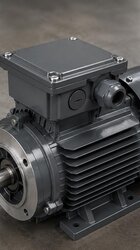
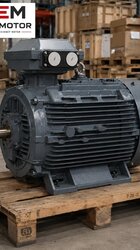
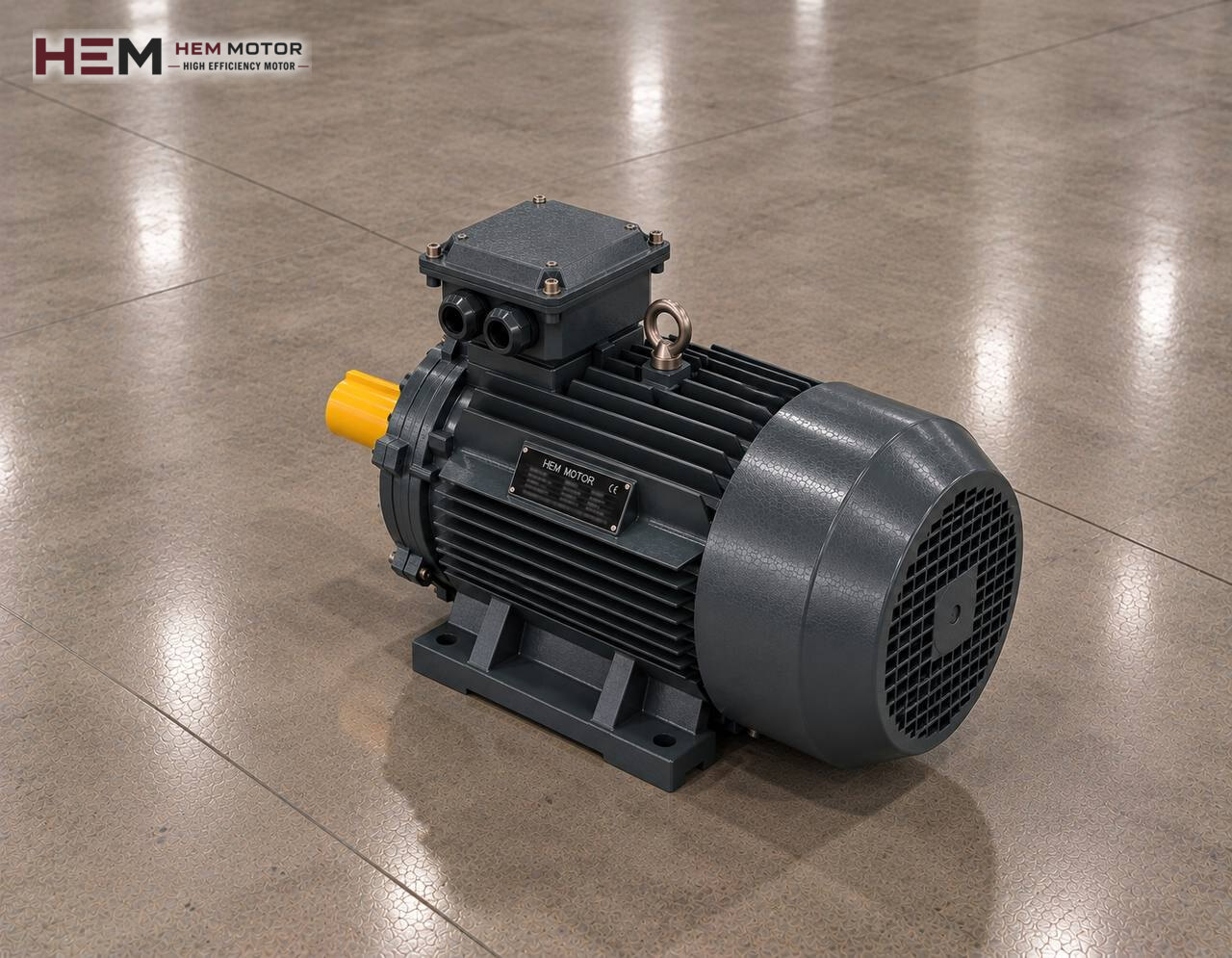
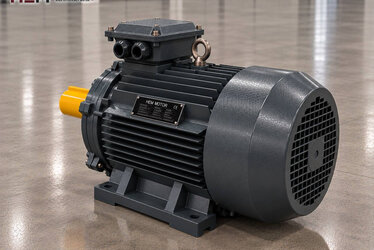
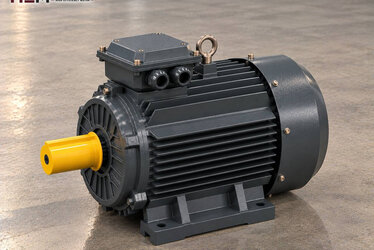
Even within one system the frame number is only the first clue to mounting; dimensions are checked on the drawing (representative image).
Prices and technical data are on the product pages; choose a model and order online.
What should you watch when reading the voltage and frequency lines?
The voltage and speed on a NEMA plate are given for the North American grid frequency; if the motor is to run on a 50 Hz grid in Turkey, those values cannot be used directly. A motor with the same pole count turns noticeably slower at 50 Hz, and the speed of the driven machine drops in the same ratio.
To find the pole count, match the plate speed with the synchronous speeds of that grid. Then select the new IEC motor with the same pole count and 50 Hz values. If the machine's output speed must stay unchanged, recalculate the pulley ratio or gearbox, or use a frequency inverter.
The voltage side is similar.
The voltage pair on the plate may not suit the 400 V grid in Turkey. Read the IEC motor's voltage from its own plate: HEM Motor models are 230/400 V or 400/690 V depending on power, and the connection is chosen accordingly. Our three-phase series are suitable for speed control with a frequency inverter; for long periods at low speed with full torque an external fan may be needed; if the drive-to-motor cable is long, a dv/dt or sine filter is considered; these conditions are stated with the order.
What mistake is made when comparing efficiency and starting data?
The most frequent mistake is mapping the efficiency percentage on a NEMA plate one-to-one onto a class in the IEC table. Because the test method and grid frequency differ, the same percentage may not correspond to the same class on the IEC side. The right approach is to read the new motor's IE class from its own plate.
On the starting side, the NEMA Design letter sums up in one letter the turning force a motor delivers at start and the initial current it draws from the grid. On a heavy-start machine such as a screw conveyor, crusher or piston compressor that starts loaded, if the old motor was a high starting torque design, the starting torque ratio of the new motor must also be checked in the catalogue.
The Code letter gives locked rotor current as a kVA range per HP. When setting the overcurrent protection in the panel, this letter is converted to the matching kVA value in the table and from there to current; the setting is approved by the electrical engineer who prepares the panel design.
How is an IEC motor selected to replace a NEMA-plated motor?
Selection starts with three pieces of information: power converted to kW, pole count adapted to 50 Hz and mounting dimensions verified against the technical drawing. No order is placed until all three are clear.
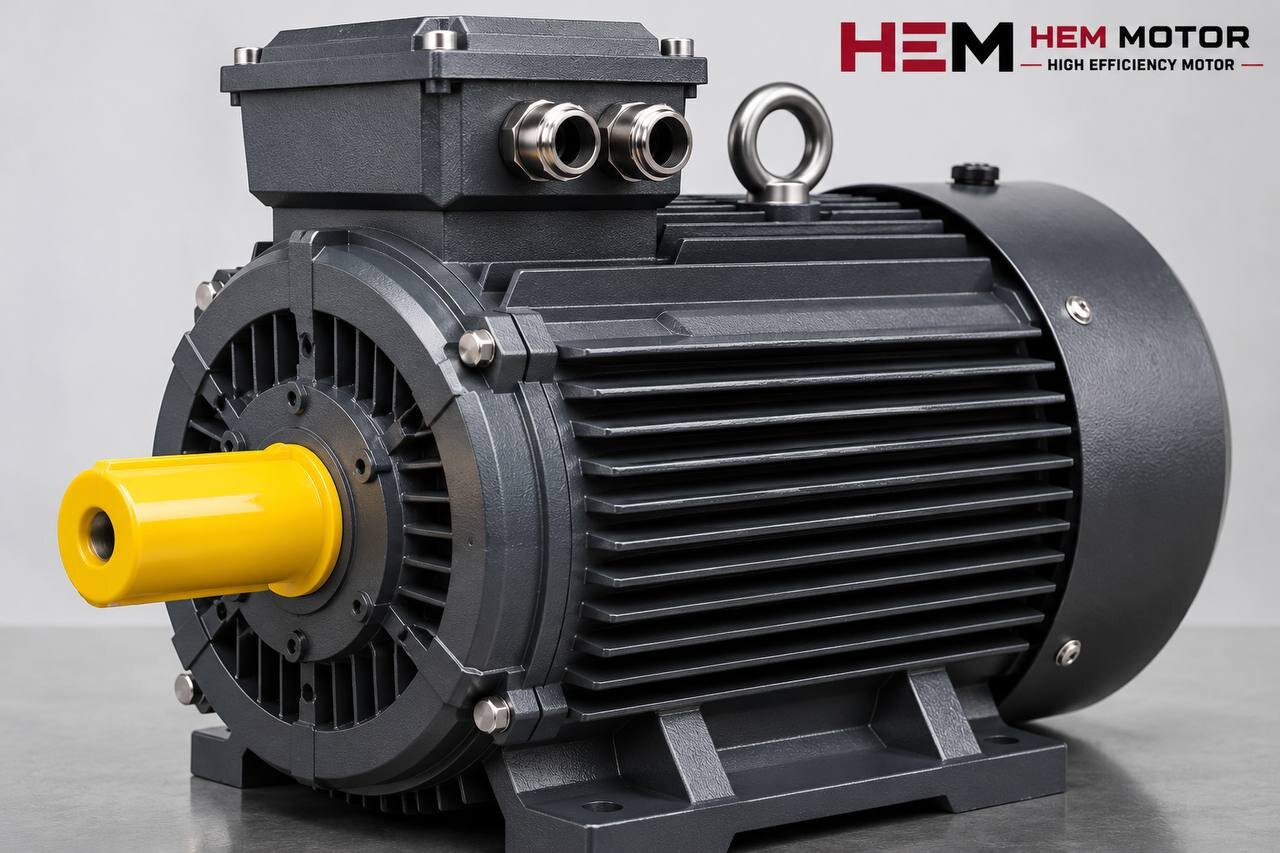
Common NEMA ratings such as 7.5 HP, 10 HP and 15 HP correspond to these steps in the 4-pole IEC series: 132S-4 (5.5 kW, 1460 rpm, 10.7 A at 400 V), 132M-4 (7.5 kW, 1460 rpm, 14.3 A) and 160M-4 (11 kW, 1465 rpm, 20.4 A). All three have a cast iron frame, 400/690 V, IP55 and class F insulation. HEM Motor products follow the IEC standard; other power and pole options sit in the same list.
The power and speed list of the same family is collected on the asynchronous electric motors page. For mounting, B3, B5, B14, B34, B35 and vertical V1/V3/V5/V6/V15 are offered depending on frame; flange size is confirmed with the order.
If you send a clear photo of your NEMA plate and the shaft and foot measurements you took through our contact page, we will translate it line by line and identify the matching IEC step together. Prices and current options can be seen in the HEM Motor product list.
Frequently Asked Questions
Does TEFC mean IP55?
Not directly; TEFC describes a totally enclosed design cooled by an external fan, and it does not give a dust and water protection level the way IP does. The protection degree of an IEC motor is read from its own plate.
Is an IEC motor of the same HP always enough to replace a NEMA motor?
If the power step is right it is enough in most cases, but starting behaviour, the speed change caused by the frequency difference and mounting dimensions must be checked separately. Measuring load current settles the decision.
What is the Code letter for?
It gives the apparent power the motor draws with a locked rotor as a range per HP. It is consulted when choosing protective devices and the starting method.
Is the insulation class on the plate the same in both systems?
Yes, letters such as B and F denote the same thermal class in both systems. Standard insulation on HEM Motor models is class F.
HEM Motor Models Related to This Article
The cards show example models related to the topic. A suitable motor is not chosen by power alone: compare speed, voltage, mounting, shaft and connection dimensions on the product page; if unsure, send a photo of the existing motor’s nameplate on WhatsApp.
In compact electric motor selection, power density shows how small a frame the same kilowatts are taken from; cooling area is the outer surface through which that frame can shed he... More Details
An aluminium frame is a sound choice for drives with low vibration, coupling alignment or moderate pulley load, no shocks and a flat base. Where small pulleys put a large radial lo... More Details
IP55 protection is enough in most cases for an electric motor working outdoors, provided the motor does not take rain directly, condensation water can drain from the frame, and the... More Details
Class F insulation means the winding materials are chosen to withstand up to 155 °C; Class B temperature rise means that at rated load the motor's winding rises no more than 80 K a... More Details
No, they are not the same thing. The insulation class defines the thermal ceiling of the insulating material around the winding; the permitted ambient temperature shows how warm th... More Details
The S3 percentage should be stated in the order because an electric motor that delivers the same shaft power in intervals heats up differently from one that runs continuously, and ... More Details
We use necessary and optional cookies to improve your experience, enhance content and analyse traffic. Under the GDPR, optional (analytics/marketing) cookies are only used with your explicit consent. Please choose your preference below.
Cookie Policy
 English
 Français
 Türkçe
 Español
 Русский
 العربية
 Deutsch
 Italiano