Class F insulation means the winding materials are chosen to withstand up to 155 °C; Class B temperature rise means that at rated load the motor's winding rises no more than 80 K above ambient. When both appear on the same nameplate, the motor is designed to run noticeably cooler than its insulation could tolerate, and the margin in between is credited to winding life.
Why are insulation class and temperature rise class separate values?
Insulation class defines the highest temperature the material can withstand; temperature rise describes how hot the motor actually gets. The first is a limit, the second a measured result.
As general engineering information, the IEC 60034-1 family names thermal classes by letter: Class B 130 °C, Class F 155 °C. Temperature rise limits use the same letters and assume a 40 °C ambient; for rise measured by the resistance method, 80 K is defined for Class B and 105 K for Class F (general information; confirm with the current text of the standard).
If the nameplate says "Isol. F" or "Ins. Cl. F" and nothing else, the class the temperature rise stays within is not stated. That information is looked for on the catalogue page, in the test report or in the order confirmation.
How much margin does Class B rise leave in a Class F insulated motor?
An 80 K rise in a 40 °C ambient means the winding runs at around 120 °C on average, while the Class F limit is 155 °C. The margin covers the allowance for the winding's hottest spot and ageing over the years.
Average winding temperature and the hottest spot inside the winding are not the same. In the middle of the slot, away from the end windings, temperature is above the average and the resistance method does not show it. That is why the standard leaves a hot-spot allowance between the class limit and the permitted rise.
On site this margin gets used up when ambient exceeds 40 °C, when the motor runs at altitudes above 1000 metres, when supply voltage is low or unbalanced, when the fan cover clogs with dust. The combination of Class F insulation with Class B rise handles some of these conditions without pushing the winding to its limit.
The margin is rarely spent on one bad condition; several small deviations stack up.
Why does winding life grow when temperature drops by 10 degrees?
Ageing of insulation material is a chemical process whose rate rises exponentially with temperature. The rough rule used in the field is that every 10 °C drop in winding temperature roughly doubles insulation life.
The rule is not a design calculation but a comparison tool (general information; confirm with the insulation material manufacturer's data). As a hypothetical example: if the same motor runs with its winding at 140 °C in one plant and 120 °C in another, the second motor's insulation ages, by rough reckoning, four times more slowly. Bearing grease shows a similar sensitivity to temperature; in a cooler motor it dries out later.
Load is seldom constant. A press motor that starts frequently during die changes, or a fan motor under a roof at midday in summer, spends hotter hours than the average on paper suggests. Those hours are where a Class B rise design really pays off. If you are considering one power step higher for such work, the rated currents of neighbouring steps can be compared side by side in the HEM Motor shop.
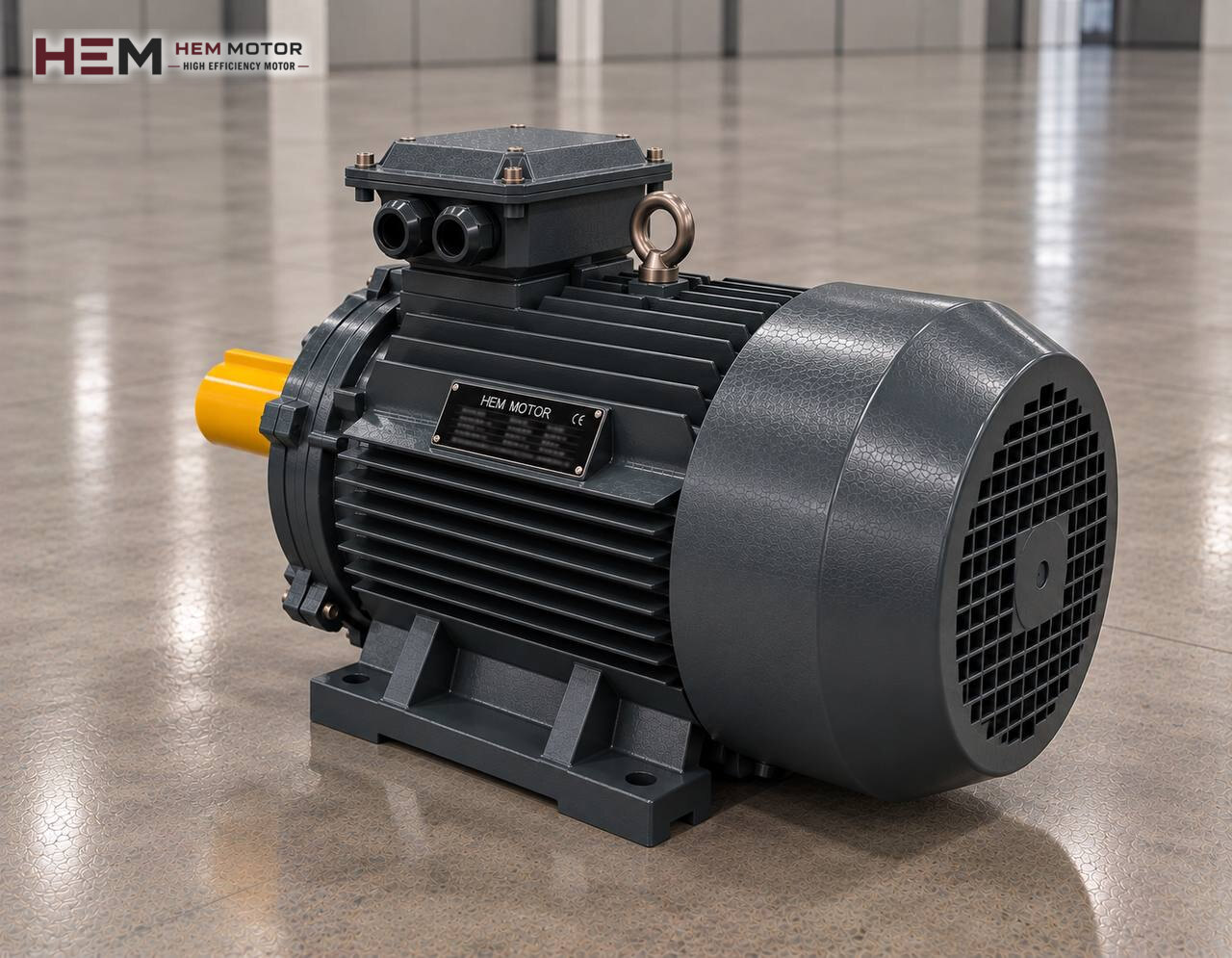
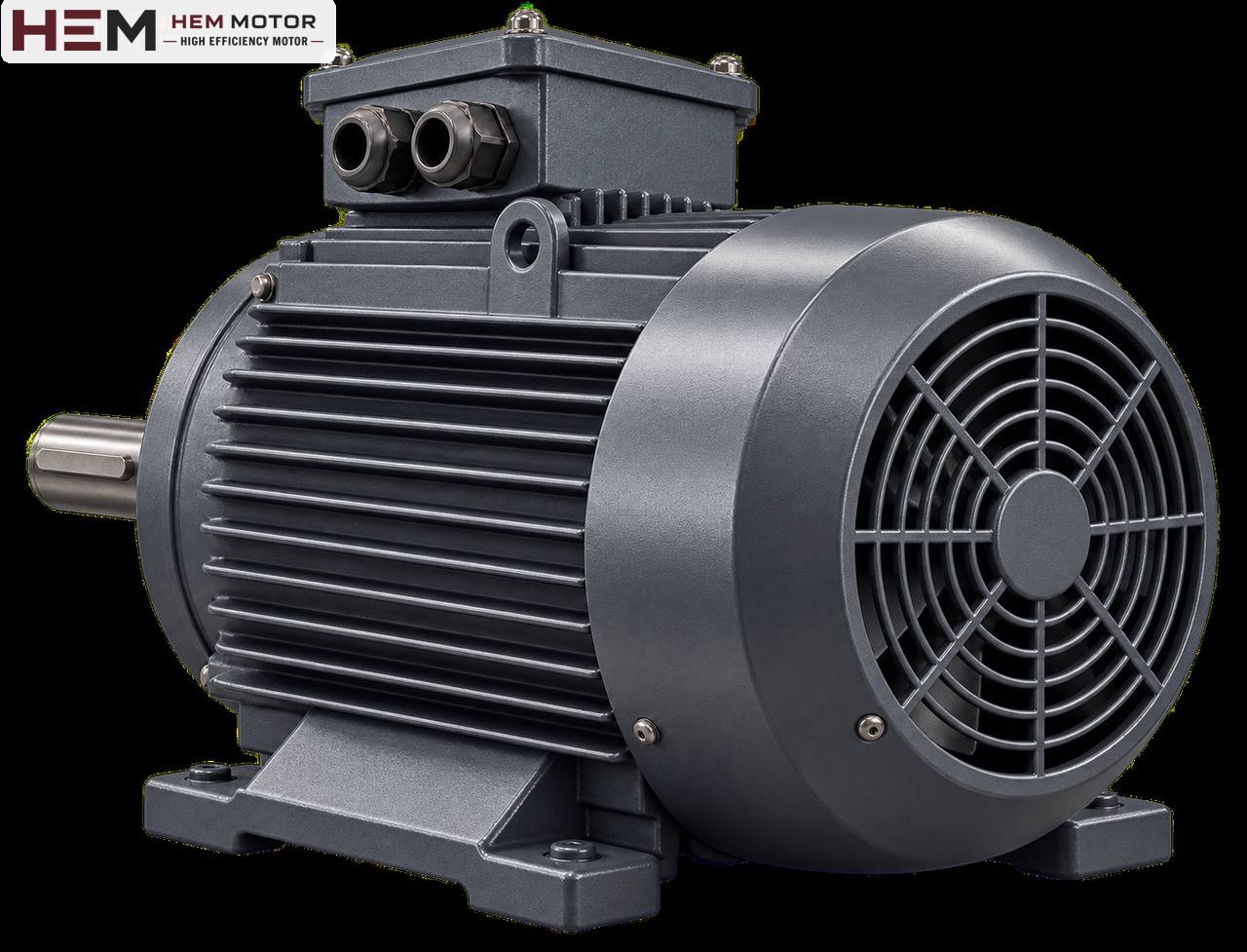
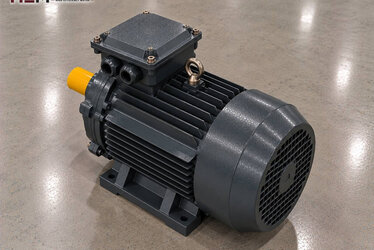
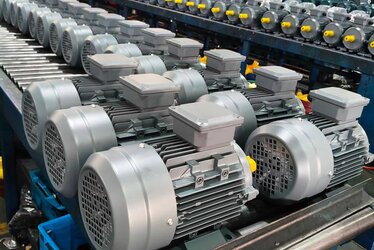
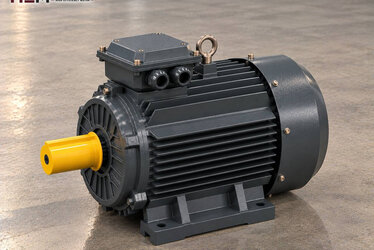
As long as the fan cover and fins stay clean, the winding temperature margin is preserved (representative image).
Prices and technical data are on the product pages; choose a model and order online.
How is temperature rise measured on site by the resistance method?
Winding resistance is measured cold and again immediately after the motor has heated up under load; because copper resistance rises with temperature at a known rate, the difference between the two values gives the average winding temperature.
With the motor stopped for at least several hours and at ambient temperature, measure resistance between two terminals with a milliohmmeter or a four-wire bridge; note ambient temperature (t1).
Run the motor at its real load until frame temperature stabilises. Check the frame with a contact thermometer every half hour; when two readings show no clear difference, it has reached equilibrium.
Switch off, lock out and measure resistance between the same two terminals as quickly as possible. Every minute that passes cools the winding; taking several readings and extrapolating back in time gives a more accurate result.
Note ambient temperature at the moment of switch-off (t2) and put the values into the formula.
For copper: ΔT = (R2 − R1) / R1 × (235 + t1) + t1 − t2. Hypothetical example: R1 = 2.00 Ω (t1 = 20 °C), R2 = 2.60 Ω, t2 = 25 °C. The calculation gives 0.30 × 255 − 5 ≈ 71.5 K, which is below the Class B rise limit.
An infrared thermometer pointed at the frame surface does not replace this measurement. The frame is always cooler than the winding; the gap depends on motor size and cooling arrangement.
If the nameplate says F, is it right to run the motor hotter all the time?
No; a higher insulation class should not be read as permission to increase load. The motor's rated power is set by the current and temperature rise on the nameplate, and continuous operation above that limit uses up the insulation margin.
A common mistake is to turn the thermal relay up when current sits slightly above rated, on the grounds that "it's Class F, it will cope". The result is not visible right away, because for the first months the motor runs without complaint, the overload does not trip and the frame does not feel much different to the hand; a few years later, insulation resistance readings taken with a megger start falling from one service to the next, the varnish darkens, and the inter-turn short usually shows up on a cold morning, at the moment of a start.
In motors running at low speed on a frequency inverter, airflow from the shaft-mounted fan drops and the winding heats up even when current looks normal. Our three-phase series are suitable for speed control with a frequency inverter; for long periods at low speed with full torque an external fan may be needed; if the drive–motor cable is long, a dv/dt or sine filter is considered; these conditions are stated with the order. A PTC sensor can be added to the winding as an order option and tracks real temperature more directly than a current relay.
Which temperature-related details should be written on the order?
Ambient temperature, altitude, duty type, starting frequency and whether a drive will be used should all be written down. These five items decide whether the standard motor's temperature margin is enough for that application.
In HEM Motor's three-phase series, insulation is Class F as standard. Whether the temperature rise of a specific model stays within Class B is confirmed with the order. As examples, three steps from the 4-pole cast iron series:
112M-4: 4 kW, 1450 rpm, 7.95 A at 400 V, 400/690 V connection. A step often seen on compressors and small fans.
160M-4: 11 kW, 1465 rpm, 20.4 A at 400 V. In enclosed machine rooms, ambient temperature should be stated separately.
180L-4: 22 kW, 1470 rpm, 39.7 A at 400 V. For frequent-start duties, the number of starts should be written on the order.
If the motor you have says F on the nameplate and still runs too hot, send the cold and hot resistance values, the ambient temperature and a nameplate photo through our contact page. We will do the calculation together and compare alternatives of the same power from the product list.
Frequently Asked Questions
Does Class F insulation mean the motor runs at 155 °C?
No. 155 °C is the endurance limit of the insulation material; the motor's real winding temperature depends on load, ambient and the temperature rise design.
If the frame is too hot to touch, has the motor overheated?
That alone is not proof. A frame at 60–70 °C can occur in normal operation; a sound decision uses a current measurement and, if possible, the resistance method.
What should be done if ambient temperature is above 40 °C?
Standard limits are defined for a 40 °C ambient. In hotter surroundings derating or one power step up is considered; ambient temperature must always be stated with the order.
Does insulation class change after a rewind?
It can. If the enamelled wire, slot paper and varnish used in the repair are not suited to Class F, the motor's temperature margin shrinks; ask the repair shop for the material class in writing.
HEM Motor Models Related to This Article
The cards show example models related to the topic. A suitable motor is not chosen by power alone: compare speed, voltage, mounting, shaft and connection dimensions on the product page; if unsure, send a photo of the existing motor’s nameplate on WhatsApp.
In compact electric motor selection, power density shows how small a frame the same kilowatts are taken from; cooling area is the outer surface through which that frame can shed he... More Details
An aluminium frame is a sound choice for drives with low vibration, coupling alignment or moderate pulley load, no shocks and a flat base. Where small pulleys put a large radial lo... More Details
IEC and NEMA nameplates are not compared directly but field by field after translation: power from HP to kW, protection from enclosure type to IP code, while efficiency class and s... More Details
IP55 protection is enough in most cases for an electric motor working outdoors, provided the motor does not take rain directly, condensation water can drain from the frame, and the... More Details
No, they are not the same thing. The insulation class defines the thermal ceiling of the insulating material around the winding; the permitted ambient temperature shows how warm th... More Details
The S3 percentage should be stated in the order because an electric motor that delivers the same shaft power in intervals heats up differently from one that runs continuously, and ... More Details
We use necessary and optional cookies to improve your experience, enhance content and analyse traffic. Under the GDPR, optional (analytics/marketing) cookies are only used with your explicit consent. Please choose your preference below.
Cookie Policy
 English
 Français
 Türkçe
 Español
 Русский
 العربية
 Deutsch
 Italiano