The vibrating screen is one of the basic machines that separate material by particle size, from sand quarries to recycling plants. When a screen breaks down or its motor burns out, the first reaction is often "we'll fit a motor of the same power". Yet the arrangement that produces the vibration on a screen is built in two different ways, and this distinction directly determines which motor can be used. In this article we explain the place of the standard asynchronous motor on screens driven by a belt and an eccentric shaft, why screens that require a vibration motor with unbalance weights are different, and how to tell the two apart on site.
Let us state it from the outset: HEM Motor's 2026 catalogue does not include vibration motors. We do not recommend a standard three-phase motor as a replacement for a vibration motor bolted directly to the screen box. Our product examples apply only to the drive arrangement in which the motor is fixed to a stationary base and the vibration is produced through a separate shaft.
Where does the vibration on a screen come from? Two basic arrangements
To shake a screen box you need a rotating unbalanced mass. The difference lies in where this mass rotates and what turns it.
1. Eccentric shaft (vibrator shaft) screen
An eccentric shaft or weighted vibrator shaft is mounted in bearings on top of the screen box or between its side walls. This shaft is turned by an electric motor sitting on a stationary base outside the screen box, through a V-belt and pulleys. While the box oscillates on its springs, the motor stays in place; the belt absorbs the difference in movement between the two sides. In this arrangement the motor is not the part that generates vibration, only the drive source that turns the shaft.
2. Screen with vibration motors
Here the vibration is produced directly by the motor. The vibration motor is bolted to the screen box, carries adjustable unbalance weights on its shaft ends and shakes together with the box. Usually two motors rotate in opposite directions to create a linear oscillation. These motors are a separate product group designed for continuous vibration: their bearings, housing structure, winding fixing and terminal box are selected for this load.
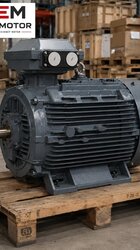
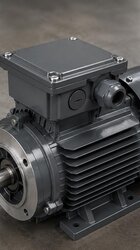
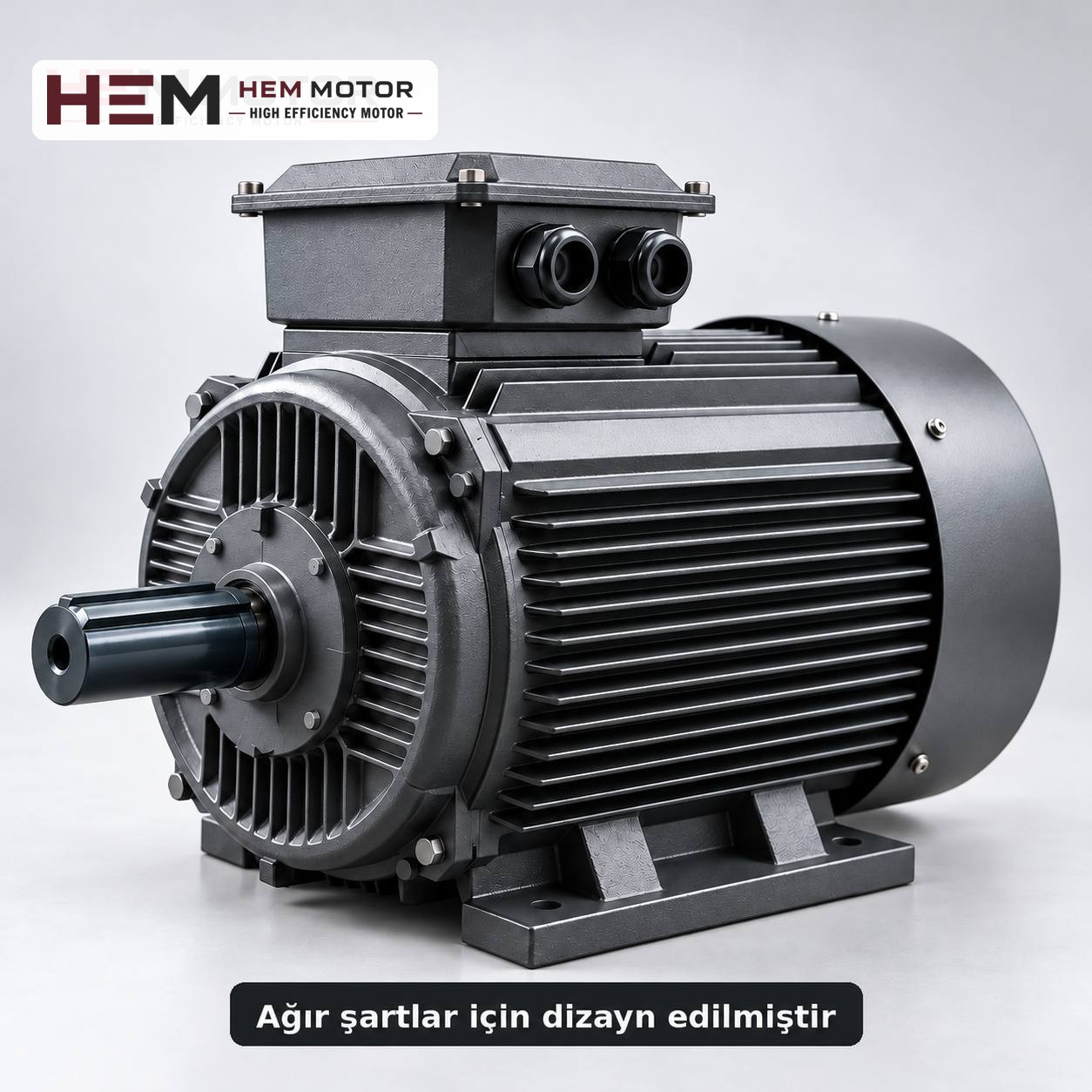
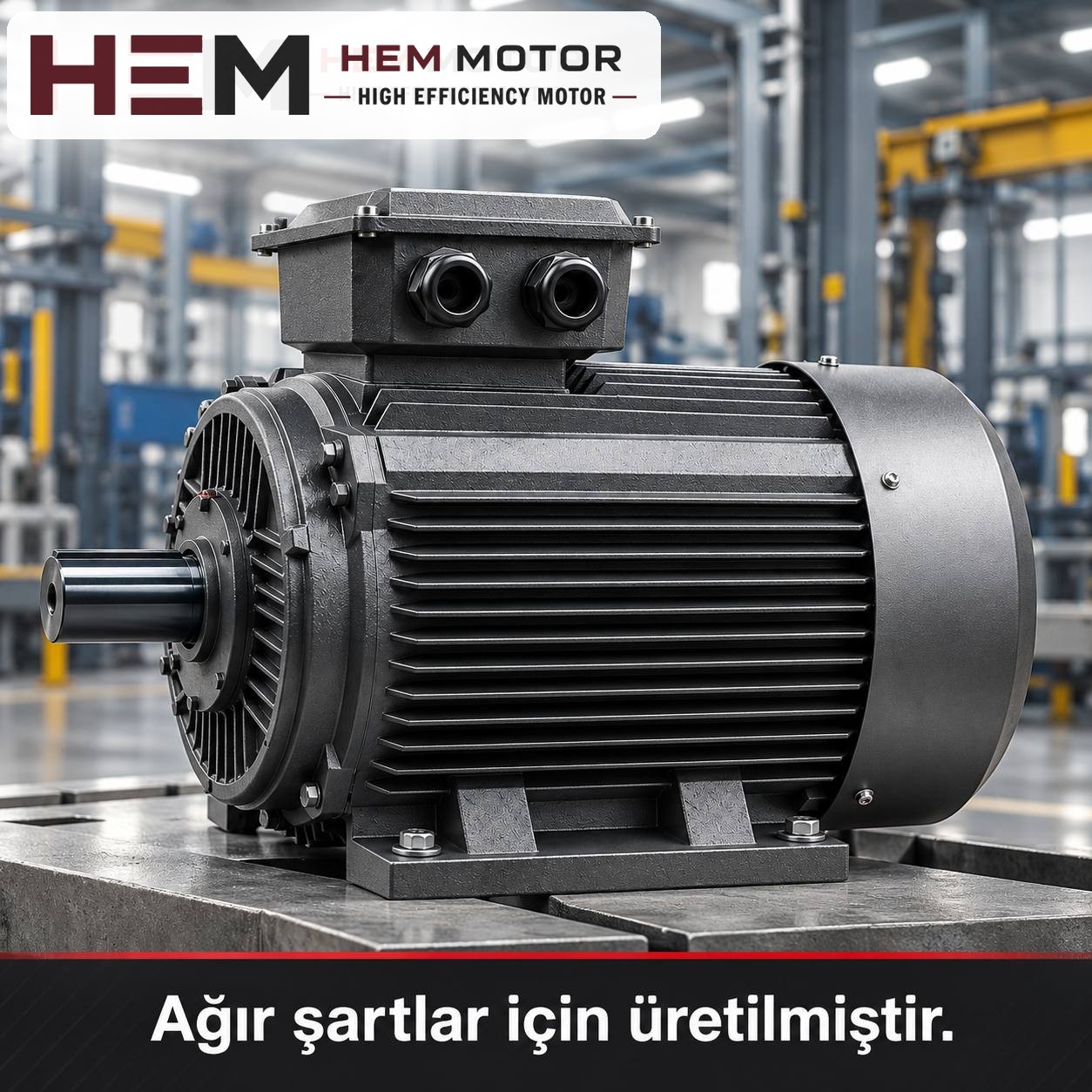
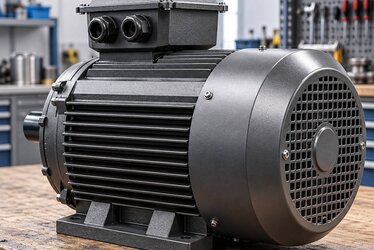
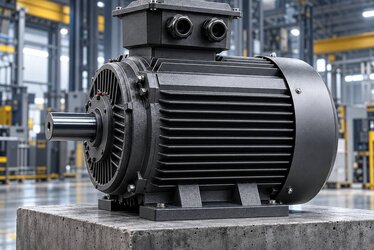
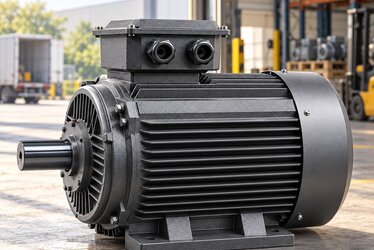
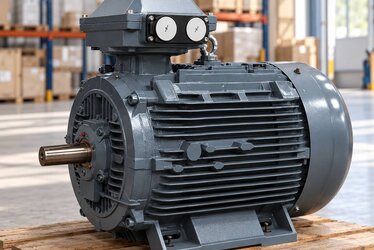
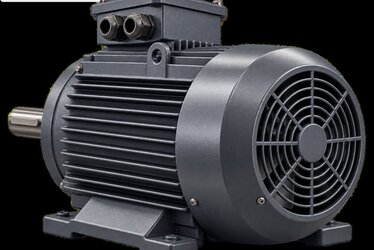
On belt-driven screens the motor runs on a stationary base outside the vibrating box (representative image).
Why can a standard motor not replace a vibration motor?
A standard asynchronous motor is designed to be fixed to a stationary foundation and to transmit power from its shaft through a coupling or pulley. When it is bolted to a screen box and weights are fitted to its shaft, the motor faces an entirely different load:
Bearing load: The rotating unbalanced mass creates a large radial force that changes direction on every revolution. The bearings of a standard motor are not selected for this continuous shock load; overheating and damage can appear within a short time.
Housing and connections: When the motor itself swings with the box, the feet, bolts, terminal box and cable entry are under constant stress; the risk of loosening and breakage increases.
Winding and rotor: Continuous acceleration fatigues the end windings and internal connections. This may cause the motor to fail not at the first start but within a few weeks.
Shaft end: On vibration motors the weights are usually located on both shaft ends; the shaft and end shield design of a standard motor is not suited to this arrangement.
For this reason, when a vibration motor swinging on top of the screen box fails, the right course is to obtain a vibration motor of the same type from its manufacturer or from the screen builder. Trying to adapt a standard motor to this duty puts both the machine and the operators at risk.
Checklist for telling the two arrangements apart on site
If you are not sure which arrangement your screen uses, check the following before removing the motor:
Where does the motor stand? If it stands on a fixed steel base or on concrete and is connected to the box by a belt, it is most probably an eccentric shaft arrangement. If the motor is bolted directly to the screen box, it is a vibration motor.
What is on the shaft end? If a pulley and belt are visible, it is a standard drive. If the shaft ends carry adjustable weight discs under a cover, it is a vibration motor.
What does the nameplate say? Besides power and speed, a vibration motor nameplate usually shows vibration-specific values such as centrifugal force (kN) or unbalance moment. These are not found on a standard motor nameplate.
How many motors are there? If there are two symmetrical motors on both sides of the box and no belt, a vibration motor arrangement is likely.
Is there a belt guard? On eccentric shaft screens the pulley and belt are usually inside a guard; behind the guard lies the bearing-mounted vibrator shaft.
If there is still doubt after this check, send us the motor nameplate together with a few photos showing the screen type and the motor position; we will assess together whether a standard motor is suitable.
Prices and technical data are on the product pages; choose a model and order online.
What to check when choosing a standard motor for a belt-eccentric drive
In the arrangement where the motor stands on a stationary base, a standard three-phase asynchronous motor can be used. However, looking at the nameplate power alone is not enough; the way a screen operates brings the following points to the fore.
Passing through resonance: At start-up and shutdown the screen passes through the natural frequency of its springs. During this time the box briefly makes wide oscillations and the motor may draw high current for longer. The starting method (direct-on-line, star-delta or drive) should be kept the same as the existing arrangement, or any change should be stated in the order.
Loaded start: If material remains on the screen when the line stops, the motor starts under load. This information matters when assessing power and the starting method.
Belt and radial load: Pulley diameter and belt tension place a side load on the motor shaft and the drive-end bearing. If you will reuse the old pulley on the new motor, check the shaft diameter and key size in the 2D technical drawings.
Speed: The speed of the eccentric shaft comes from the motor speed and the pulley ratio. If you change the motor speed, the vibration frequency changes too; this upsets the operating values set by the screen builder. Keep the same number of poles when replacing.
Environment: Screening sites are dusty and often outdoors. Our models on sale are IP55-rated with class F insulation; where dust and impacts are heavy, the cast iron frame stands out. State separately in the order any conditions beyond IP55, such as washing screens with direct water spray.
Mounting: In this arrangement the motor is usually fitted foot-mounted (B3) on a slide rail or adjustment plate; the slide rail allows the belt tension to be adjusted. B3, B5, B14, B34, B35 and vertical arrangements are offered according to the frame; the flange size is confirmed with the order.
When selecting power, it is not right to state an exact kW based on the size or the number of decks of the screen. The rating of the existing motor, the density of the material, whether there is a loaded start and the operating time are assessed together.
Example models: for the standard drive scenario only
The models below are given as examples for the arrangement in which the motor stands on a stationary base and turns the eccentric shaft through a belt. They are not recommended as replacements for a vibration motor.
All three models are 4-pole, three-phase, with a cast iron frame, IP55 and class F insulation. On a 400 V network they are connected in delta (Δ). The rated speed in the table is the value read on the nameplate under load. The current price is on each model's product page; you can see other powers and speeds in the cast iron frame models list.
Hypothetical example: replacing the motor on a belt-driven screen
The following sequence is hypothetical; it is not a real customer application. Suppose that at a sand and gravel plant the eccentric shaft of a two-deck screen is turned by V-belt by a motor fixed to a stationary base next to it. The motor has burned out, and its nameplate shows 11 kW and a speed of around 1,460.
Confirm the arrangement: The motor is outside the box, fixed by its feet to a slide rail, with a pulley on the shaft end. This is the standard drive arrangement.
Keep power and speed: The 11 kW and 4 poles on the nameplate are retained; this points to the model with code 160M-4. Changing the speed is not recommended because it would change the vibration frequency.
Compare the connection: The frame code, shaft diameter and foot spacing of the old motor are compared with the technical drawing; if the pulley fits the new shaft, it is reused.
Review the start: If material remains on the screen when the line stops, this is stated in the order and the starting arrangement is assessed accordingly.
Note the environment: For an open, dusty site a cast iron frame is chosen; if the position is exposed to rain, overhead protection is planned separately.
If the same plant has a pre-screening unit with two vibration motors bolted to the box, the motors of that unit fall outside this assessment and are sourced from a vibration motor supplier.
Conclusion and what to send before ordering
Motor selection for a vibrating screen starts with understanding how the vibration is produced. If the motor stands on a stationary base and turns the eccentric shaft by belt, a standard three-phase motor is the right choice. If the motor is attached to the box and produces the vibration itself with its weights, the product you need is a vibration motor, and a standard motor cannot take its place.
To determine the right model for a standard drive together, send us the following information:
Power (kW or HP) and speed of the existing motor; if possible, a photo of the nameplate
A photo showing the motor position and the belt-pulley arrangement
Mounting arrangement (mostly B3 foot-mounted) and frame code
Network voltage and the starting method used
The material being screened, whether there is a loaded start, and the ambient conditions (dust, outdoor site, water)
Review suitable models and current prices on the buy electric motors page. To ask for the right model with your motor's nameplate data, or to make sure about your arrangement, contact us through our contact page.
HEM Motor Models Related to This Article
The cards show example models related to the topic. A suitable motor is not chosen by power alone: compare speed, voltage, mounting, shaft and connection dimensions on the product page; if unsure, send a photo of the existing motor’s nameplate on WhatsApp.
There is no single "seed cleaner motor" in a seed cleaning and grading machine; the machine consists of several motors, each carrying a different load: the drive that shakes the si... More Details
If a compressor motor cannot start against tank pressure, the cause is usually not the motor's power. The most common causes are a faulty unloader or check valve, low supply voltag... More Details
On a dough kneading machine, the spiral or fork arm folds the dough with a slow but powerful movement; on most models the bowl also turns about its own axis. This need for low spee... More Details
On a circular saw, the toothed blade cuts the material at dozens of revolutions per second; on most machines the blade is attached to the motor shaft or to a shaft very close to th... More Details
On a wood band saw, the blade that does the cutting runs over two large wheels; the motor usually turns the lower wheel through a belt and pulley. Thanks to this arrangement, a ban... More Details
On a bridge-type marble cutting machine, the main motor is the part that turns the diamond blade and carries the heaviest load throughout the cut. When this motor has to be replace... More Details
We use necessary and optional cookies to improve your experience, enhance content and analyse traffic. Under the GDPR, optional (analytics/marketing) cookies are only used with your explicit consent. Please choose your preference below.
Cookie Policy
 English
 Français
 Türkçe
 Español
 Русский