English
 Français
 Türkçe
 Español
 Русский
 العربية
 Deutsch
 Italiano

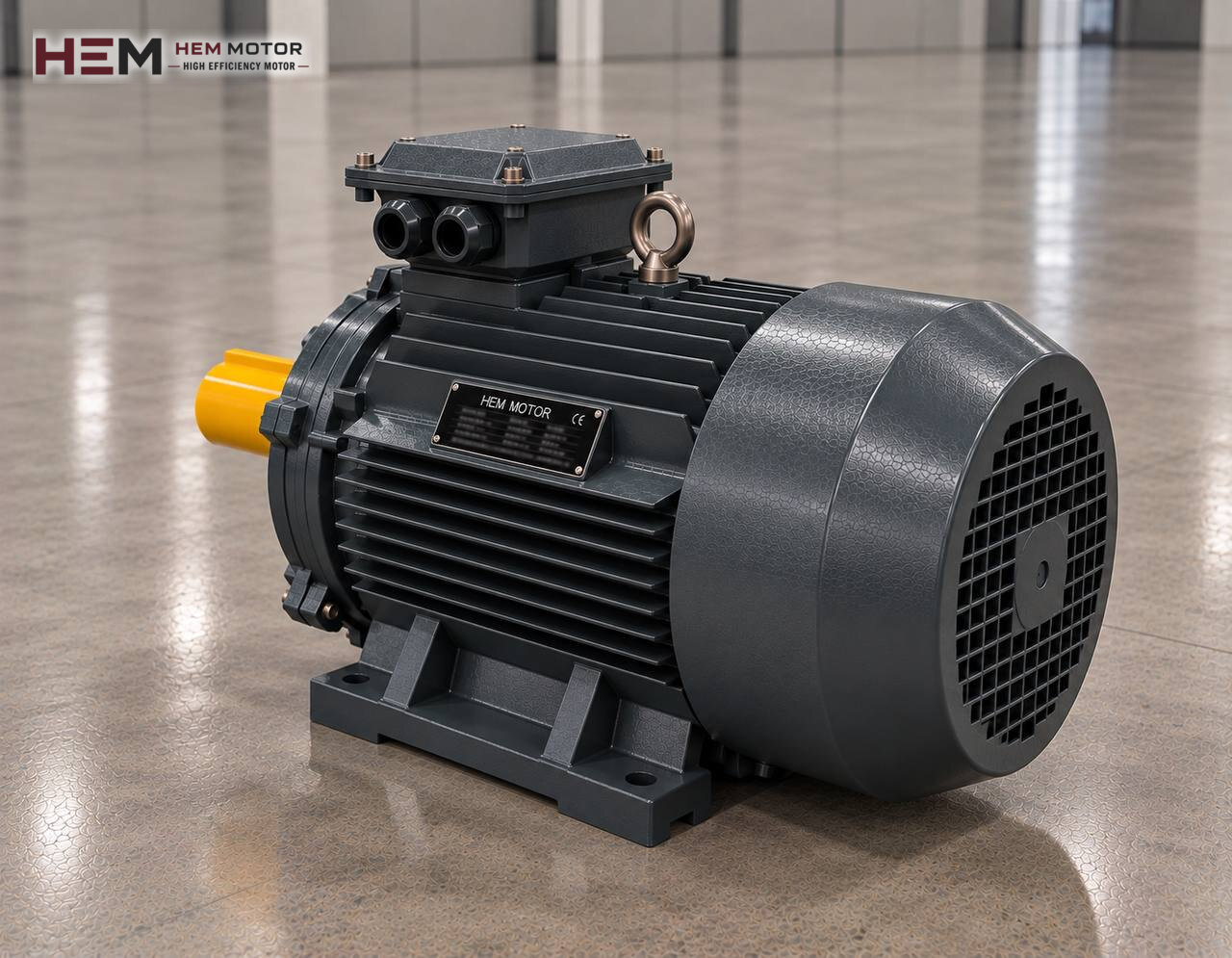

A smaller IE4 motor cannot be chosen in place of an IE3 electric motor just because the efficiency class is higher; a motor's power is set by the torque and speed demanded at the shaft, not by its efficiency. One size down is considered only if measurement shows that the existing motor is not actually loaded that much, and the decision is made with the same method whether you move from IE3 to IE4 or stay in the same class.
Does the efficiency class change the motor's shaft power?
It does not.
The kW value on the plate states the power the motor can deliver continuously at the shaft; the IE class classifies how much extra it draws from the supply while delivering that power, in other words its losses.
A 7.5 kW IE4 motor delivers the same shaft power as a 7.5 kW IE3 motor. The difference lies in the active power drawn from the supply: in an IE4 design the share turned into heat in the core, winding and rotor is smaller, and the frame stays a little cooler. That coolness does not make the motor stronger.
A common idea on site is that a 5.5 kW IE4 motor will stand in for the old 7.5 kW motor. That comparison confuses loss with work. Losses are already a small fraction of shaft power. Reducing them does not create extra power to meet the torque the machine demands, and the starting torque a crusher or screw conveyor asks for in the first seconds does not shrink because the class label on the plate changed.
So when is one size down possible?
It is possible when the existing motor runs clearly below its rating.
This is a measurement and calculation job independent of the efficiency class, done with a log taken over at least one shift rather than a single instantaneous clamp reading, because a line that starts empty in the morning and runs full in the afternoon, or a mix that changes from batch to batch, makes the motor's real load look lighter than it is in a short measurement.
To find the load ratio, measure the motor under normal production conditions, ideally during the heaviest batch. A three-phase power analyser gives active power directly; without an analyser, current, voltage and speed are read together. Shaft power is the active power drawn from the supply multiplied by efficiency, and efficiency at part load is somewhat lower than on the plate (general information; confirm with the machine manufacturer).
A hypothetical example: a four-pole IE3 machine with 7.5 kW on its plate draws 5.4 kW of active power from the supply during the busiest shift, and its part-load efficiency is taken as about 0.88. Shaft power comes to roughly 4.75 kW. In this picture a 5.5 kW motor looks sufficient for continuous load; but the decision does not end here.
Starting torque, peak loads and plans for process growth are the next checks. On machines such as a crusher, a conveyor starting with a full belt or a fan with a heavy impeller, low continuous load alone is not enough to move to a smaller motor; the torque needed at start and the starting time are calculated separately.
Why should speed be checked separately when moving to an IE4 motor?
Because in high-efficiency designs slip usually becomes smaller as rotor losses fall, and rated speed rises slightly. On a centrifugal pump, an extractor fan or a cooling tower fan, this small rise in speed can increase the power drawn more than expected.
On centrifugal loads, power varies roughly with the cube of speed. A one per cent rise in speed raises the power drawn by the pump or fan by about three per cent (general information; confirm with the pump or fan manufacturer's curve). Flow and pressure rise too; if the valve is not throttled the plant does not notice, but it shows up when the motor current is measured.
That is why the rated speeds on the two plates are written side by side. If the difference is more than a few rpm, the pump impeller is trimmed, speed is set with a frequency converter, or the load ratio is recalculated at the new point. Our three-phase series are suitable for speed control with a frequency converter; for long periods of full torque at low speed an external fan may be needed; if the drive-to-motor cable is long, a dv/dt or sine filter is considered; these conditions are stated with the order.
Can frame and connection dimensions change?
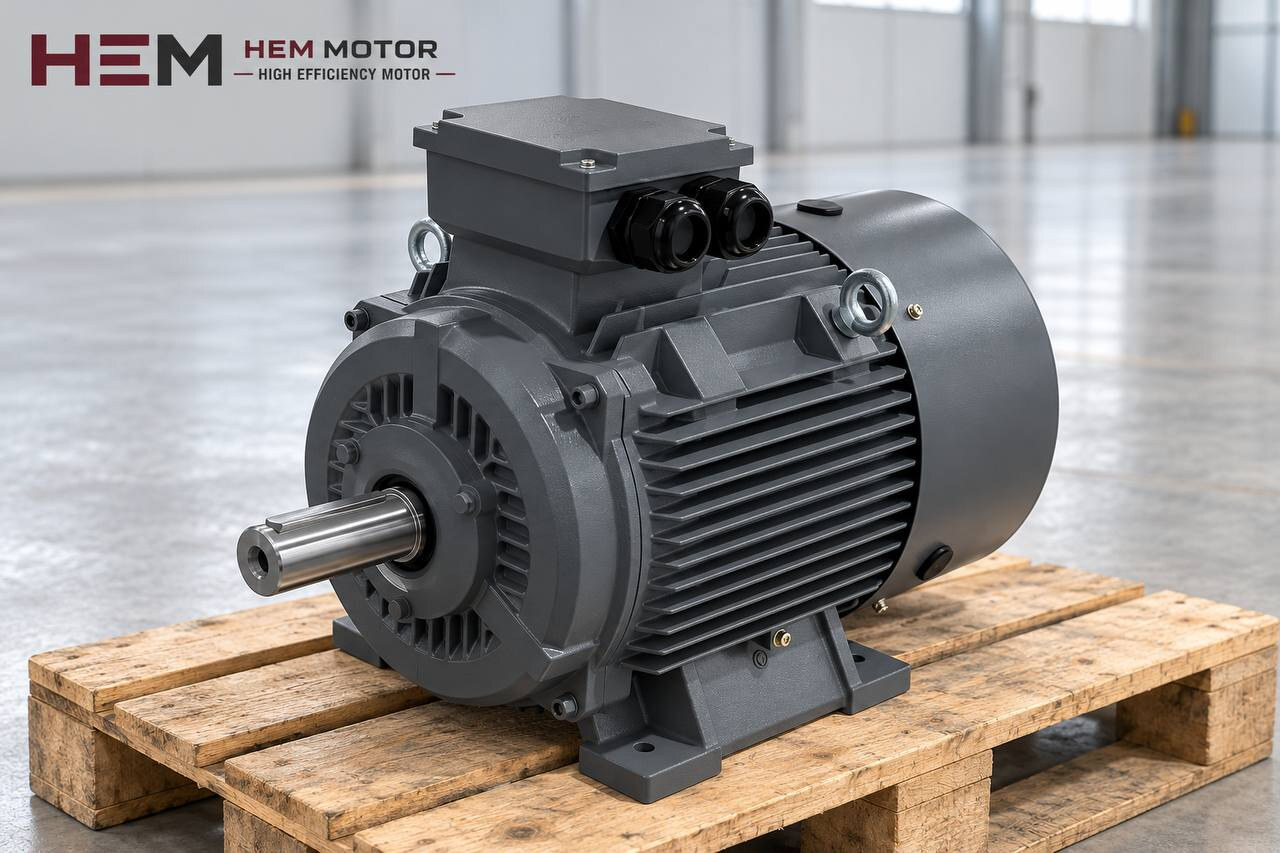
They can. IE3 and IE4 models of the same power do not always fit the same IEC frame; to raise efficiency the core may have been lengthened or the frame grown by one size. When you go one size down, the frame may shrink; the shaft thickness, foot hole spacing and flange then come out different.
The IEC frame number is the first piece of compatibility information; exact compatibility is confirmed by comparing mounting type, shaft diameter and length, foot hole spacing, flange and electrical values. For the figures, see the frame drawings on the technical drawings page. If changes are needed on the coupling or pulley side, that work also belongs in the decision table; improvising an adapter on site can trade the efficiency gain for a failure risk.