No, it is not enough. An IE3 label only states the efficiency level of the motor at rated load; it does not say whether the motor will fit the machine, carry the load or match the supply. An IE3 purchase made without checking power, speed, IEC frame, mounting type, voltage, torque and ambient conditions can end with a motor that is removed on site and sent back.
Which questions does an IE3 label leave unanswered?
IE3 is a minimum efficiency line set in the IEC 60034-30-1 classification for each power step and pole count; it says nothing about mechanical dimensions, torque, voltage or degree of protection.
Two IE3 motors from two different suppliers can carry the same kW and speed on paper. Even so, one may have a light-alloy housing and the other a cast iron one; one may come with feet, the other with a flange. One nameplate may show a low voltage pair, the other a high one. If the purchase form only says "15 kW, 1500 rpm, IE3", every one of these differences stays open.
The class also refers to rated load. In a motor running at half load, the real efficiency can fall behind the figure on the label. The class is a laboratory measure, independent of how the motor will be used.
What use is the IE3 class if power and speed are chosen wrong?
Very little.
A motor bought larger than needed runs lightly loaded; cos φ drops and the line has to carry current that does no work. An undersized motor runs above its nameplate current, the winding heats up and the insulation ages far sooner than expected. In both cases the benefit of the class on the label never shows up in the records. A wrongly sized IE3 can fall behind a correctly sized IE2.
The check is simple. Read the loaded current of the existing motor with a clamp meter and write it next to the rated current on the plate; if it is far below rated, the next lower power step comes onto the table, if above, the next higher one, but before deciding you should also take a reading during the heaviest shift, with the fullest product and at a cold morning start, because a single reading rarely gives the full picture of the load. For speed, look at the input speed the machine needs. Coupling a 2-pole IE3 to a gearbox that expects a 4-pole motor is a wrong decision from the start, whatever class is printed on the label.
Why can the frame differ at the same kW and efficiency class?
Frame length and material change with design, cooling method and series type.
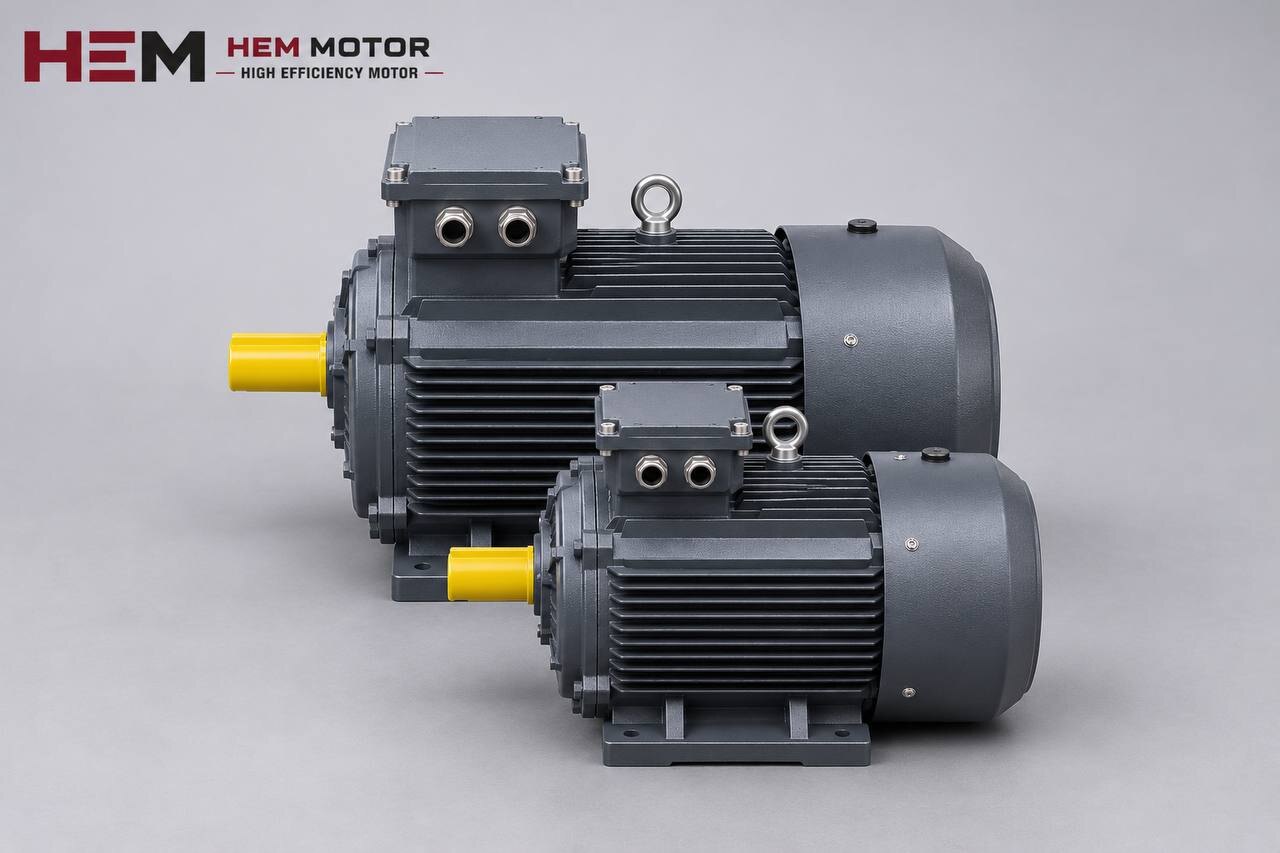
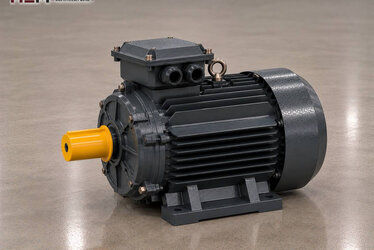
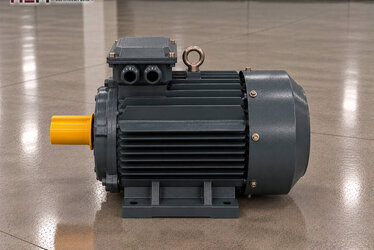
An example from the HEM Motor list shows this clearly. There are three 11 kW, 4-pole models: the aluminium frame 160M-4, the cast iron frame 160M-4 and the compact aluminium frame 132M-4K. All three have 11 kW, 20.4 A at 400 V and 71.7 Nm rated torque. The first two are in frame 160M, the third in frame 132M.
On site the difference shows at the base frame. If the base is drilled for 160M foot holes, a 132M frame will not sit on it, and vice versa. Because shaft height changes, the coupling hub has to be revisited too. The IEC frame number is the first clue to fit; final fit is confirmed by comparing mounting type, shaft diameter and length, foot hole spacing, flange and electrical values. Dimensions are given by frame on the technical drawings page. You can open the three frames of the same power side by side on the motor sales page.
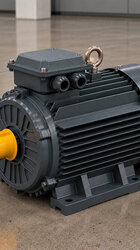
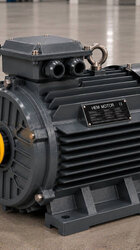
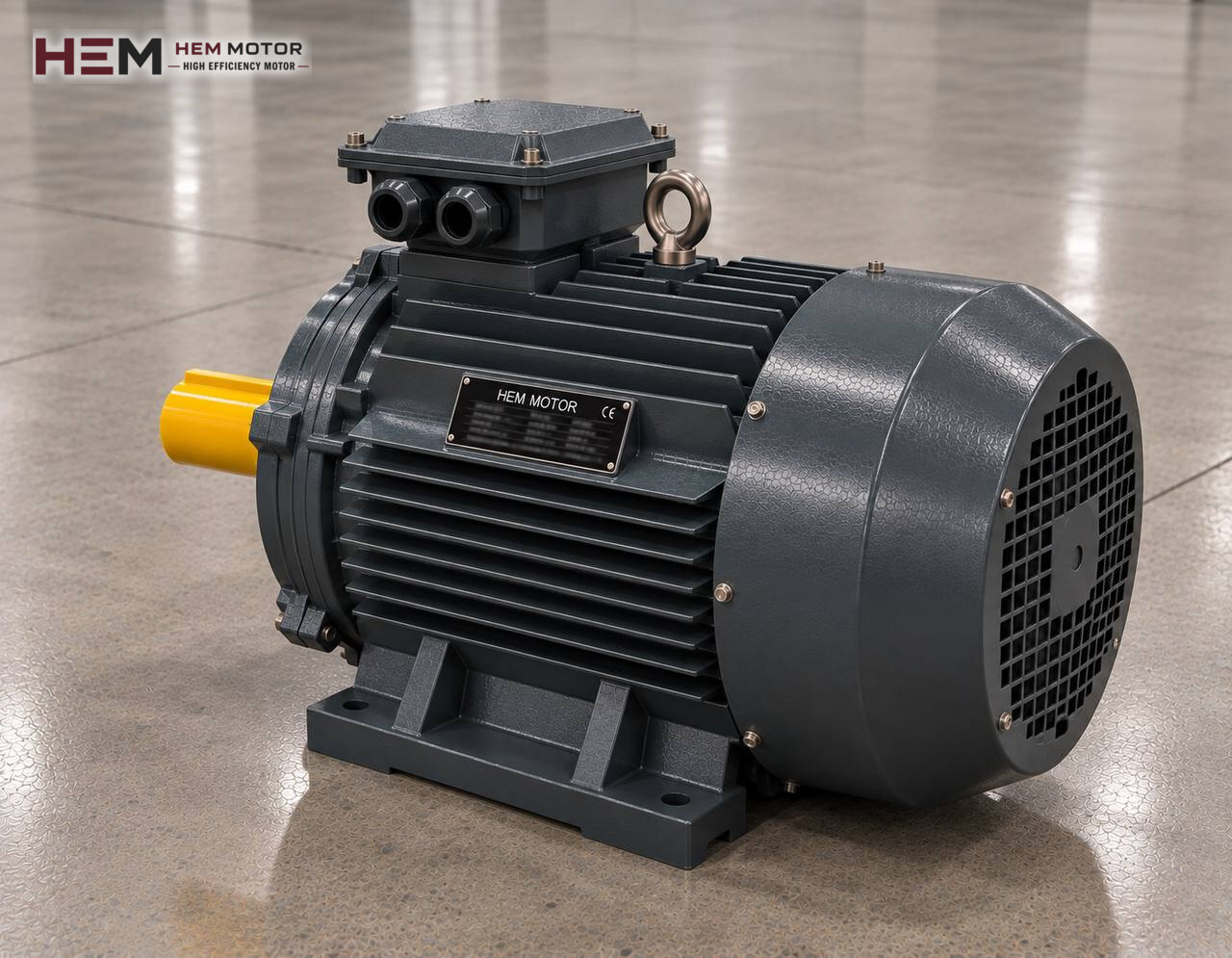
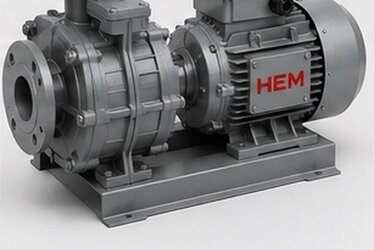
Even with the same power and class on the label, the frame length can differ; base holes and hub size are compared separately (representative image).
Prices and technical data are on the product pages; choose a model and order online.
Which details must be complete on the purchase form?
At least eight items should be written next to the efficiency class; if one is missing, a gap opens between the quotation and the need on site.
Item
Where it comes from
What happens if it is missing
Power (kW) and speed
Existing nameplate, machine file
Load not covered, or motor needlessly large
IEC frame number
Nameplate, cast marking on old frame
Base and shaft height do not match
Mounting (foot, flange, vertical)
Where the motor is fixed
Flange or foot mismatch
Voltage and connection
Nameplate voltage line, supply
Wrong connection, low torque
Starting method
Panel: direct, Y/Δ, soft starter, drive
Suitable voltage rating for Y/Δ not chosen
Ambient conditions
Site: dust, humidity, washdown, temperature
Protection and insulation options left out
Drive use
Panel and process
Need for a separate fan or output filter is missed
Shaft end and key
Hub or pulley
Hub has to be re-machined
HEM motors come with IP55 as standard protection and class F winding insulation. B3, B5, B14, B34, B35 and vertical V1/V3/V5/V6/V15 are offered depending on frame; flange size is confirmed with the order. A PTC or PT100 embedded in the winding and an anti-condensation heater are added to the order on request.
Beyond the efficiency class, what matters with a frequency inverter?
Three things: the speed range, the torque needed at low speed and the cable run between panel and motor terminal box.
Since the fan is mounted on the shaft, cooling air drops as the motor slows down. A conveyor motor running slowly but fully loaded for hours heats up even if it is IE3. A long cable can also carry voltage spikes to the winding. Our three-phase series are suitable for speed control with a frequency inverter; for long periods at low speed with full torque a separately driven fan may be needed; if the drive-to-motor cable is long, a dv/dt or sine filter is considered; these conditions are stated with the order.
The sign on site is simple. If the frame of an inverter-driven motor is clearly hotter at low speed than at full speed, cooling is not enough; take infrared thermometer readings at both operating points and note them down.
When does the efficiency class really decide?
If the motor runs long hours close to rated load, the class makes a measurable difference on the yearly kWh bill. This comparison only makes sense once the other conditions are set up correctly.
Order matters. First the machine's needs (power, speed, torque, starting), then mechanical fit (frame, mounting, shaft), then electrical fit (voltage, starting method, drive) and the environment (protection, temperature). Once these are settled, the choice between IE3, IE4 and IE5 is left to the yearly energy calculation.
HEM Motor offers motors in three high efficiency classes; which class is supplied for a given model is confirmed with the order. General information on the IE3 series is on the IE3 electric motors page. For general purpose use you can look at the industrial motor family. For comparison by power and frame, see the electric motor shop.
Photograph the nameplate, base and shaft end of the motor you are replacing and send them through our contact page; along with the class we will check frame, mounting and voltage fit and pick the right model together. Frame options at the same power sit side by side in the HEM Motor product list.
Frequently Asked Questions
Can an IE3 motor directly replace an old IE1 motor?
It can if the frame number, mounting, shaft dimensions and voltage match. High efficiency motors sometimes come in a different frame length, so dimensions should be checked on the technical drawing.
How do you choose between a light-alloy and a cast iron frame at the same power?
Look at ambient conditions, vibration and mounting location. Even with the same current and torque, frame length and mechanical strength differ; the frame that fits the base is the first piece of information.
What should I look for on the nameplate regarding efficiency class?
The nameplate shows the IE class and rated efficiency. Check for which power and speed this value is given and whether it matches the model in the quotation.
Is it a problem to buy a motor with the same power but a different frame?
If the base, hub or flange has to be adapted, extra work appears. Before the swap, compare the frame number and connection dimensions of the old motor with the new one.
HEM Motor Models Related to This Article
The cards show example models related to the topic. A suitable motor is not chosen by power alone: compare speed, voltage, mounting, shaft and connection dimensions on the product page; if unsure, send a photo of the existing motor’s nameplate on WhatsApp.
The efficiency class of a rewound IE3 electric motor is verified by measurement, not by the nameplate: the motor is tested under load and input power is compared with shaft power, ... More Details
A smaller IE4 motor cannot be chosen in place of an IE3 electric motor just because the efficiency class is higher; a motor's power is set by the torque and speed demanded at the s... More Details
For an IE3 electric motor running at 50 percent load, the renewal decision is made by first measuring the real load and then comparing two options on the basis of loss difference: ... More Details
Almost all of the cost difference between the same IE3 electric motor running four hours and twenty hours a day comes from energy, and the difference is directly proportional to ru... More Details
A 4-pole, 250 kW IE3 motor on a 400 V supply draws about 418 A at rated load. Started direct on line, that climbs to roughly 3000 A. The motor weighs over a tonne and delivers arou... More Details
In an electric motor renewal, production downtime is costed by multiplying the number of hours stopped by that line's hourly downtime cost; the hourly cost in turn is the sum of it... More Details
We use necessary and optional cookies to improve your experience, enhance content and analyse traffic. Under the GDPR, optional (analytics/marketing) cookies are only used with your explicit consent. Please choose your preference below.
Cookie Policy
 English
 Français
 Türkçe
 Español
 Русский
 العربية
 Deutsch
 Italiano