Almost all of the cost difference between the same IE3 electric motor running four hours and twenty hours a day comes from energy, and the difference is directly proportional to running hours: with the same load and efficiency, the motor running twenty hours uses five times the kWh. Maintenance and bearing costs also grow with hours, but short operation brings a separate burden of frequent starts and stops.
Which cost items make up the difference between four and twenty hours of operation?
Three items are decisive: energy drawn from the supply, maintenance tied to running hours, and the cost of downtime risk. The purchase price is the same in both scenarios; spread over the years, however, its share per running hour becomes smaller with twenty-hour use.
The energy item dominates. A motor running continuously easily exceeds its own purchase price in electricity consumption within a few years. With four-hour use the picture is more balanced; the motor's first cost, maintenance and the number of starts become more visible in the calculation.
That is why it is normal for two plants to give different answers to the same question about the same IE3 motor. A mill's aspiration fan that turns all day and a workshop compressor switched on at the start of each shift produce very different cost profiles with the same nameplate.
How is annual energy consumption calculated?
Annual consumption is the product of the power drawn from the supply and the running hours accumulated in a year; the power drawn is obtained by dividing the actual shaft load by efficiency.
E [kWh/year] = (Prated × y / η) × tday × dyear
In the formula y is the load ratio (shaft power used divided by nameplate power), η the efficiency at that load, tday daily running hours, and dyear annual working days. The efficiency value is read from the catalogue or nameplate; since it can change slightly at part load, use the value at the point closest to the load ratio.
Do not guess, measure. Read the current under load with a clamp meter and compare it with the rated current on the nameplate; a more reliable route is to measure kW with a three-phase power analyser. Take the measurement at a typical moment of the shift, with the machine in production.
Cost is then a single multiplication: annual kWh × your electricity unit price. Take the unit price from your bill; if the tariff varies by time of day, calculate night and day hours separately.
Hypothetical calculation: how many kWh does a 15 kW motor use at four and at twenty hours?
As an example, take the cast iron 160L-4: 15 kW, 1465 rpm, 27.3 A at 400 V. Assume a load ratio of 0.75, an efficiency of 0.92 and 300 working days a year; these values are for the example only, replace them with your own measurements.
Power drawn from the supply: 15 × 0.75 / 0.92 ≈ 12.2 kW. Since 11.25 kW reaches the shaft, about 0.98 kWh turns into heat in every running hour.
Item (hypothetical)
4 hours a day
20 hours a day
Annual running time
1,200 hours
6,000 hours
Annual energy
About 14,640 kWh
About 73,200 kWh
Loss turned into heat
About 1,176 kWh
About 5,880 kWh
Annual cost
14,640 × unit price
73,200 × unit price
The gap between the two scenarios is about 58,560 kWh a year. Multiplying this figure by the unit price on your bill gives the annual difference caused by running time alone for the same motor. The loss row matters too: with twenty-hour use, the energy the motor turns into heat inside itself approaches half of the total consumption of four-hour use.
Prices and technical data are on the product pages; choose a model and order online.
At what running time does the efficiency class difference start to matter?
The money value of an efficiency difference also grows with running hours; the extra payment for a higher efficiency class pays back roughly five times faster with twenty-hour use than with four-hour use.
When comparing two motors, calculate the annual loss difference like this:
ΔE = Pshaft × (1/η1 − 1/η2) × annual hours
In the hypothetical example, let the shaft power be 11.25 kW and the efficiencies 0.920 and 0.935. The difference is about 0.196 kWh per hour; that makes about 235 kWh over 1,200 hours and about 1,176 kWh over 6,000 hours. The payback period of the extra investment is found with a simple ratio: price difference / (ΔE × unit price). For prices, see the electric motor prices page and the relevant product pages.
HEM Motor's range includes IE4 and IE5 options alongside IE3; which class is supplied for a particular model is confirmed with the order. General information on the series is on the IE3 electric motors page. You can compare options of similar power with their current and torque values in the electric motor shop.
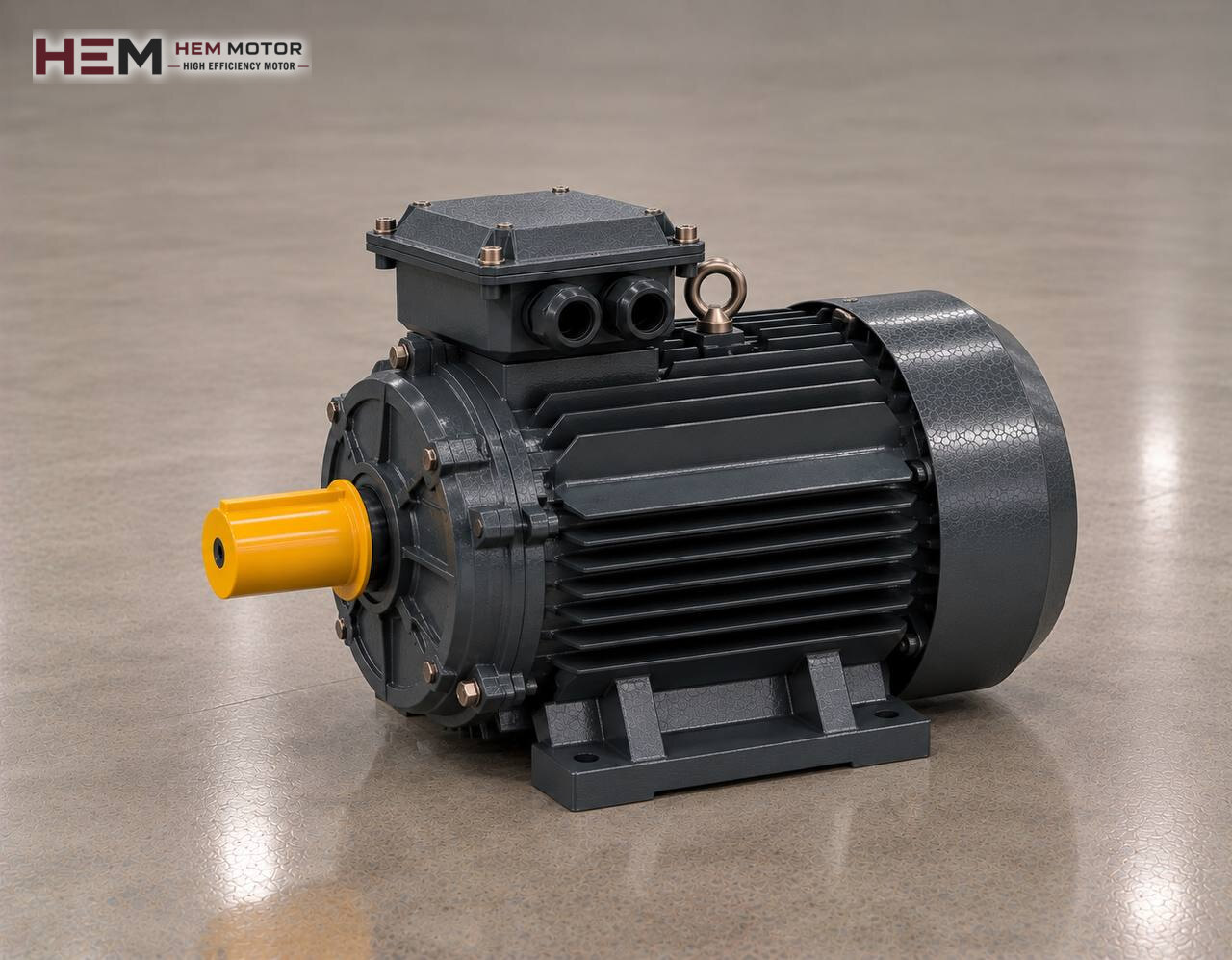
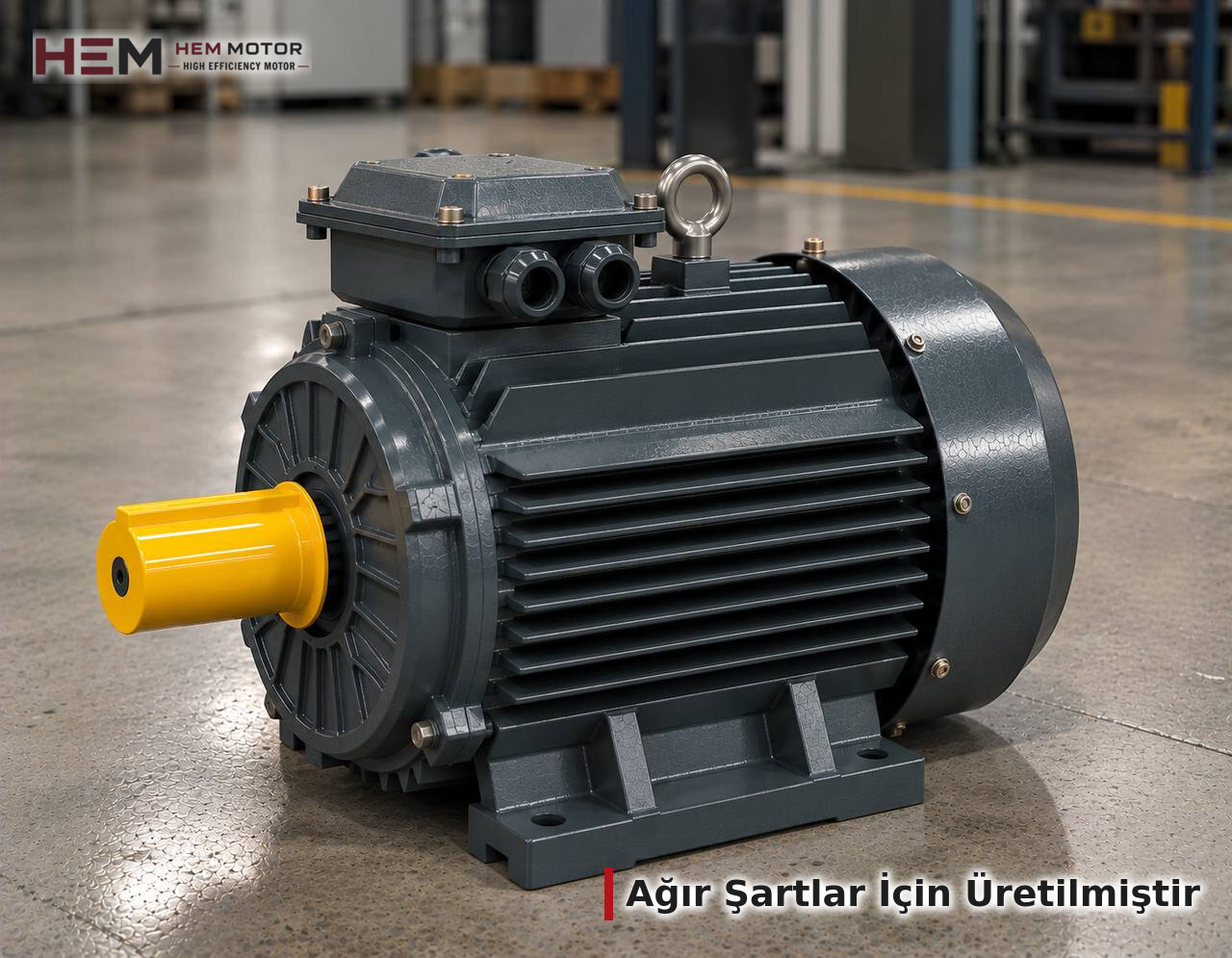
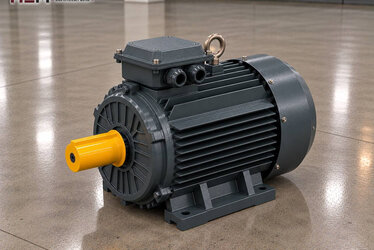
On a motor that runs day and night, the energy on the bill exceeds the motor's own price within a few years (representative image).
How do maintenance and bearing costs change with running hours?
Bearing life, relubrication interval and winding ageing depend directly on running hours; a motor running twenty hours fills its maintenance calendar proportionally faster than one running four.
Bearing manufacturers give life in hours. Because the relubrication interval on motors with grease nipples is also defined in hours, a motor that needs grease once a year on a four-hour schedule brings the maintenance team to the bearing cap five times in the same year on a twenty-hour shift pattern. Bearing make, type and grease nipples have not been verified model by model for HEM motors; confirm with the order.
The practical answer is a counter. Fitting an hour meter in the panel is cheap and ties the maintenance plan to real hours instead of guesses. Monthly readings with a vibration pen and bearing cap temperature logged with an infrared thermometer give early warning with twenty-hour use.
What hidden costs appear with short operation?
Four-hour daily use is often not a single long run but a pattern of switching on and off several times a day; every start puts extra strain on the motor and the supply.
A motor started direct-on-line rises far above its nameplate current in the first second or two; the peak-hold button on a clamp meter shows this jump easily. The winding heats quickly at each start, and rotor bars and end windings take a mechanical shock. In applications with more than a few starts per hour, this load becomes more decisive than total running hours. If the number of starts is high, a controlled start with a soft starter or drive should be discussed.
Our three-phase series are suitable for speed control with a frequency converter; for long operation at low speed with full torque a separate fan may be needed; if the drive-to-motor cable is long, a dv/dt or sine filter is considered; these conditions are stated with the order.
Long standstills carry risk too. Moisture can collect in the winding of a motor idle for weeks; in damp plants an anti-condensation heater is an order option.
The same calculation holds at lower power: with a motor such as the aluminium frame 112M-4 (4 kW, 7.95 A) the kWh figures shrink, while the ratios stay the same. At higher power, building the same table with the cast iron 200L-4 (30 kW, 53.8 A) immediately shows the size of the twenty-hour gap. The other steps of the same family are listed on the asynchronous electric motors page.
Share your machine's daily running hours, number of starts and measured load current together with the motor nameplate through our contact page; we will build the kWh calculation with your data and settle the efficiency class choice together. Models by power and speed can be found on the HEM Motor sales page.
Frequently Asked Questions
Is a high efficiency class necessary for a motor running four hours a day?
With short operation the annual value of the efficiency difference is small; the decision depends more on first cost and number of starts. Still, measure load ratio and running hours and do your own calculation with the ΔE formula.
If running hours double, does energy cost double too?
If load and efficiency stay the same, yes, it rises linearly. If the load ratio changes, calculate each operating period separately and add them up.
How do I find the load ratio?
The most accurate way is to measure kW with a three-phase power analyser. Reading current with a clamp meter gives a rough idea, but at light load current makes the load look larger than it is.
Which electricity unit price should I use in the calculation?
Use the unit price on your own bill. If the tariff varies by time band, calculate separately for the hours in which the motor runs.
HEM Motor Models Related to This Article
The cards show example models related to the topic. A suitable motor is not chosen by power alone: compare speed, voltage, mounting, shaft and connection dimensions on the product page; if unsure, send a photo of the existing motor’s nameplate on WhatsApp.
No, it is not enough. An IE3 label only states the efficiency level of the motor at rated load; it does not say whether the motor will fit the machine, carry the load or match the ... More Details
The efficiency class of a rewound IE3 electric motor is verified by measurement, not by the nameplate: the motor is tested under load and input power is compared with shaft power, ... More Details
A smaller IE4 motor cannot be chosen in place of an IE3 electric motor just because the efficiency class is higher; a motor's power is set by the torque and speed demanded at the s... More Details
For an IE3 electric motor running at 50 percent load, the renewal decision is made by first measuring the real load and then comparing two options on the basis of loss difference: ... More Details
A 4-pole, 250 kW IE3 motor on a 400 V supply draws about 418 A at rated load. Started direct on line, that climbs to roughly 3000 A. The motor weighs over a tonne and delivers arou... More Details
In an electric motor renewal, production downtime is costed by multiplying the number of hours stopped by that line's hourly downtime cost; the hourly cost in turn is the sum of it... More Details
We use necessary and optional cookies to improve your experience, enhance content and analyse traffic. Under the GDPR, optional (analytics/marketing) cookies are only used with your explicit consent. Please choose your preference below.
Cookie Policy
 English
 Français
 Türkçe
 Español
 Русский
 العربية
 Deutsch
 Italiano