The efficiency class of a rewound IE3 electric motor is verified by measurement, not by the nameplate: the motor is tested under load and input power is compared with shaft power, or losses are separated one by one to calculate efficiency, and the result is compared with the IE3 limit for the same power and pole count. The IE3 marking on the nameplate does not by itself prove that the winding stayed true to the original design.
Through which losses does a rewind affect efficiency?
A rewind mainly affects copper losses and iron losses. Copper loss depends on winding resistance, iron loss on the condition of the lamination stack, and both can change during repair.
Copper loss is set by wire cross-section, number of turns and end-winding length. If the repair shop uses thinner wire than the original or leaves the end windings long, winding resistance rises and more heat is produced at the same current. If the number of turns has been reduced, flux rises and no-load current and iron loss increase.
On the iron loss side, the main risk is the method used to strip the old winding. If the lamination stack is baked at a high temperature or heated with a flame, the insulation between laminations can break down and eddy current loss grows. Burrs and dents left on the slot teeth after stripping have the same effect (general information; confirm with rewind standards and the repair shop's procedure).
Friction and fan losses stay the same if bearings and fan are unchanged. If they were changed, this item enters the table too. It is a small item, but it is not ignored.
Which data should be recorded before the repair?
A record made before stripping is the basis of every later comparison. If the original winding data is lost, there is no reference left against which to compare the post-repair measurement.
Nameplate photo: power, voltage, current, speed, efficiency value and IE class.
Before stripping, the three phase resistances on the cold winding (with a milliohmmeter) and the ambient temperature at the time of measurement.
If possible, no-load current and no-load power at rated voltage.
Winding data: wire diameter and number of parallel strands, number of turns, coil pitch, connection, end-winding length. Ask the repair shop for this in writing.
Lamination stripping method and oven temperature. A repair shop that records this information is a good sign.
A maintenance team with these data in hand can assess the post-repair measurements in half an hour. Without them, comparison can only be made with a healthy motor of the same type or with values in the manufacturer's catalogue.
By which methods can efficiency be measured on site?
The most direct way is to run the motor on a dynamometer or load bench and measure electrical input power and mechanical shaft power at the same time: η = Pshaft / Pinput. Shaft power is calculated from torque taken with a torque meter and speed taken with a tachometer.
IEC 60034-2-1 defines, alongside the direct method, indirect methods based on separating losses for determining efficiency; the preferred methods used for IE class determination are specified in this standard (general information; confirm with the current text of the standard). The indirect method combines a no-load test, winding resistance, a load test and a stray loss calculation.
If there is no load bench at the plant, a rougher approach is used. Before and after repair, input power is measured with a power analyser on the same machine, at the same load, at the same voltage and if possible at the same time of day; assuming shaft power has not changed, every rise in input power reads directly as a rise in losses. This method does not certify an IE class. It is, however, a strong sign of whether the repair has spoiled efficiency.
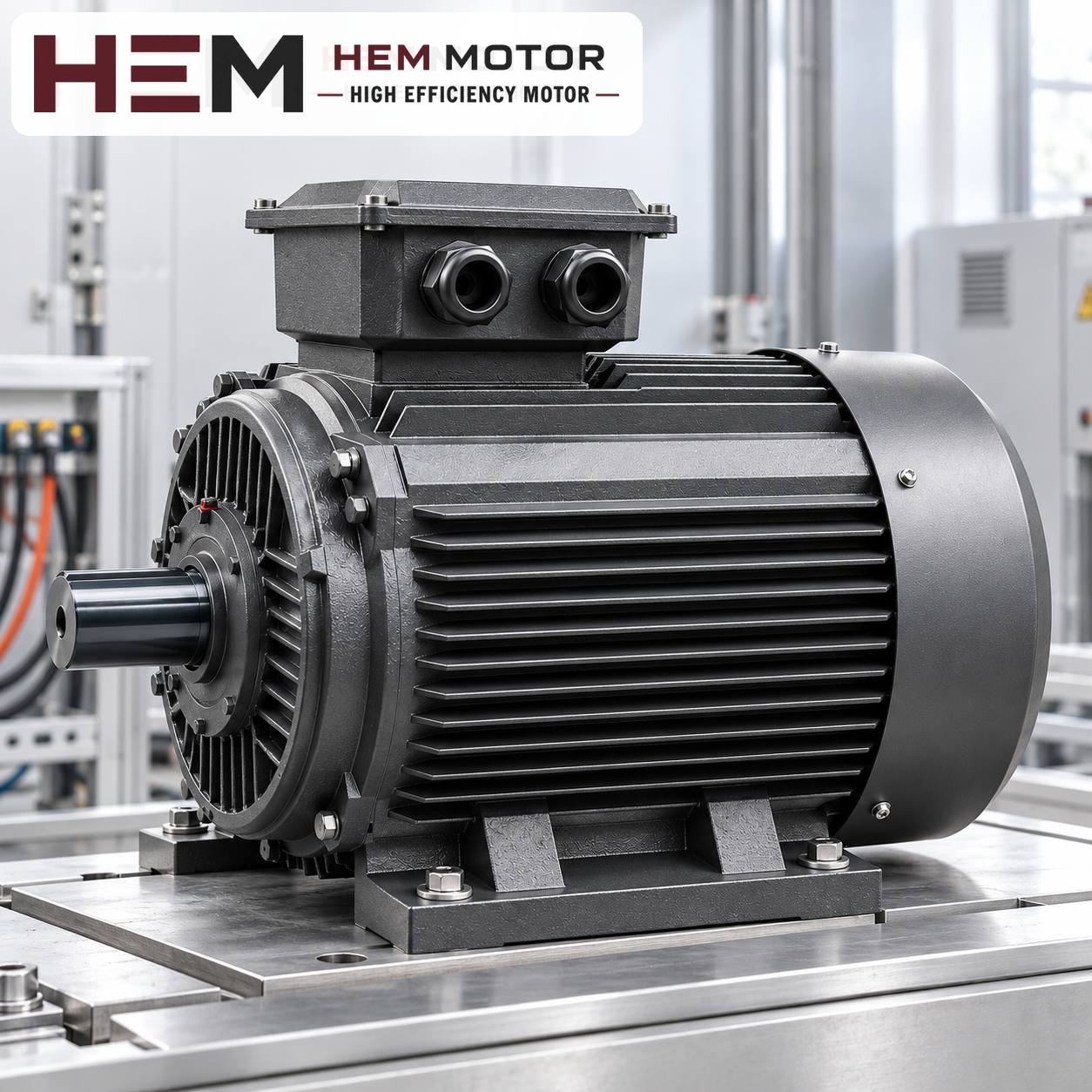
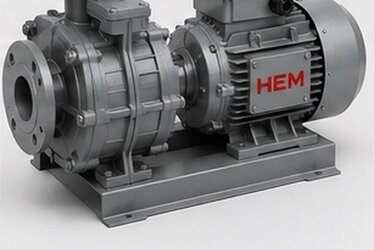
Efficiency is determined on a load bench where input and shaft power are measured simultaneously (representative image).
Prices and technical data are on the product pages; choose a model and order online.
How are the measured values compared with the IE3 limit?
Measured efficiency is compared with the IE3 lower limit defined in IEC 60034-30-1 for the motor's rated power and pole count. A motor below the limit is not in that class, even if its nameplate says IE3.
A quick check table for indirect comparison:
Measurement
Change compared with before repair
Possible meaning
Cold winding resistance (corrected to the same temperature)
Clear increase
Thinner wire or long end windings; copper loss has risen
No-load current
Clear increase
Fewer turns or damaged lamination stack
No-load power
Increase, no-load current normal
Lamination insulation damaged, iron loss up
Input power under load (same machine, same load)
Increase
Total loss has risen; IE3 limit at risk
Speed under load
Decrease
Slip has increased; may be rotor- or voltage-related
When comparing resistance, the two readings must be corrected to the same temperature; for copper, R20 = Rt × (235 + 20) / (235 + t) is used. If two values taken on a cold morning and a warm afternoon are compared without correction, the repair shop may be blamed unfairly.
The effect of every percentage point of efficiency loss on annual energy is calculated with your own plant's data. As a hypothetical example: if input power has risen by 0.3 kW at the same load after repair, multiplying this difference by annual running hours gives the extra consumption in kWh; multiplying by your unit energy price gives the annual difference.
Rewind or a new IE3 motor: which information decides?
The decision is made by weighing together the loss increase measured after repair, the motor's annual running hours and the cost difference between repair and a new motor. On a motor that runs little, a small efficiency loss may be acceptable; on a pump running three shifts, the same loss can exceed the price of a new motor in a short time.
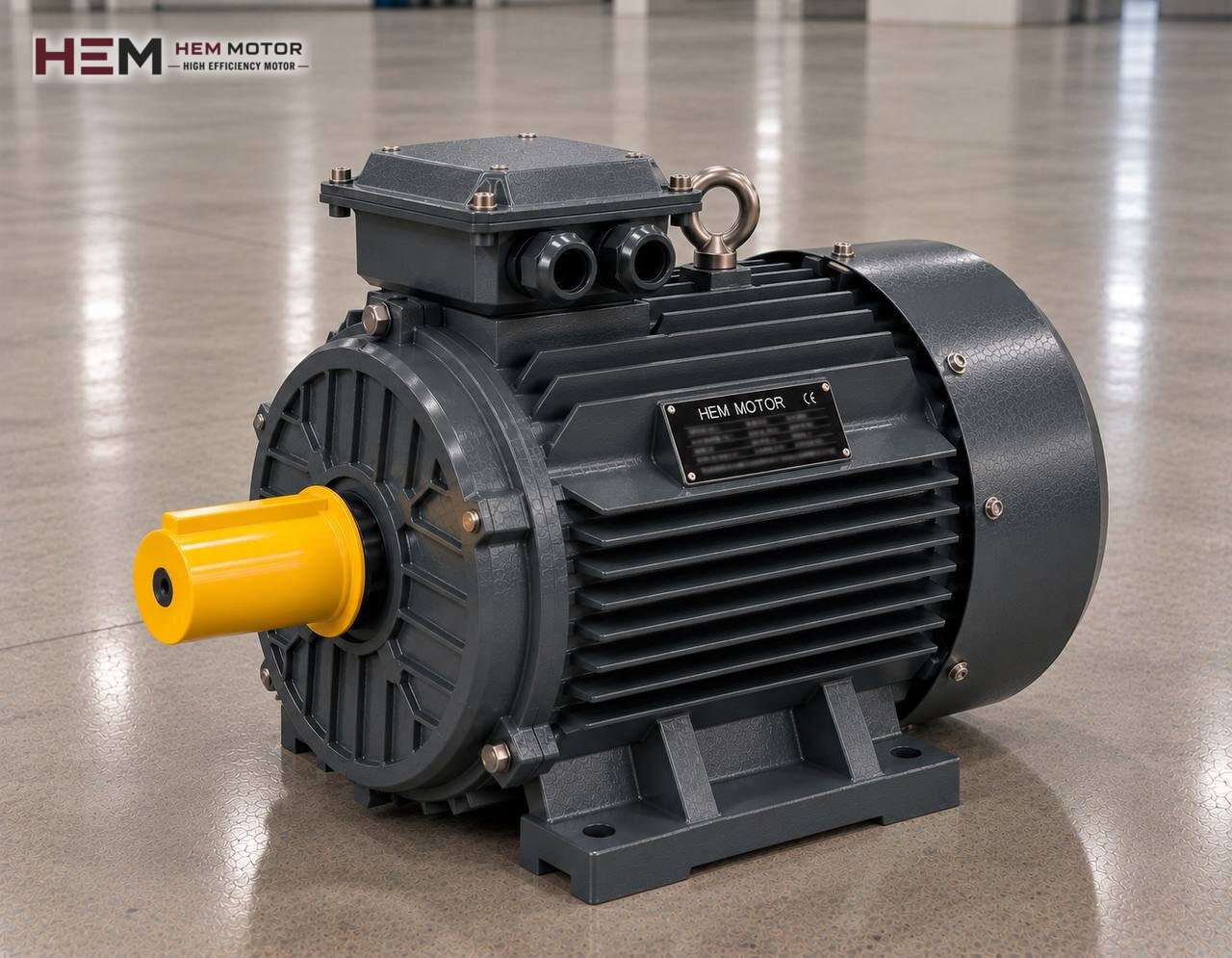
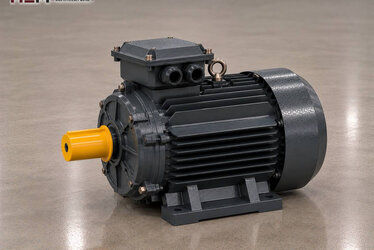
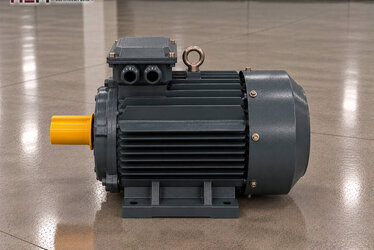
In motors that have already been rewound more than once, the lamination stack wears a little more each time. For such a motor, switching to a new IE3 motor instead of another repair is the shortest way to regain a documented efficiency class. HEM Motor offers motors in IE3, IE4 and IE5 efficiency classes; the class in which a specific model code is supplied is confirmed with the order. General information on the IE3 series is on the IE3 premium efficiency electric motors page, and the power table of the same family is listed in the electric motor shop.
4-pole cast iron examples from the power range that is often rewound:
160L-4: 15 kW, 1465 rpm, 27.3 A at 400 V, 400/690 V connection.
Mounting fit is checked separately when replacing: the IEC frame number is the first piece of compatibility information; exact fit is confirmed by comparing mounting type, shaft diameter and length, foot hole spacing, flange and electrical ratings. Other steps of the same family are on the three-phase asynchronous electric motors page.
If you have resistance, no-load current and input power measurements from before and after the repair, share them with a photo of the motor nameplate through our contact page. We will interpret the result together and, if needed, choose a replacement IE3 model from the product list.
Frequently Asked Questions
Can the repair shop keep the IE3 nameplate?
The nameplate can physically be kept, but what determines the efficiency class is not the plate but the condition of the winding and lamination stack. Ask for the post-repair measurement result in writing.
If no-load current rose after repair, has the motor dropped out of IE3?
Not conclusively on its own, but it points to iron loss or a change in the number of turns. It should be assessed together with an input power measurement under load.
Can efficiency be measured with a clamp meter?
No. Efficiency requires input power measured with a power analyser and shaft power from torque and speed; current alone shows neither power factor nor losses.
After how many rewinds should a motor be replaced with a new one?
There is no fixed number. The loss increase measured at each repair and the condition of the lamination stack are tracked; if measurements show deterioration, a new motor is considered.
HEM Motor Models Related to This Article
The cards show example models related to the topic. A suitable motor is not chosen by power alone: compare speed, voltage, mounting, shaft and connection dimensions on the product page; if unsure, send a photo of the existing motor’s nameplate on WhatsApp.
No, it is not enough. An IE3 label only states the efficiency level of the motor at rated load; it does not say whether the motor will fit the machine, carry the load or match the ... More Details
A smaller IE4 motor cannot be chosen in place of an IE3 electric motor just because the efficiency class is higher; a motor's power is set by the torque and speed demanded at the s... More Details
For an IE3 electric motor running at 50 percent load, the renewal decision is made by first measuring the real load and then comparing two options on the basis of loss difference: ... More Details
Almost all of the cost difference between the same IE3 electric motor running four hours and twenty hours a day comes from energy, and the difference is directly proportional to ru... More Details
A 4-pole, 250 kW IE3 motor on a 400 V supply draws about 418 A at rated load. Started direct on line, that climbs to roughly 3000 A. The motor weighs over a tonne and delivers arou... More Details
In an electric motor renewal, production downtime is costed by multiplying the number of hours stopped by that line's hourly downtime cost; the hourly cost in turn is the sum of it... More Details
We use necessary and optional cookies to improve your experience, enhance content and analyse traffic. Under the GDPR, optional (analytics/marketing) cookies are only used with your explicit consent. Please choose your preference below.
Cookie Policy
 English
 Français
 Türkçe
 Español
 Русский
 العربية
 Deutsch
 Italiano