English
 Français
 Türkçe
 Español
 Русский

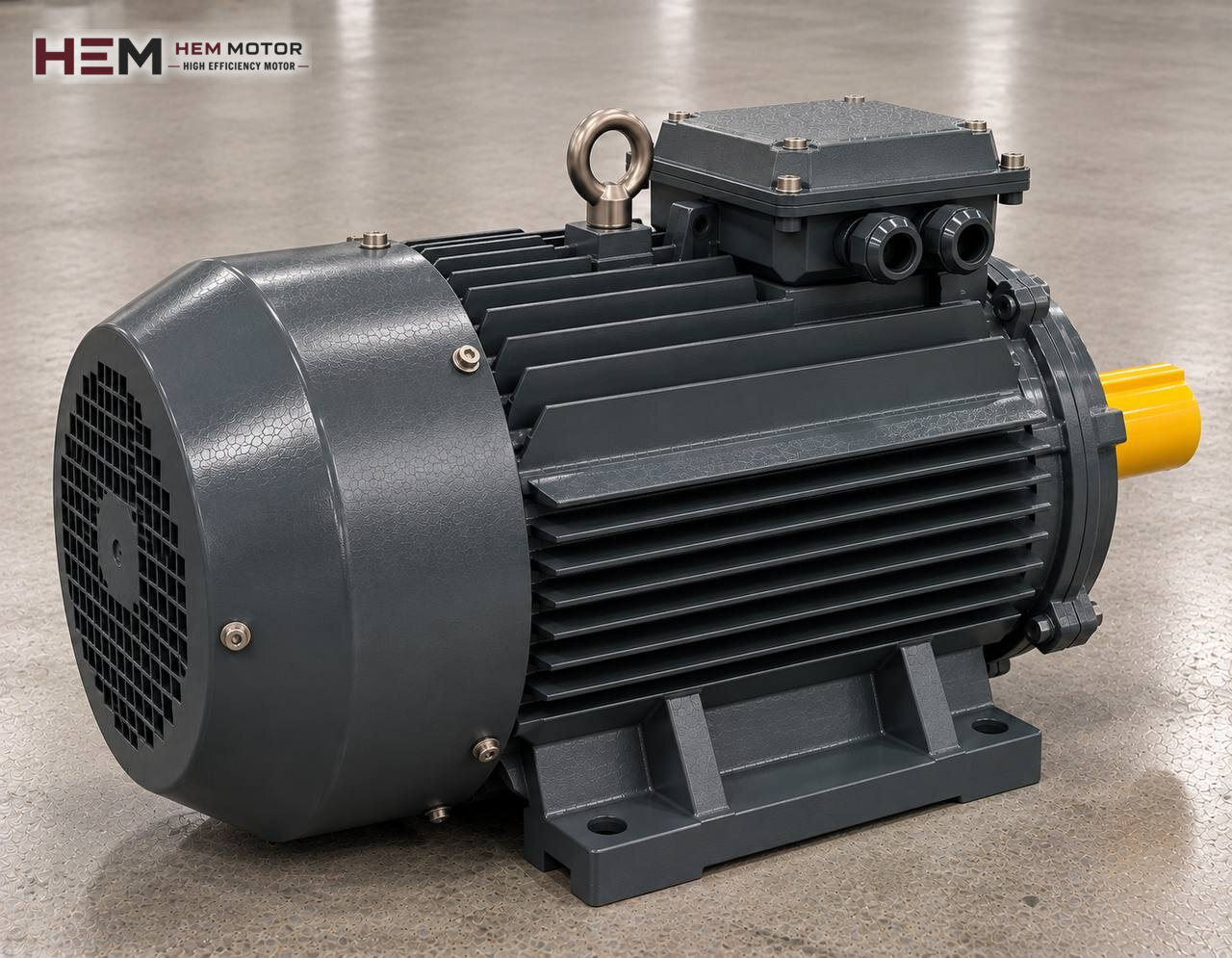
A metal band saw is a workshop machine that runs a thin toothed steel blade over two wheels to cut solid bars, tubes and profiles to length. Applications in other industries are listed on the electric motors for industries page. This page covers the main blade motor, the hydraulic downfeed unit and the coolant pump on scissor-type (hinged-arm) and twin-column metal band saws; band saws that cut wood are not covered here.

Why does the blade run slowly when cutting metal?
A blade that reaches very high surface speeds in wood cannot be used at the same speed on steel; the tooth tip heats up and dulls quickly. On metal band saws the blade travels at a few tens of metres per minute, and even slower in hard alloys. To obtain this low speed, a gearbox is almost always placed between the motor and the drive wheel. On small machines this is usually a worm and wheel type; large column machines often use a helical gearbox.
The motor therefore turns at standard speed; slowing the wheel down and multiplying the torque is the job of the gearbox. Workshops most often have a 4-pole motor, i.e. one in the 1,500 rpm class. For motor selection on geared drives, see the electric motors for reducers page.
Adjusting blade speed to the material
Mild steel, stainless steel, brass and aluminium are not cut at the same speed. On older machines the speed is selected by moving the belt on a step pulley. On newer machines the blade motor is fed by a frequency inverter and the operator sets the speed from the panel.
One point to keep in mind with a drive: when the blade is slowed down, the fan on the motor's own shaft also slows down, while the cutting torque does not fall. If the motor will run loaded at low frequency for long periods, a separately powered cooling fan should be considered. If the drive sits in the cabinet and the motor is at the far end of the machine, the long cable brings a dv/dt or sine filter into question. HEM's three-phase series are suitable for inverter supply; simply state these two conditions in your order. For details, see the inverter-compatible electric motors page.
If an older machine has a pole-changing two-speed motor, add this to your quote request; the suitable replacement is then assessed together.
Cutting load, starting and blade jamming
Starting a band saw is light: the blade turns without touching the workpiece, and the arm or bridge comes down afterwards. The load begins when the teeth enter the material and changes across the section. When cutting a solid bar, the contact length is longest in the middle, so the motor current peaks there; on thin-walled tube the load is pulsating and irregular.
If the blade jams in the cut, the gearbox forces the motor with high torque. The basic protection here is a motor protection switch set correctly to the nameplate current. For direct monitoring of winding temperature, a PTC or PT100 sensor can be added as an order option. Blade-break and guard safety switches are the machine builder's equipment.
Hydraulic downfeed unit and coolant pump
On semi-automatic and automatic machines, the arm descent speed and the clamping of the workpiece in the vice are handled by a small hydraulic unit. The motor in this unit does not produce the cutting force; it only turns the pump, and pressure and descent speed are set by valves. Motor power is determined by the pump flow and working pressure; the subject is explained on the electric motors for hydraulic pumps page.
Coolant (soluble oil emulsion) is delivered to the blade by a small pump. The motor of this pump sits on top of or beside the tank and is exposed to splashing emulsion. A standard IP55 motor is not designed for a location where liquid is sprayed directly at it or collects around it; the motor should be placed outside the splash path, and if necessary the machine builder should add a shield.
Example HEM motors for metal band saw drives
| Drive | Work done by the motor | Value to check | Example HEM model |
|---|---|---|---|
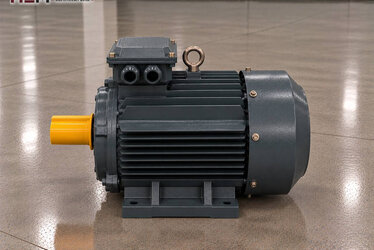
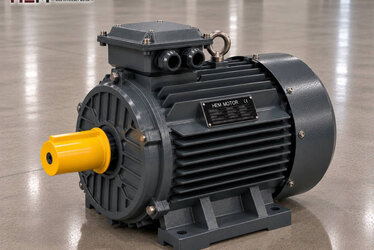
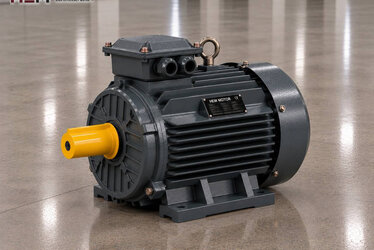
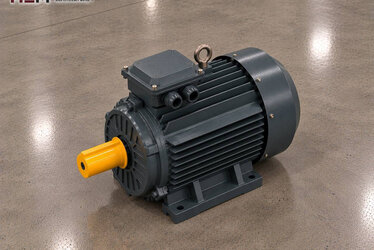
| Scissor-type workshop saw | Turning the blade wheel through a worm gearbox | Gearbox input, flange type | 90L-4 aluminium — 1.5 kW, 1,445 rpm |
| Twin-column automatic saw | Long cuts on large sections | Section diameter, drive use | 112M-4 cast iron — 4 kW, 1,450 rpm |
| Hydraulic downfeed and vice | Turning the pump intermittently | Pump flow, pressure | 80M2-4 aluminium — 0.75 kW, 1,420 rpm |
| Coolant pump | Continuously delivering emulsion | Pump type, splash path | 63M2-2 aluminium — 0.25 kW, 2,730 rpm |
The motors in the table are for guidance. The right motor is determined by the machine's actual load, required speed, mounting arrangement and workshop conditions; the most reliable starting point is the nameplate of the motor already on the machine.
Mounting, chips and maintenance
The blade motor is usually flange-mounted to the gearbox, so flange type (B5 or B14) and shaft diameter are decisive when replacing it. HEM offers foot-mounted B3, flange-mounted B5 and B14, foot-and-flange B34 and B35 versions and the vertical positions V1, V3, V5, V6 and V15 depending on frame size; the dimension that must fit the gearbox bore is confirmed with the order.
Metal chips and emulsion mist collect on the fan cover grille. Regular cleaning lets the motor draw cool air freely. If gearbox oil is leaking near the motor flange, the seal should be checked so that oil does not reach the winding. If a brake motor is wanted so that the blade stops quickly, please specify this in your order.
For small workshops without a three-phase supply, the single-phase electric motor series in the 0.18–5.5 kW range can be considered.
Information to send for a quote
Write to us with the machine type (scissor-type, twin-column, mitre cutting), the power (kW) and speed (rpm) of the current motor, the supply voltage, the mounting arrangement and flange type, the gearbox make and how many motors you need. If the motor will run on a drive, mention that too.
If the nameplate is legible, sending a photo speeds things up: send the nameplate, we find the equivalent. Priced models are on the electric motor shop page; for WhatsApp and phone, see the contact page.
Frequently Asked Questions
Why is the motor on a metal band saw not connected directly to the wheel?
When cutting metal the blade speed must be low; standard motor speed is far above that. The gearbox both reduces the speed and multiplies the torque needed for cutting.
If I add a frequency inverter, do I still need the step pulley?
In most cases the speed can be set from the drive. At very low blade speed, however, the motor can overheat; then a separate fan or a suitable gearbox ratio is needed. Please specify the operating range in your order.
Will the arm come down faster if the hydraulic unit motor is upsized?
Descent speed is set by the valve setting and pump flow; a stronger motor alone does not change it. Such a modification should be made together with the machine builder.
What should I do if the coolant pump motor gets wet with emulsion?
The motor should be moved out of the splash path or a shield placed in front of it. A standard motor is not built to run in liquid or under constant spray.
Can I fit a 2-pole motor instead of a 4-pole one?
If the gearbox ratio stays the same, the blade runs about twice as fast and tooth life is shortened. Keeping the pole number of the old motor is the right way when replacing it.